


This article may contain links to products and services we use and recommend. We may receive compensation when you click on links to those products. For more information, see our Disclosure Policy.

Learning a language is hard work (even if polyglots make it seem like a walk in the park). I’ve faced the familiar challenge of picking up the basics of a new language before a trip, then trying to use and build on that knowledge during my travels (through regular classes and by chatting with locals), only to lose most of it through a lack of exposure and practice afterwards.
For years, I struggled to find an app that supported my language learning journey long-term… until I discovered Busuu. In this review, I share my personal experience using the Busuu app to refresh, retain and improve my Spanish, giving you (hopefully) all the insights you need to decide if it could be the right language learning app for you.
What is Busuu?
Brief background
I always find it fascinating to learn who is behind a service or product (and why they created it). Busuu has an interesting (hi)story, too.
Like Socialbnb, Busuu was the brainchild of two German-speaking university buddies: Austrian Bernhard Niesner and Swiss Adrian Hilti. As their final project, completed during their MBAs at IE Business School in Madrid, Spain, they developed an online language-learning platform that offered interactions with native speakers at an affordable price. Thus, Busuu was born in 2008. And here is a fun fact: The app is named after a now extinct language once spoken in Cameroon.
In 2022, the app was acquired by US EdTech giant Chegg. The two co-founders are no longer involved in Busuu’s development, but the ideas of the original project – interactions with native speakers and affordability – persist.

Busuu was developed in 2008 by Bernhard Niesner and his uni mate Adrian Hilti | Image courtesy of Busuu
Core features
Busuu offers a structured curriculum based on the CEFR (Common European Framework of Reference for Languages), with lessons including native-speaker videos, (written/verbal) community feedback and AI-supported learning, revision and review sessions to help reinforce learning and boost retention. The app today supports 13 common languages. It also offers completion certificates for extra motivation (though the certificate’s broader recognition is limited).
What is the CEFR?
The CEFR is a widely used scale that describes what you can actually do in a language, from beginner to advanced. The six levels range from A1 (basic survival phrases) to C2 (near-native fluency). As you progress through the levels, your practical language skills improve: from introducing yourself and handling everyday conversations, to following discussions and expressing ideas. Many language schools and language learning apps (including Busuu) use the CEFR to build their curriculum, making it easier for students to move between different learning tools while maintaining a clear sense of progress.
For context: My language learning journey
Language learning has been a constant thread throughout my life, though definitely not a straight and linear one.
I’m a native German speaker and learned Russian as my first foreign language at school, followed by English in my mid-teens. Over time, English became part of my everyday life through study, work and long periods living abroad, and I now consider myself fully bilingual.
I first dabbled in Spanish when I had a boyfriend from Barcelona in my early twenties. But I didn’t put much effort into learning the language until much later. In 2017 (and well into my 40s), I started learning Spanish more seriously, attending language schools in Ecuador and Guatemala while travelling around Central and South America. At the end, I had even reached C1 (advanced level), but years without consistent practice inevitably took their toll.
With plans to return to Latin America in 2025, I got into using language learning apps: first to dust off my rusty Spanish – initially with Duolingo and later with Busuu – and then to refresh and retain my Spanish skills after attending 1:1 Spanish lessons in Mexico and Ecuador (once again), graduating with B1 this time.

I've been learning languages my whole life - even making it to C1 level in Spanish in 2017 (but forgetting a lot afterwards due to a lack of practice)
My language app requirements
Using (the free version of) Duolingo initially, I had a clear sense of what did and didn’t work for me. Duolingo’s inferred and gamified approach might be okay for some, but it frustrated me.
I wanted something more explicit and structured, without being too rigid or academic, and with content that was useful in real-life scenarios. Offline access mattered, too, as I often study while travelling with limited connectivity. And affordability was important for long-term use. Above all, though, I was looking for an app that could help me gradually rebuild, retain and improve my Spanish alongside formal language school study. That’s when I came across Busuu.
And before I jump into my detailed review: While I used Busuu purely for personal learning, it’s worth noting that the platform is also used in educational and workplace settings.
Finding an app that suited my learning style took some trial and error | Image courtest of Pasja1000 on Pixabay
Busuu Language App Review
1. Learning Methodology and Pedagogical QualityRating 4.7 out of 5 stars
What immediately stood out to me when I started using Busuu was how much more structured the learning felt (compared to Duolingo). The app also placed me at a realistic starting point (Level B1) through a short placement test. Even so, I can access lessons at lower or higher levels as needed.
Grammar is explained clearly and directly within the lessons, with short summaries that help connect the dots as you go. In the paid version, you can also revisit and practice specific grammar rules. I found this especially helpful for refreshing rules I had already learned but partly forgotten. Perhaps unsurprising, given its CEFR alignment, the overall approach felt closer to formal language learning, making it easier for me to move between formal language school studies and Busuu.
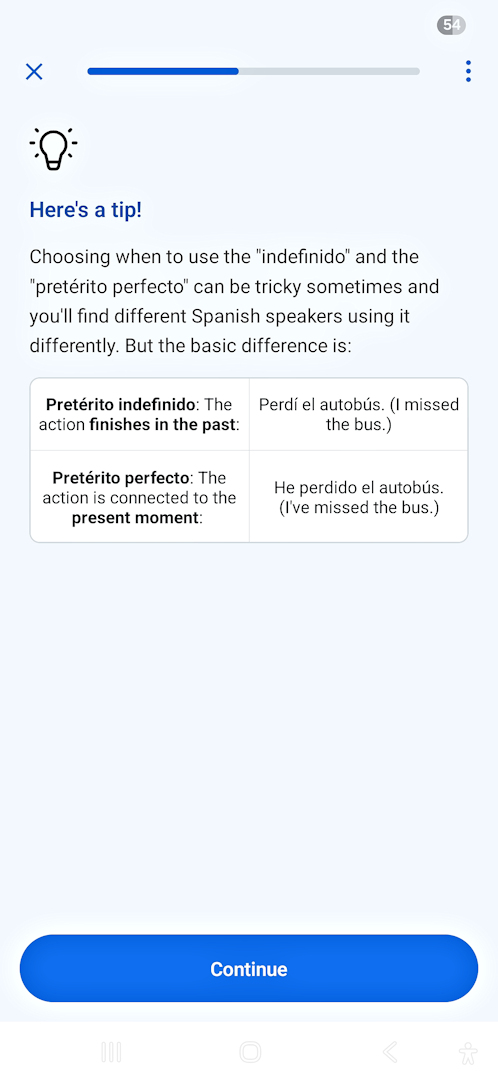
I love Busuu's in-lesson grammar tips
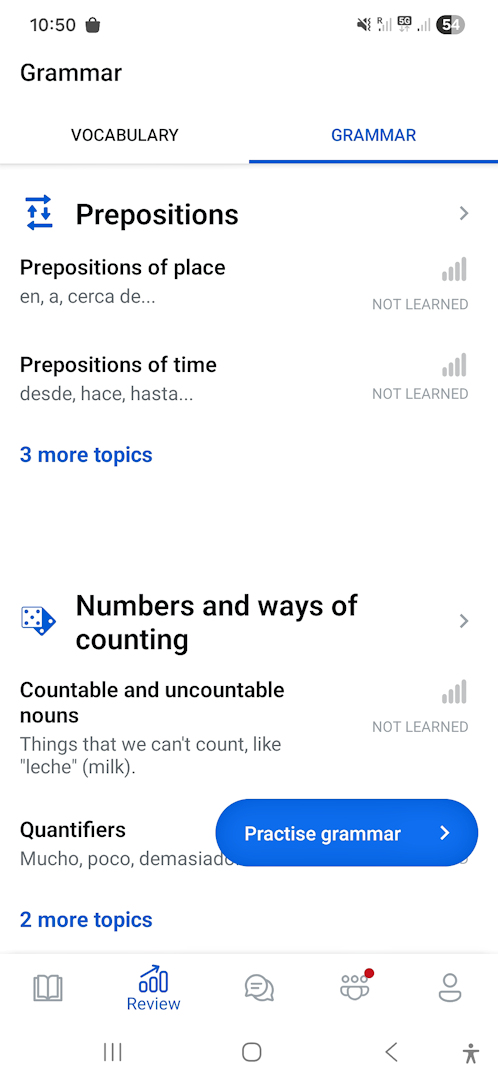
... and the ability to review specific rules
I deducted a few points for the app’s (lack of) exercise variety: The app’s focus on retention is okay, but could be improved by weaving more of the new vocabulary and any mistakes made into future exercises, rather than repeating the exact same exercise/s (you made mistakes in) at the end of a session and repeating exercises from prior sessions in the lesson checkpoint. A better (more challenging and exciting) way would be to test your new knowledge through a variety of different exercises.
2. Holistic ComprehensionRating 4.5 out of 5 stars
Listening – 4.0/5.0
Videos feature native speakers, and dialogues sound natural. Pacing is adjusted adequately for different levels, with slower, clearer speech early on and a more natural delivery later (though a manual speed adjustment or transcript would be useful at times).
The major limiting aspect of the app, though, is its focus on Spain (and Castellano). While some nuances between European Spanish and Latin American Spanish are explained, it still feels one-sided, missing the all-important exposure to the variety of Latin American dialects.
Writing – 4.9/5.0
Busuu places a welcome emphasis on correct spelling (including the right placement of accents), and writing full sentences and short texts. I found this especially useful for rebuilding my active vocabulary after long periods of inactivity.
I also found the community feedback extremely valuable: (Largely) thorough and constructive, peer reviewers have often drawn attention to small grammatical details and cultural nuances that are important for accuracy, but, sadly (as mentioned above), are often missing from the actual lessons.
Speaking – 4.0/5.0
Dedicated speaking lessons are only accessible in the paid version, where you can compare your pronunciation directly with a native speaker’s. The quality of the speaking exercises could be improved, though, as the speech recognition is inconsistent: It doesn’t always pick up all the words spoken and marks you down at times, even when the pronunciation closely matches that of the native speaker.
Users of the free version can only practice speaking (with delayed feedback) in the Busuu community.
AI Functionality – 4.9/5.0
The standard of this Busuu feature was a pleasant surprise, adding a valuable layer of conversational practice when you don’t have easy access to a native speaker:
- Conversations felt realistic and flowed naturally (especially at the intermediate level).
- The tone of the AI sounded human – even with a humorous touch (not at all robotic).
- The transcript of my spoken responses was way more accurate than in the speaking exercises.
- Improvement opportunities are highlighted at the end of the conversation.
3. Real-world usefulness (for travel and daily life)Rating 4.8 out of 5 stars
Busuu explains grammar and usage directly within the lessons, which made it much easier (for me) to understand and retain key language basics.
Busuu’s lessons also feel genuinely useful beyond the app. Lesson themes move quickly into everyday situations, and the vocabulary reflects how Spanish is actually used. From Elementary A2 onwards, topics become increasingly practical, covering situations like finding accommodation, making arrangements and handling day-to-day interactions – exactly the kind of vocabulary I need while travelling.
While I miss the exposure to Latin American speakers, the focus on real-life scenarios (supported by the AI conversation feature) helped me regain confidence speaking with locals relatively quickly.
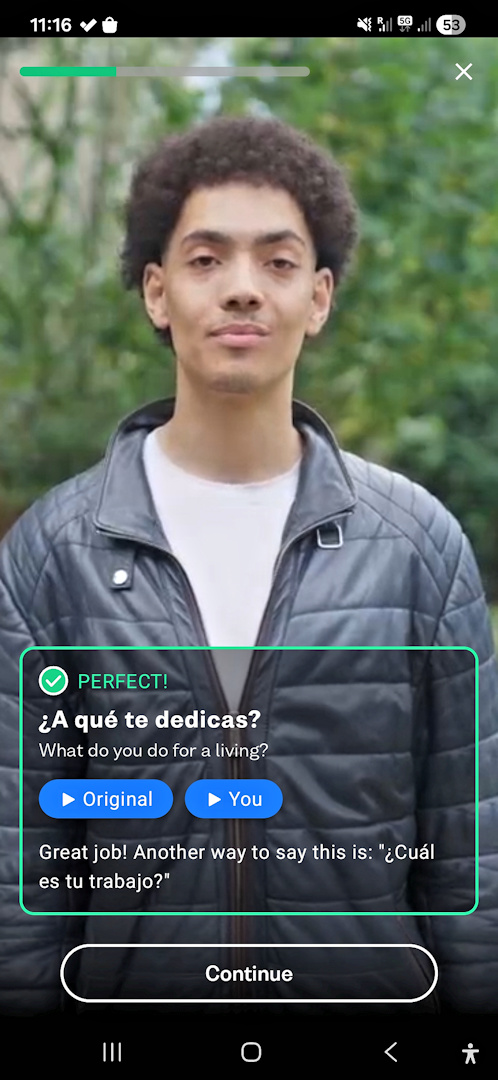
Speaking exercises mimic the real-world

... and AI conversations are very useful
4. Goals, progress tracking and motivation toolsRating 4.7 out of 5 stars
What worked well for me was the goal-setting feature (personal study plan), which sets a regular reminder and estimates how long it will take to reach a certain target level based on the effort you’re able and willing to put in. It would be great if the app could show in 6-month intervals how students track against their study plan.
I also found Busuu‘s progress tracking and motivational approach more helpful and less distracting (than Duolingo’s gamified approach), with motivation coming from actual learning progress rather than through points or badges earned or leaderboard positions gained:
- End-of-lesson thresholds (of 80%) encourage focus and accuracy rather than rushing through (timed) exercises to chase points.
- The fluency percentage makes progress feel tangible beyond the subjective perception of knowing more.
I did notice, however, occasional inconsistencies in how accuracy scores are calculated at the end of each lesson: even when responding 100% accurately, a (much) lower result is shown. While it didn’t impact my overall experience (or motivation), it’s worth fixing.
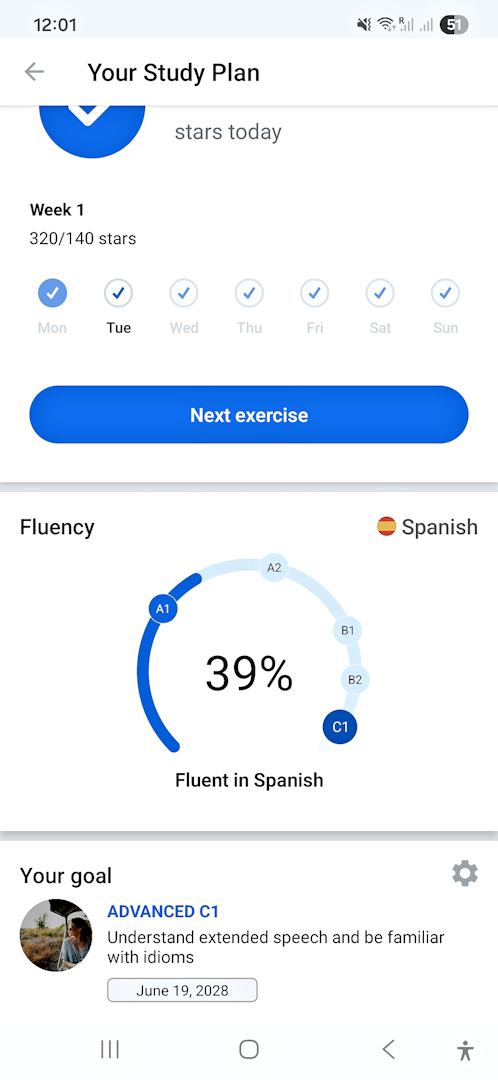
A study plan holds students accountable
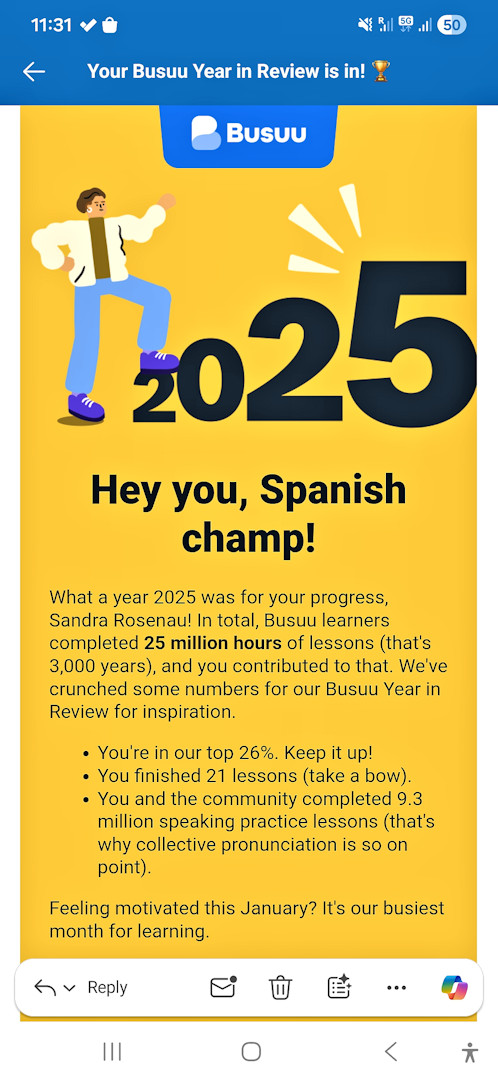
... and your progress is tracked over time
5. Interface, lesson design and user experienceRating 4.5 out of 5 stars
Navigating the Busuu app is intuitive. Lessons are clearly laid out (and you can easily access earlier or later ones, too). Sessions have the perfect length (Duolingo’s often felt too long), making it easy to fit your language learning into even the busiest of days.
Like most users, I started out with the free version, which was a bit slow and unresponsive at times. What bothered me the most, however, were the constant ads and sign-up offers, interrupting the flow and making the app use painful (obviously intended to get you to sign up to the paid version). In the paid version, the app loads quickly and works reliably. Not being interrupted by ads is bliss.
Worth noting for someone with visual impairments: In the mobile app, font sizes can’t be adjusted, but dark mode is available. This is one area where Busuu can improve the UI/UX.
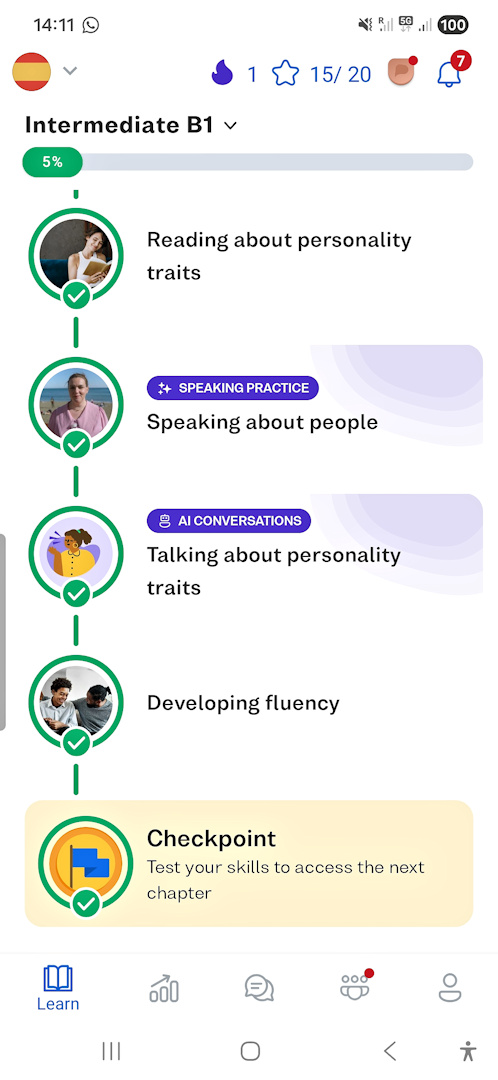
I prefer Busuu's clean layout
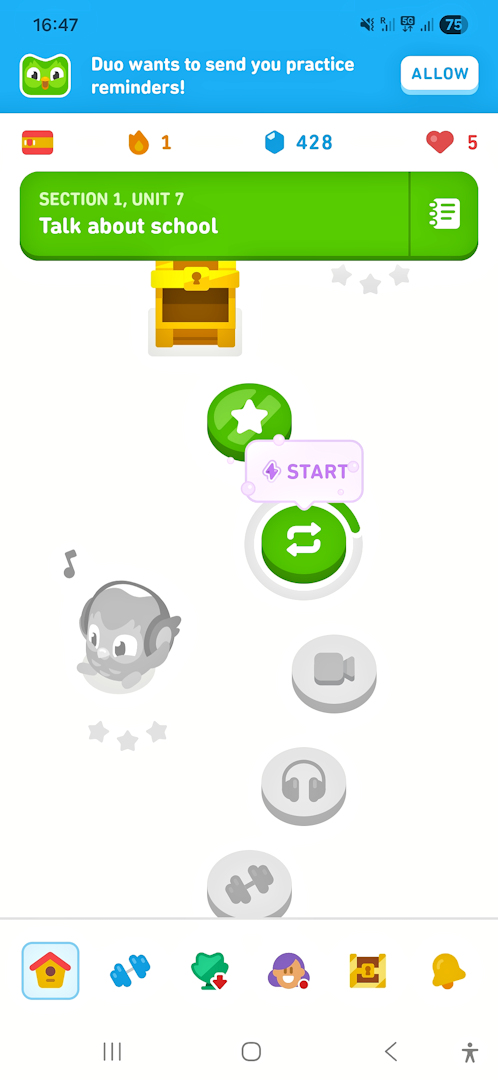
... over Duolingo's gamified UI
6. Offline functionality and suitability for travelRating 4.5 out of 5 stars
Offline access (to continue studying during long bus journeys/train rides/flights or in remote locations) was one of my key requirements, and Busuu delivers on this – but only in the paid version (and with caveats):
- Offline functionality is limited to lessons without audio recording, meaning speaking practice and AI conversation sessions, as well as lesson checkpoints, are not available without an internet connection.
- Each lesson also needs to be downloaded individually (before going offline), which requires some planning ahead.
The syncing progress once back online works seamlessly, though.
7. Transparency of pricing and value for moneyRating 4.9 out of 5 stars
Like most popular language apps, Busuu follows a freemium model, with optional paid subscriptions that unlock full functionality. Paid subscriptions are available on a monthly or annual basis.
While usable, Busuu’s free version is limited in its usefulness due to
- its disruptive ads
- non-access to speaking or AI conversation sessions (thus preventing learners from ever achieving full lesson completion), and
- the lack of offline access.
Sign-up offers for the premium version pop up regularly, but discounts change frequently (and I’m pretty certain they even vary by location). If you’re unsure whether the paid version meets your needs, you can test the premium version via a 7-day free trial or sign up with a 14-day money-back guarantee.
I purchased the annual premium subscription at a heavily reduced rate (more than 50% off). At that price (about half the cost of the equally discounted annual Babbel subscription), getting Busuu’s paid version was a no-brainer. Fortunately, the same discounted rate seems to apply upon renewal. Fingers crossed.
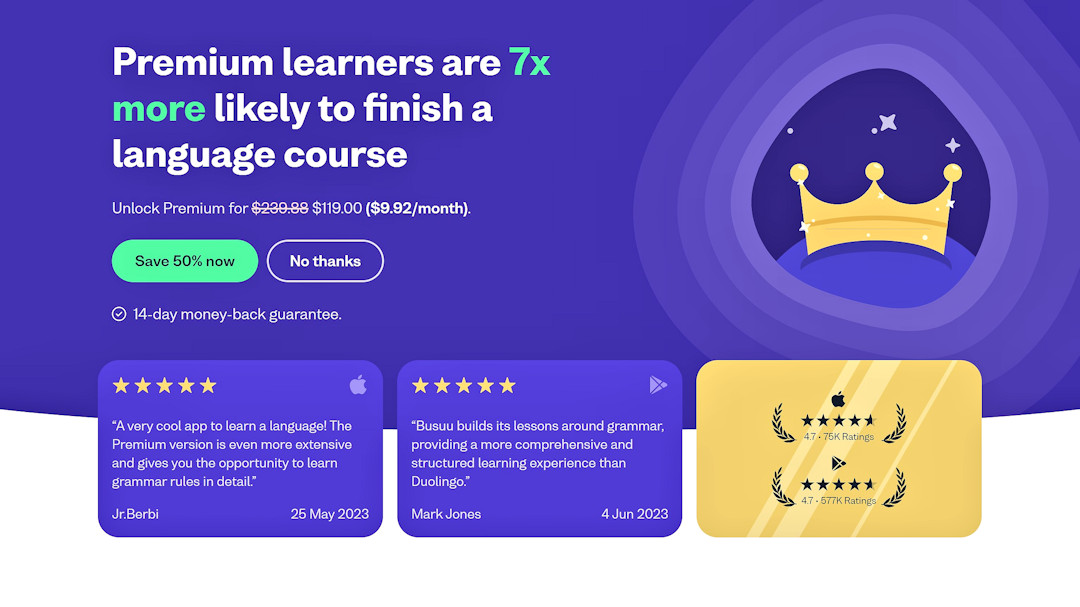
Don't pay full price: Busuu Premium is often available at a discount of 50% (or more)
Pros and cons of Busuu
What Busuu Does Well
- Structured, holistic approach: Given its CEFR-based approach, Busuu learners can seamlessly transition between app use and 1:1 language learning in (overseas) language schools.
- Native speaker exposure: Videos and community feedback give exposure to real pronunciation, intonation and usage – vital for practical language use beyond textbook sentences.
- Good AI functionality: Supports conversational practice for those without easy access to native speakers.
- Affordable: Good value for money (especially when heavily discounted): structured lessons, review, community and certificates (though the latter aren’t widely recognised).
Where Busuu Falls Short
- Limited language variety: English-speakers can learn up to 12 languages – the same as in Babbel but way below Duolingo (which offers over 30 languages, including Latin, Esperanto and some native indigenous languages).
- Free tier is limited: The freemium learning experience is heavily impacted by ads, and learners don’t have access to speaking/AI and offline functionality.
- Inconsistencies: Speech recognition during speaking exercises is not the best, which can be frustrating for people with a heavy accent in a foreign language. Community feedback is not moderated and may vary in accuracy and helpfulness.
- Focus on Spain/Castellano: Learners miss out on hearing Latin American dialects.
How Busuu compares with Duolingo and Babbel, and who it is best for
If you’re wondering which is the best language-learning app for beginner/intermediate/advanced learners, here are my 5 cents…
Based on my own experience, Busuu sits somewhere between Duolingo and Babbel, both when it comes to its learning approach and the type and level of learner it would suit. Busuu is structured enough to build a solid foundation, yet flexible and practical for everyday use (up to advanced level).
Duolingo
Great for beginners who like playful, inferred learning and are motivated by collecting points or badges, or want to learn a new alphabet – including Arabic or Cyrillic (I used it to learn Hiragana for our trip to Japan).
Busuu
Best suited for beginner to intermediate learners who want to build a strong foundation (grammar and vocabulary) in a structured way (Spanish is supported up to C1) and in a real-world context, with native speaker community support.
Babbel
Good for all levels, but best for intermediate to advanced learners who seek structured, holistic learning and want to improve their real-world/multicultural vocabulary and conversation skills.

I found Duolingo useful when learning a new alphabet - like Arabic, Chinese (or in my case, Japanese Hiragana)
Which offers the better FREE language app version?
Of the three, Busuu‘s free version (though plastered with ads) is still the most useful, in my opinion – at least for anyone who seeks to build a solid foundation in a new language. Duolingo is okay if you’re looking to learn a language that Busuu doesn’t offer. Babbel’s free version is unusable: once you’ve completed your placement test (which slotted me into a level way too high for me BTW), you have access to one lesson (to get a sense of what to expect), but everything else requires a paid subscription.
Practical Tips: How to get the most from Busuu
- Set a regular learning schedule and stack the habit (for example, 10-20 minutes daily over your lunch break)
- Pay attention to pronunciation in the native-speaker video lessons
- Actively submit writing and/or speaking exercises for community feedback (and help other learners)
- Make use of dedicated grammar/vocabulary review sessions to address weak points
- Pair Busuu with real-world practice beyond the app (it’s easy to transition to/from 1:1 lessons if your language school adheres to the CEFR)

If you're after a good free language learning app, give Busuu a try - I prefered it over Duolingo | Image by jairojehuel on Pixabay
Data and Privacy Considerations
Busuu encourages interaction with other learners; thus, some profile information is visible to the community. This makes peer-to-peer feedback more personal, but it may also deter some more privacy-conscious learners.
Privacy and cookie settings are clearly laid out in the app, with options to manage different types of consent (strictly necessary, functional, targeting, performance) in the app settings. Busuu’s privacy and data policies are available on its website: Privacy Policy | Use of Cookies | Terms of Service. If you want to compare privacy standards between Busuu, Babbel and Duolingo, check out Privacy Spy: Busuu | Babbel | Duolingo.
Learning a language is a journey
No app is perfect, and success depends on many other factors – from personal learning style to time commitment, immersion outside the app and much more. If you used Busuu or another app: What was your experience, and what features worked for you (or didn’t)? Please let me know.
Before you go, if you liked our article and found it helpful, we would appreciate it if you could share it with your friends and family via the Share buttons below. Even better: Leave a short review on Trustpilot or Google, which would help us further build our online reputation as a (trustworthy and helpful) travel and lifestyle blog.