

This article may contain links to products and services we use and recommend. We may receive compensation when you click on links to those products. For more information, see our Disclosure Policy.

Are you planning a last-minute trip to Panama City?
Book your transportation to/from and around Panama City, keeping your carbon footprint in mind:
Find your perfect accommodation in Panama City. We recommend these small-scale and centrally located options near public transport:
When managing money across countries, we keep fees low and decisions deliberate. We use XE to check exchange rates, Wise to move and spend money internationally, and PocketSmith to track where it all goes.
Buying travel insurance can feel overwhelming. Start by reading our buyer's guide to finding insurance that suits your needs. Then compare options on the Insubuy marketplace (with all the information you need to find the one that's right for you).
Map of Accommodation, Points of Interest, Eateries and Transport
Below is a map of the recommended accommodations, points of interest, eateries, and transport terminals or stops mentioned in this article.
Panama Canal Museum in Casco Viejo
Before heading to the Canal, we recommend visiting the Panama Canal Museum [Google Maps location].
Located at Plaza de la Independencia in Casco Viejo, the museum covers not only the Canal’s construction but also Panama’s broader history – from pre-Columbian times, through Spanish colonial rule and Panama’s independence, all the way to the modern era. Across two floors, the exhibitions use maps, photographs and other artefacts to explain the vision, challenges and human costs behind the canal. Interactive elements and bilingual panels make it easy to absorb key information without feeling overwhelmed.

As you'll learn in the Panama Canal Museum, building the Canal was a truly international effort
A Brief History of the Panama Canal
The idea of connecting the Atlantic and Pacific Oceans across the isthmus of present-day Panama dates back to early Spanish colonial rule. But it took another 300 years until French engineer Ferdinand de Lesseps (the father of the Suez Canal) led the first serious attempt. Starting in 1881 (the French Canal Company had its headquarters in the museum building), the French aimed to build a sea-level canal but were defeated by Mother Nature and financial collapse. More than 20,000 workers died.
A US-led project took over in 1904 after acquiring the rights from the newly independent Republic of Panama. American engineers adopted a lock-based design with artificial lakes and channels (to overcome terrain constraints), and aggressive mosquito-control campaigns (to drastically reduce tropical diseases).
Opened in 1914, the 80km/50 mile long Panama Canal revolutionised global trade by cutting 13,000 km off the journey between the east and west coasts of the Americas. US-controlled for over 85 years, the Canal was transferred to Panama in 1999 (after lengthy negotiations). A massive expansion project in 2016 (voted for by a majority of the Panamanian people) added new locks for larger vessels, and ensuring the Canal’s future.

After decades of negotiations, the Panama Canal handover was agreed in 1977 and completed in 1999
If you can’t make it to the Panama Canal Museum or you would like to supplement your visit, we recommend watching Johnny Harris’ video: How The US Stole The Panama Canal.
Locks on the Pacific side (and when/how to visit them by bus)
The Pacific entrance to the Panama Canal is home to three sets of locks (esclusas in Spanish): Miraflores, Cocolí and Pedro Miguel. These locks take ships from the Pacific Ocean to Gatun Lake, a vast artificial lake in the centre of Panama, approximately 26 metres above sea level.

Sets of locks on both the Caribbean and Pacific side move ships from ocean level to Gatun Lake (and back down)
Miraflores Locks
Opened in 1914, the Miraflores Locks move ships from the Pacific Ocean to Miraflores Lake (and vice versa) through two locks – one immediately after the other. Its visitor centre, open 08:00-18:00 and with entry fees of USD17.22 per adult, offers a front-row seat to the action, complete with an IMAX 3D film (narrated by Morgan Freeman) and a multi-level observation deck with bilingual live commentary.
Miraflores is the closest set of locks to Panama City and thus on every organised tour itinerary. Be prepared to share the visitor centre and observation deck with a lot of people, especially early in the afternoon. Book your tickets online to avoid the ticket office queue. We also recommend watching the IMAX film before heading to the observation area. Screenings take 45 minutes and start at 8:45, 9:45, 11:00, 12:15, 13:30, 14:45, 16:00 and 17:15. If you’ve visited the Canal Museum, you’ll hear a few things you already know, but the film is still worth watching.
The observation deck has minimal shade (or cover in the case of rain). Wear sunscreen and a hat, and bring a rain poncho. With two oceans close by, the weather in Panama changes quickly: In the 1.5 hours we visited Miraflores, we had both blue skies and sunshine, and a downpour.

Miraflores Locks form part of the original Panama Canal build opened in 1914 and are the most visited of all the locks
Cocolí Locks
Opened in 2016 as part of the Panama Canal Expansion, Cocolí’s modern three-tier lock system accommodates Neo-Panamax, among the world’s largest vessels.
Unfortunately, there’s no public access to the lock site itself. Still, you can catch glimpses of the ocean giants moving in and out of Cocolí from the Miraflores viewing platform (Miraflores and Cocolí are side-by-side but slightly offset, with Cocolí a bit further west). The sight is impressive – especially when you compare the scale of the ships passing through Cocolí with those (already large ships) going through Miraflores.
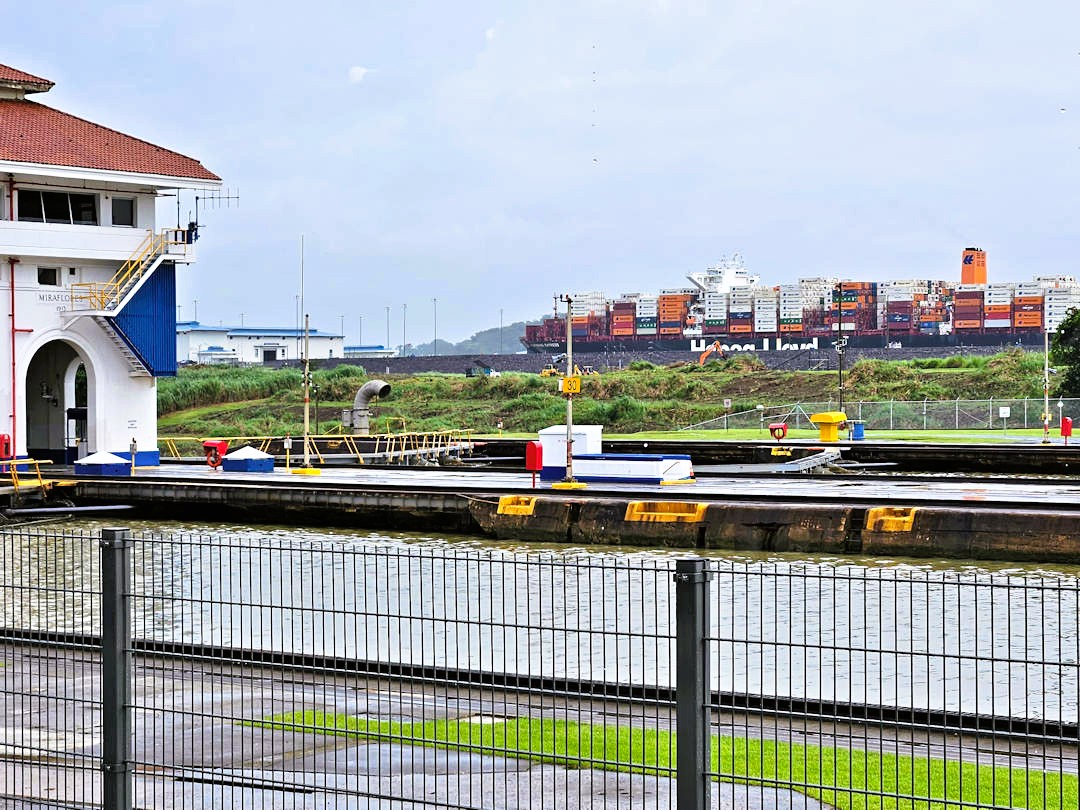
The Cocolí Locks are not accessible to tourists, but giant ships traversing the locks can still be observed from a distance
Pedro Miguel Locks
Five kilometres further east and built at the same time as Miraflores, Pedro Miguel is a single set of locks connecting Miraflores Lake with Gatun Lake. Without a visitor centre (or any service), it’s much quieter than Miraflores. Here, you can watch vessels pass, peering through a wire fence from the roadside (free of charge).
Tip Visit the locks on the Pacific side in the afternoon when most ships are being processed through the locks from east to west. There is no food at Pedro Miguel, and the food at Miraflores is expensive and not particularly good. We therefore recommend having lunch at Albrook Mall before you make your way to the locks.

The Pedro Miguel Locks don't have a visitor centre - peer through the fence instead as ships travel past right in front
What is Albrook (and how do you get there)?
Albrook is Panama City’s central transportation hub. This busy complex combines the Gran Terminal Nacional de Transporte/Central Bus Terminal, the Albrook Metro Station and Albrook Mall, one of the largest shopping centres in Latin America. Despite its name, it’s not centrally located but a few kilometres west of Casco Viejo, next to Albrook Gelabert Airport (IATA: PAC).
For travellers, Albrook is the gateway to almost anywhere in Panama. From here, you can catch metro buses (to neighbourhoods across the capital), regional and long-distance coaches to every province and even connections to Costa Rica. It’s also where you’ll catch the buses to the Panama Canal locks.
Getting to Albrook is straightforward: If you’re staying in Casco Viejo, the easiest and cheapest option is the Metro (Line 1 terminates at Albrook), with frequent daily trains. Check Google Maps or Moovit for the best connection from your accommodation. Uber is also inexpensive.
How to get to the Miraflores/Pedro Miguel Locks by public transport
Pedro Miguel Locks
To get to Pedro Miguel, take the C790 or C970 bus from the Albrook Bus Terminal (Platform C/Bahia C – Google Maps location) or F030 bus (from Bahia H – Google Maps location) and get off at Mirador Pedro Miguel-R [Google Maps location]. There are 4-6 buses every hour, so you’ll never wait long.
Miraflores Locks
From the Albrook Bus Terminal, catch the C810 bus (Bahia D) directly to the visitor centre. Buses run roughly every 20 minutes. If you’re coming from Pedro Miguel, return to the main road, catch the C790, C970 or F030 back towards town and get off at Miraflores-I [Google Maps location]. It’s a flat 1km walk from the roadside to the visitor centre.

The C810 bus from Albrook Terminal takes you directly to the Miraflores Visitor Centre
How to use public transit in Panama City
Panama City’s public transport system is efficient and inexpensive. It includes the metro (two lines) and an extensive bus network.
To ride, you’ll need either a RapiPass or a Metro Card. You can buy these rechargeable plastic cards (both cost PAB/USD2), check and top up the balance at all metro stations. The same card can be used by more than one person – tap for each passenger as they pass through the barriers at the metro station or on the bus. The only difference between the two cards is that the RapiPass can also be used to pay the terminal fee at the turnstiles in Albrook before boarding intercity buses (PAB/USD0.10).
Metro rides cost PAB/USD0.35, and metro bus fares are PAB/USD0.25 per ride (except the buses travelling along the Corredor Norte or Corredor Sur toll roads, which cost PAB/USD1.25 and are labelled accordingly).
Locks on the Caribbean side (and when/how to visit them by bus)
The Caribbean entrance to the Panama Canal offers two perspectives on the waterway: the century-old Gatun Locks [Google Maps location] and the modern Agua Clara Locks [Google Maps location]. Both sets of locks sit side-by-side, and the entry ticket for one includes entry to the other (but more on that below).
Tip Visit the Caribbean locks from early morning to mid-afternoon when most ships are being processed here.
Agua Clara Locks
Opened in 2016 as part of the Panama Canal Expansion, Agua Clara is a three-tier lock system built to allow Neo-Panamax vessels to transit from the Caribbean Sea to Gatun Lake.
Its visitor centre (open 08:00–17:00, with entry fees of USD10 per adult) is far less crowded than Miraflores, making for a more relaxed experience. A visit to Agua Clara Locks includes a 12-minute video (alternating between English and Spanish every half-hour), covered viewing platforms, and a 1km walking trail along the Canal with shaded seating at the end. You’ll also find a 500-metre ecological trail through the rainforest—a peaceful bonus for nature lovers.
There’s no café on site, only vending machines, so bring your food and use the picnic tables overlooking Gatun Lake. Tickets can be booked online.

The locks at Agua Clara, opened in 2016, are wide and deep enough to be used by Neo-Panamax vessels | Image by Monica Volpin on Pixabay
Gatun Locks
Part of the original engineering of the Canal opened in 1914, this three-tier lock system handles vessels up to Panamax size. Its newly opened visitor facilities (Google Maps location, open 08:30-16:30) include bathrooms and covered seating with bilingual narration during ship transits.
The visit to the Gatun Locks is included in your entry ticket for Agua Clara. A free shuttle between the two lock systems (via the Atlantic Bridge) is available.
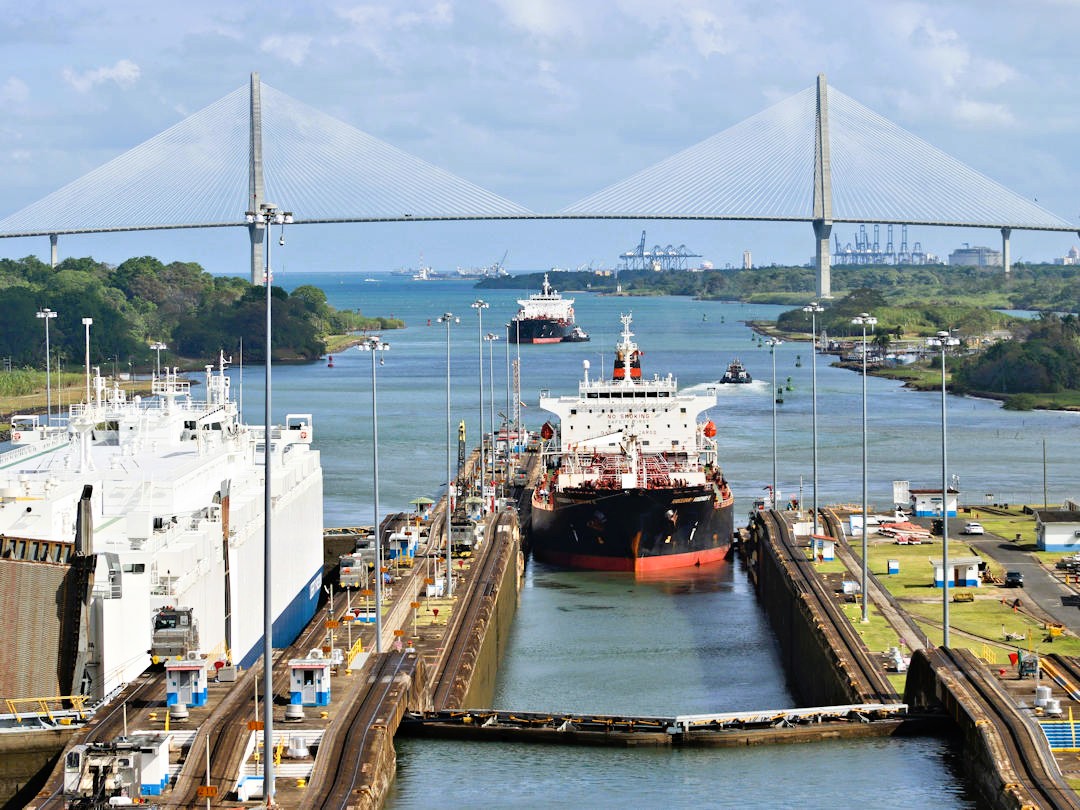
Entry to the original Gatun Locks is included in your entry ticket for Agua Clara | Image courtesy of Alex Pagliuca on Unsplash
How to get to Agua Clara/Gatun Locks by public transit from Panama City
From Panama City’s Albrook Bus Terminal, take an ULTRACOLPA or EPACOC bus (from Gates B-15 to B-18) to the Caribbean port town of Colón. Buses leave roughly every 30 minutes and take 75-90 minutes.
From the Bus Terminal in Colón [Google Maps location], take an Uber or taxi to Agua Clara Locks [Google Maps location]. If you plan to see both locks, begin at Agua Clara and then use the free shuttle to Gatun Locks. From Gatun Locks, take another Uber or Taxi back to the Bus Terminal in Colón, and from there, the bus back to Albrook.

To get to the locks on the Caribbean side, take a bus to Colón, and from there a Taxi or Uber
Is it possible (without a car) to visit all Panama Canal locks on the same day?
Yes. You can visit the locks on both sides of the Canal in a single day without a car, but be prepared for a long (9-10 hour) day.
Given the ships’ transit times, the most sensible approach is to start with the Caribbean locks. From Panama City’s Albrook Bus Terminal, take an early morning bus following our instructions to the Agua Clara and Gatun Locks (and back to Albrook). Have lunch at Albrook Mall’s food court before heading out again.
From Albrook, follow our instructions to Pedro Miguel and Miraflores Locks for your afternoon visit.
Panama Canal Railway Journey (to Colón and back)
Timing and Route
The Panama Canal Railway offers a different, more scenic way to experience the famous Canal, as the train closely traces the Canal and the original railway route that opened here in 1855. During the rail journey, you’ll often travel alongside cargo ships, and you can even spot wildlife – we saw two toucans (and many other birds) as well as river turtles.
Operating only on Saturdays from 9:00 to 12:30, and departing from the Corozal Passenger Terminal in Panama City, the train makes its way past the Pacific locks and Miraflores Lake, continues through lush jungle (and even a short tunnel), crosses the Chagres River and sprawling Gatun Lake (over several bridges and causeways), before reaching the port town of Colón after about 1 hour and 15 minutes. In Colón, the train stops for about 20 minutes (unfortunately, passengers can’t get off) before returning to Corozal.
To get to/from the Corozal Passenger Terminal, it’s easiest to take an Uber.
Stay connected the moment you land
We use Airalo eSIMs on (almost) every trip to avoid roaming charges and the hassle of buying a local SIM. You can install your eSIM before you travel and get online as soon as you arrive. Airalo works in 200+ countries (we've used it across the Americas, Europe and Asia), but not everywhere - so check coverage before you buy.
New to Airalo? Use code NEWTOAIRALO15 for 15% off
Already a customer? Use AIRALOESIM10 for 10% off

A Panama Canal Railway passenger train travels once a week from Corozal Station in Panama City to Colón (and back)
Ticketing and check-in process
Tickets cost USD40 per person for the luxury coach and USD50 per person for the panoramic coach. Check the schedule on the Railway’s Instagram and book well in advance: Only one panoramic coach is available, and it sells out weeks ahead. Even the luxury carriages (of which we counted five on our journey) were sold out on the day we travelled.
Tickets are emailed with a QR code, which you present at check-in (left door: luxury coaches, right door: panoramic coach). Arrive early as seating is on a first-come, first-served basis. Check-in officially opens at 8:30, but we recommend arriving as early as 8:00. We arrived at 8:20 and were among the last two groups of passengers allocated to carriages.
Tip If you can, try to be near the front of your boarding group, as that’ll give you first choice of seat/s once you enter your allocated carriage.

Arrive at Corozal Station way before check-in opens and aim to be at the front of your boarding group for the best choice of seats
Seating and On-board Facilities
Luxury coaches feature wide leather benches for up to three passengers on one side, and single chairs on the other, while the Panoramic coach features leather benches for two passengers on either side. All seats face each other with tables in between. As the name suggests, the panoramic coach offers domed, panoramic windows (with an elevated section) for maximum visibility. Luxury coaches have standard train windows. Each carriage has a small bar at the front and an old-style but clean bathroom opposite the bar.

The Panoramic coach offers domed, panoramic windows (with an elevated section) for maximum visibility
Don’t worry though if you’ve missed out on a Canal side spot: There is an open-air platform at the end of each carriage you can step out onto during the journey. Just beware of the breeze, as the train travels at speed (we measured a maximum of 80km/h) and won’t stop if you lost a hat, sun glasses or your mobile phone/camera.

Luxury coaches offer comfortable leather chairs and benches, with old-style wood panelling
During the journey
Upon departure, one of the attendants provides safety instructions and a summary of the railway’s history (in Spanish, via microphone). If you don’t speak Spanish, visiting the Panama Canal Museum [Google Maps location] beforehand will provide enough context (and we’ve already mentioned the need to take care when visiting the outside platforms).
During the journey to Colón, the attendants serve complimentary coffee and water via a cart. Soft drinks and snacks are available for purchase (from the cart and at the bar). On the return trip, passengers receive a snack box (ours contained potato chips, cookies, raisins, and a sweet treat).
On the return journey, staff may also provide light entertainment. In our case, they performed popular Panamanian folk song El Tambor de la Alegría and the birthday song for those who celebrated their birthday on the train.
Tip Bring a warm layer (as the air conditioning inside the carriages is freezing). Also bring a camera with zoom lens for wildlife and ship photography.

The Panama Canal Railway traces the Canal, at times travelling right next to it, at other times traversing thick jungle where you can spot wildlife
Organised Panama Canal Experiences
Keen to experience the Panama Canal and all it has to offer, but prefer someone else to do the organising for you? No worries. We recommend these organised Group tours:
Got some spare time? Explore Panama City on foot or by bike
Whether you choose the UNESCO-listed old quarter or the real Panama City with its bustling markets, traffic-choked highways and glittering high-rises, joining one of the free walking or cycling tours provides an even better understanding of the city’s role as a historic crossroads between the two oceans, and the challenges of the past and present. Here are a few recommendations:

If you've got time, explore Panama City (beyond Casco Viejo) on a guided tour on foot and by bike
Where to stay in Panama City
Panama’s capital is a sprawling city, with neighbourhoods varying greatly in atmosphere, amenities and safety. If you want to be close to the main sights mentioned in our article, we recommend staying in one of the following two neighbourhoods.
Casco Viejo
With its cobblestone streets and restored colonial buildings, Panama’s old quarter (also called Casco Antiguo and officially known as San Felipe) is compact enough to walk everywhere and offers a ton of cafes, museums and waterfront viewpoints. Traffic in Casco Viejo unfortunately is a nightmare (way too many cars for its narrow, one-way colonial streets), so if you travel by Uber (to/from a sight further away, during the day), it’s best to meet them/let them drop you off at the border with Santa Ana (Calle 12 Oeste/Plaza Santa Ana).

With its restored colonial buildings, museums and restaurants, UNESCO-protected Casco Viejo is a great base for your Panama Canal explorations
South-eastern part of Santa Ana
This part of neighbouring Santa Ana (east of Calle 16 Oeste and south of Plaza Santa Ana) is a good alternative for a quieter, more affordable but still central location. From here, you can reach all the sights in Casco Viejo on foot, and walk (during the day) along Avenida Central España (a pedestrian thoroughfare) to the 5 de Mayo Metro Station [Google Maps location] – to travel to Albrook or Tocument Airport.
Other nearby neighbourhoods – including other parts of Santa Ana and neighbouring El Churillo – are best avoided, as they are unsafe for tourists, especially after dark.
Below are our recommended accommodations:
| Name | Property Features | Price Indicator | Book Now |
|---|---|---|---|
| Casa Malva | Gorgeous apartment in Santa Ana. Artistic décor with kitchen, washer, TV and balcony. Guests praise cleanliness, the quiet building, and proximity to restaurants, shops, and historic sites. | $ | Book Now |
| AmazINN Places Casa Fortaleza | Elegant apartments in Casco Viejo with a sun terrace, garden and year-round outdoor pool. Units feature air-conditioning, kitchenette, washing machine, balcony with sea views, and 24-hour front desk. Just steps from the Canal Museum. | $$ | Book Now |
| Casco Viejo Apartment | One-bedroom apartment overlooking Casco Viejo’s main plaza. Includes balcony, terrace with city views, air-conditioning, soundproofing, and a fully equipped kitchen with washing machine. Close to the Canal Museum. | $$ | Book Now |
| Santa Ana Apartment | Beautiful, modern one bedroom unit. Amenities include free Wi-Fi, full kitchen, airconditioning, a small balcony, washer/dryer, and two large TVs with Netflix. Self check-in via keypad. | $$ | Book Now |

Neighbouring Santa Ana offers a more authentic, local (and more affordable) stay in Panama City (but not all areas are safe)
Keen to experience the Panama Canal but still got some questions?
If there is anything on your mind that I haven’t answered yet, please let me know. And if you’ve already been: Which was your favourite experience along the Panama Canal?
Before you go, if you liked our article and found it helpful, we would appreciate it if you could share it with your friends and family via the Share buttons below. Even better: Leave a short review on Trustpilot or Google, which would help us further build our online reputation as a (trustworthy and helpful) travel and lifestyle blog.