

This article may contain links to products and services we use and recommend. We may receive compensation when you click on links to those products. For more information, see our Disclosure Policy.

Our bus suddenly grinds to a halt somewhere in the middle of the Lithuanian countryside. A handful of people eagerly wait to get on. Among them a guy in his 40s. Faintly resembling Jason Donovan in Neighbours, he wears acid-washed jeans and a shimmering pink, purple and teal nylon tracksuit jacket. The bus radio starts blaring Voyage, Voyage. If my smartphone didn’t tell me otherwise, I could swear it is 1989.
Exploring the Baltics often felt like travelling back in time. As someone born behind the Iron Curtain, I share a history with these countries. Whether it’s that or simply the unpretentious beauty of Lithuania, Latvia and Estonia, and its peoples’ humility, I don’t know: Exploring the Baltics felt familiar, yet strange and exciting at the same time.
If it’s your first visit to the Baltics and you’re wondering what to expect, here are a few things worth knowing. Before you finalise your plans, compare flights to Vilnius, Riga, or Tallinn and make sure you have travel insurance that suits how you travel.
The Baltic countries are proud of their national identities
What many don’t know (we certainly didn’t): During the 15th century, the Grand Duchy of Lithuania was actually the largest country in Europe. No kidding! While Lithuania’s rulers did a bit of land grabbing in the Middles Ages, for centuries, it was the three Baltic countries that had to endure being occupied by other forces: Germans, Danes, Swedes, Poles and Russians conquered and subdued the Baltics at one point or another (often more than once). While being part of other countries, Estonian, Latvian and Lithuanian national identities continued to evolve in the communities, through cultural traditions, poems and songs.
Being annexed by the Soviet Union in 1944, all three countries only regained independence in 1991. It may, therefore, come as no surprise that you will see the national flags and national colours everywhere.
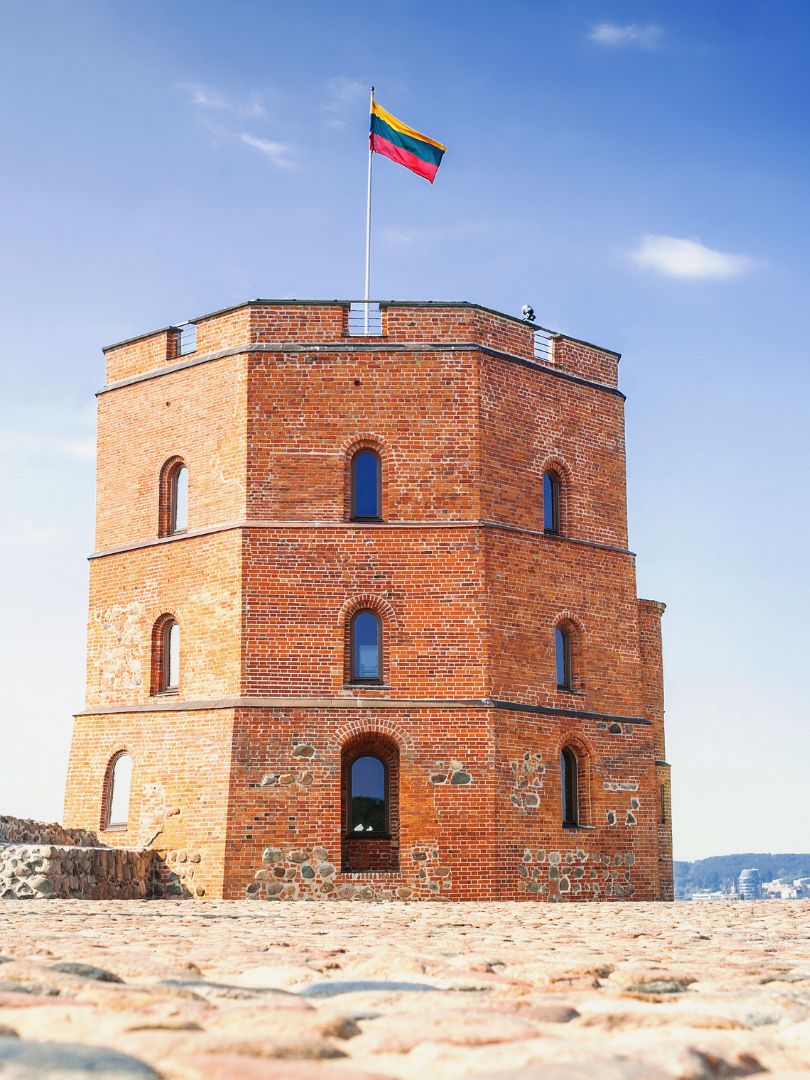
Lithuanian Flag on Gediminas Tower, Vilnius
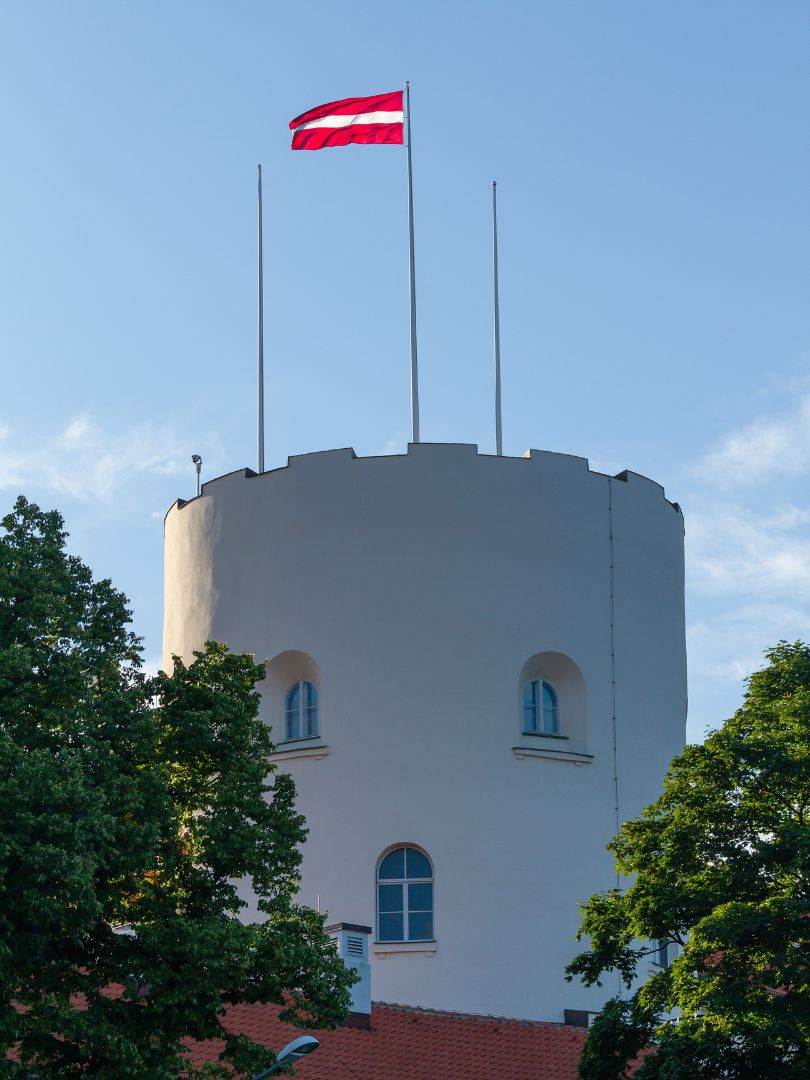
Latvia flag on castle
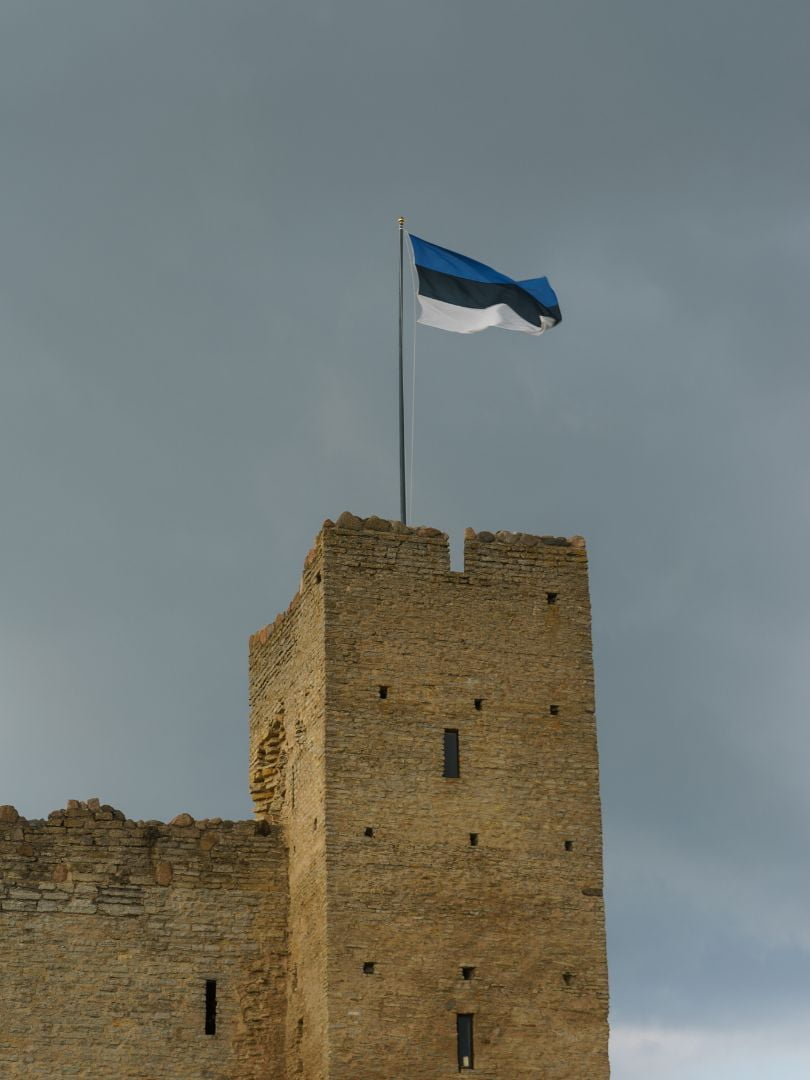
Estonia flag on castle
While some wanted BREXIT, the Baltics are pro-European
Because of their history, all three Baltic states are fiercely protective of their independence, seeking NATO and EU membership as early as 2002 (and becoming members in 2004).
There are no physical borders between the three countries. You will see road signs indicating you’re leaving one and entering the other. And between Latvia and Estonia, we saw white and black wooden markers every 20 metres or so. But no one will check your passport: the Baltics are part of the Schengen area.
Another interesting fact that ties the Baltics to Europe: Europe’s geographic centre is actually located in Lithuania – 20-odd kilometres north of Vilnius (in Radžiuliai). And from about 2030, the Baltics will be connected to the rest of Europe via a high-speed rail network called Rail Baltica.
Map of Accommodation, Points of Interest, Eateries and Transport
Below is a map of the recommended accommodations, points of interest, eateries, and transport terminals or stops mentioned in this article.
Baltic cuisine was shaped by its history… and is delicious
Baltic food is hearty, with influences from the foreign forces that invaded and occupied the Baltics over the centuries: from potatoes in all variations (boiled, fried, in dumpling or pancake form), sausages (including some made with potato puree), pickles and earthy soups, all the way to cheese (including cheese made from apple and little curd cheesecakes) and rye bread (baked, fried… and in fluid form, no kidding). Make sure you try it. It’s delicious.
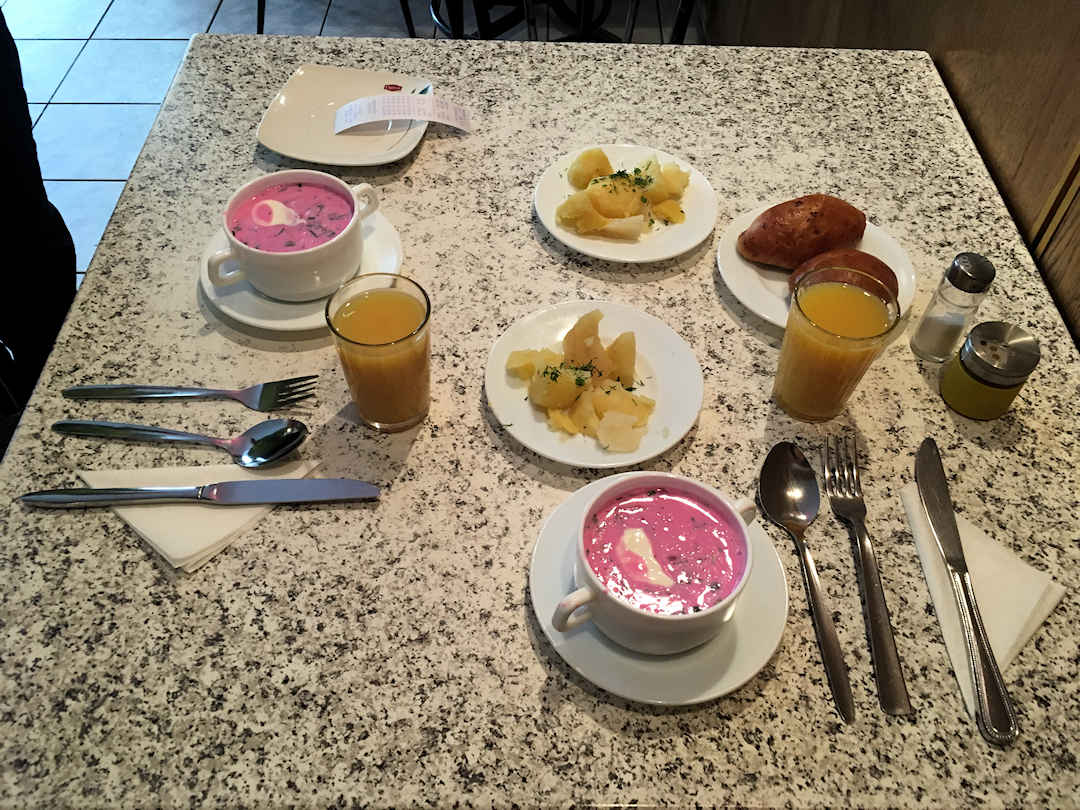
Cold beetroot soup in Lithuania is served with a dollop of sour cream and a side of boiled potatoes
Where to try Baltic cuisine
To try Lithuanian cuisine at reasonable prices, head to one of the Etno Dvaras or Bernelių Užeiga restaurants (both have outlets in Vilnius and Kaunas) or Sultiniai [Google Maps location] in Vilnius.
For a traditional Latvian lunch in Riga, head to Salve [Google Maps location] or to one of the LIDO Bistro outlets. In Bauska, we recommend Pie Rātslaukuma [Google Maps location] and Mežs Kungs [Google Maps location]. In Gauja National Park, head to Hotel Sigulda [Google Maps location] or Pasēdnīca [Google Maps location].
LIDO Bistros are also a good spot to taste Estonian cuisine - Tallinn has two outlets. To taste traditional Seto cuisine and other Estonian dishes, head to Seto Tsäimaja [Google Maps location] in Värska. On Saaremaa, we recommend Restoran Särg [Google Maps location] and Restoran Hafen [Google Maps location].
What looks like a church is not always a church
Another reminder of the different forces shaping the history of the Baltics are its colourful churches of all denominations: you can find Catholic, Protestant and Eastern Orthodox churches everywhere. During Soviet times, practising religious beliefs was suppressed, and many churches were re-purposed for non-religious uses. While many churches have been returned to being places of worship, others are still being used as museums, art galleries and (thanks to their great acoustics) concert venues.

In the Baltics, not all edifices that look like churches are - St Nicholas in Tallinn, for example, is a Medieval Art Museum
There are many museums and memorials worth a visit
Speaking of museums: all three Baltic countries boast incredibly interesting museums, collections and memorials. Some are very well-curated (and even interactive). Others could use a helping hand to make them more accessible to a broader audience. Most museum staff we spoke to were enthusiastic and eager to share their knowledge. So, if something doesn’t make sense, just ask.
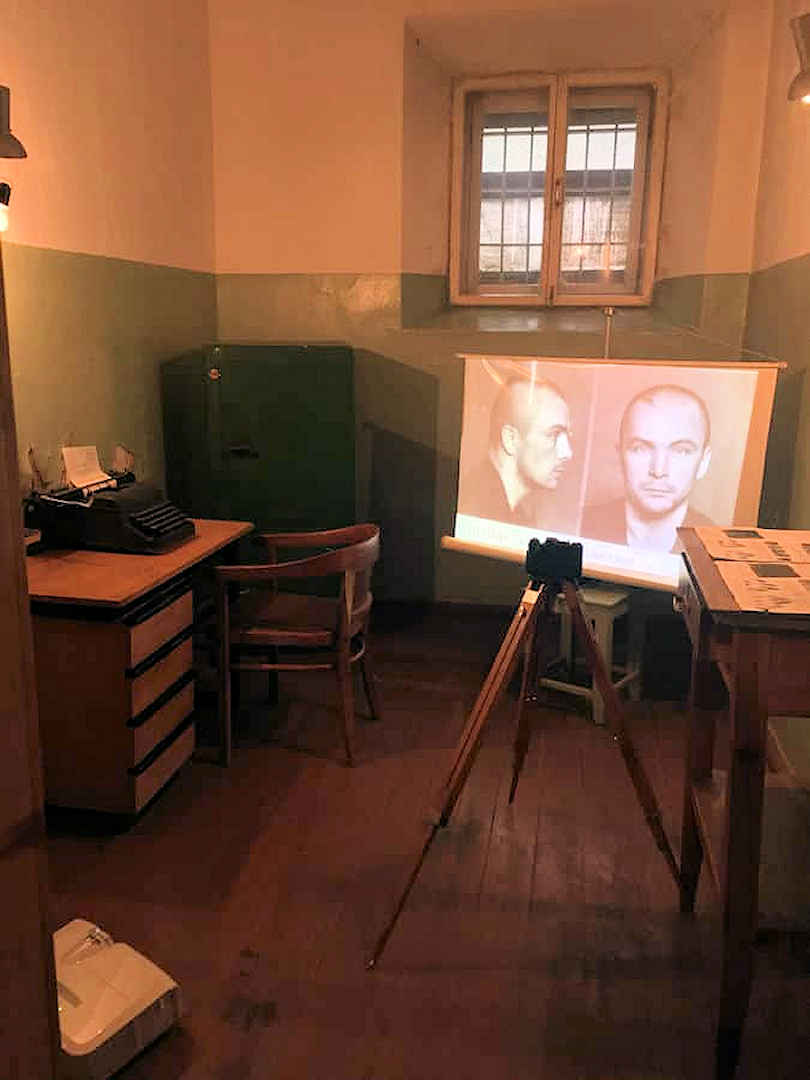
The Museum of Occupations and Freedom Fights - gruesome but one of our favourite museums in the Baltics
English is widely spoken (but only by people under 40)
If you speak to someone 50+ (for example, when you buy groceries), don’t take their indifference or blank look as unfriendly (though some older folks are grumpy). People who are Paul and my age (or older) grew up under the Soviet regime; which means Russian was the (first and often only) foreign language they learned at school.
If you need help, approach a person in their 20s or 30s. Chances are they are keen to practise their English (and they speak it very well).
Do you have a brilliant business idea? Come to the Baltics
Home to around 6.1 million people (2.9 million in Lithuania, 1.8 million in Latvia and 1.4 million in Estonia), the three Baltic states are among the European leaders when it comes to the number of start-ups per capita. Estonia is the birthplace of Wise and Bolt. Our email marketing provider, MailerLite, was founded in Lithuania (we visited them in their Vilnius headquarters). Even one of our short-term rental accommodation hosts worked in the Baltics’ start-up scene.
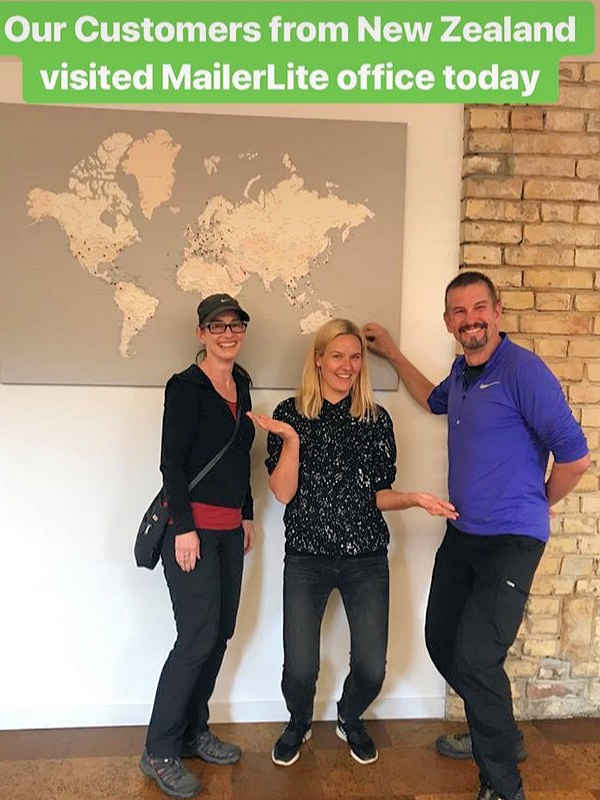
The Baltics are a breeding ground for start-ups (including our email marketing provider MailerLite)
The Baltics are pretty flat (and windy)
The Baltics won’t be a favourite for mountain goats, as the highest point in the Baltics – Estonia’s Suur Munamägi – is only 318 metres above sea level. Latvia’s and Lithuania’s highest peaks are 312 metres (Gaiziņkalns Hill in Latvia) and 294 metres (Aukštojas Hill in Lithuania), respectively.
Without more prominent mountains for protection, hardly a day goes by without at least some wind. Which is great to cool you down in summer and if you love kite surfing (which you can do on the Baltic Sea and on many lakes – the Baltics have more than 10,000). And it’s great for harnessing wind to produce renewable energy. But it also means it can get pretty chilly in Winter.
Baltic cities boast stunningly (and some less so) beautiful architecture
While many Western European cities were bombed into oblivion during World War II, Baltic cities, towns and villages survived World War II relatively unscathed. From Romanesque and Gothic medieval old towns to strikingly opulent Art Nouveau streetscapes, you can find it all in the Baltics – (sometimes a little too) well preserved.

Baltic streetscapes are not all about quaint medieval old towns
Many older houses are made of wood, especially in smaller towns and in the countryside (and on the Baltic coast near Riga). Given the countries’ forests, wood was a cheap building material. Wood also seems to be making a bit of a come-back: we saw quite a few new builds made from wood (including log houses).
Unfortunately, you can also see the same austere Soviet-era apartment blocks throughout the Baltics. Made from prefabricated concrete in the 1960s and 1970s, they have the same footprint: 3-6 storeys high, 2-4 units on each floor, some units with balconies/some without. Some blocks have been renovated with new insulation, balconies and paint on the outside. Others still look the same as they did 40 years ago.

Austere Soviet-era apartment buildings are still part of the streetscape in the Baltics
Trolleybuses are a very common mode of transport
All three capital cities and Lithuania’s second-largest city, Kaunas, have trolleybuses. Initially just another remnant from Soviet times, buses that run on electricity (supplied directly from the grid) are making a come-back as public transport networks around the world are electrifying their fleet.
While Kaunas gave its old trolleybuses a fitting send-off by turning them into street art, the colour choices these days are a bit more boring: Vilnius’ are red and cream-coloured. Kaunas’ are green and black. Riga and Tallinn boast blue and white ones.
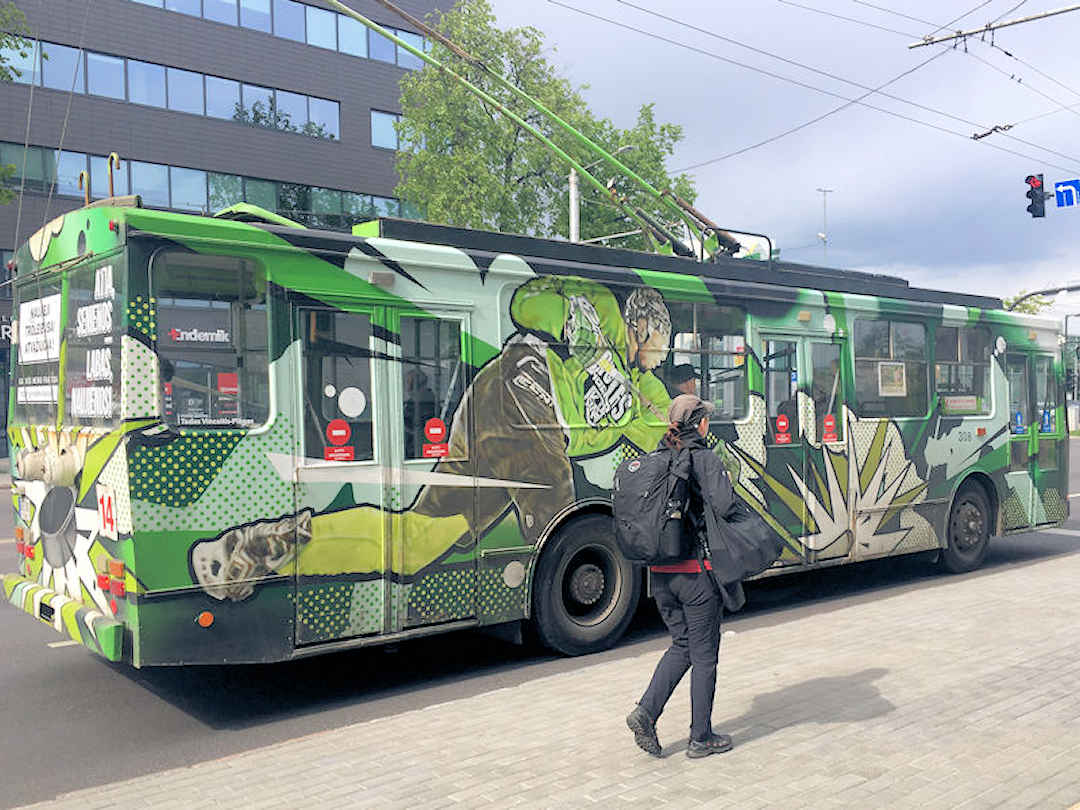
When Kaunas replaced its trolleybuses, the city turned them into street art, to give them a well-deserved send-off
Football/Soccer is NOT the National Sport
While each Baltic state has its own national football team, football/soccer is not the National Sport. Instead, Lithuanians go nuts for Basketball – the Lithuanian National Team ranks at the top of the FIBA World Ranking. Latvians go bonkers for Ice Hockey – the Latvian National Team ranks highly in the IIHF Ranking. Estonians love both (though with less success at the international level), and sports and the outdoors in general.
One small practical tip before you go: having mobile data from the start makes border crossings, station changes, maps and translations much easier, so it is worth sorting an eSIM before you arrive.
What surprised you about the Baltics?
What interesting and unusual things did you discover when visiting the Baltics? Please send me an email.
Before you go, if you liked our article and found it helpful, we would appreciate it if you could share it with your friends and family via the Share buttons below. Even better: Leave a short review on Trustpilot or Google, which would help us further build our online reputation as a (trustworthy and helpful) travel and lifestyle blog.