

This article may contain links to products and services we use and recommend. We may receive compensation when you click on links to those products. For more information, see our Disclosure Policy.
We’d seen the stunning pictures of Fitz Roy Peak. Heck, we even wear Patagonia gear (which famously uses the mountain massif in its logo). While we knew what awaited us, catching our first in-person glimpse of majestic Fitz Roy still took our breath away. Approaching from El Calafate and turquoise Lake Viedma in the early evening, we first spotted the towering mountain range through the clouds many kilometres before reaching El Chaltén – the rays of the sun setting over the Andes making our first encounter even more magical.
If you’re wondering whether to head to Torres del Paine (TdP) or Los Glaciares, or you’re already planning your hiking adventure in El Chaltén and have questions, our article has got you covered. From the best time to visit, to recommendations around hiking trails and essential logistics for your visit, here is all the information you need.
Are you planning your trip to El Chaltén last-minute?
Book your transportation to/from and around El Chaltén, keeping your carbon footprint in mind:
Find your perfect El Chaltén accommodation with Booking.com. We recommend these traditional, small-scale and centrally located options near public transport:
When managing money across countries, we keep fees low and decisions deliberate. We use XE to check exchange rates, Wise to move and spend money internationally, and PocketSmith to track where it all goes.
Get comfortable with Spanish before your trip
You don’t need fluency, but knowing a little Spanish can make everyday travel easier. Busuu offers a simple way to practise before your trip and decide how much effort is worth it.
Buying travel insurance can feel overwhelming. Start by reading our buyer's guide to finding insurance that suits your needs. Then compare options on the Insubuy marketplace (with all the information you need to find the one that's right for you).
Where is El Chaltén (and why should you go)?
El Chaltén sits in the northern part of Los Glaciares National Park in Argentina‘s Santa Cruz Province. The park, a UNESCO World Heritage site and Argentina’s largest (over 600,000 hectares), protects parts of the Southern Patagonian Ice Field.
Heralded as the Hiking Capital of Argentina, El Chaltén and its surroundings offer countless trails for all fitness levels, many accessible directly from town. True, El Chaltén and Los Glaciares National Park are no longer the undiscovered gems they once were, and they may not have a W/O-Trek (or Torres del Paine‘s well-oiled tourism infrastructure). But the surrounding mountains and glaciers here are equally majestic, and you can create your own multi-day hiking adventure or attempt the Huemul Circuit without breaking the bank.
First settled in the early 1900s and officially founded on 12 October 1985, El Chaltén has more of a frontier town atmosphere than Puerto Natales in Chile, the much larger and more established gateway to TdP. A bit rough around the edges, its tourism infrastructure still tries to catch up with its popularity: many roads in town are still unpaved, and its seasonal influx of guests is often accommodated in rustic cabins and tiny houses. But that’s all part of its charm.

Heralded the Hiking Capital of Argentina, El Chaltén is the gateway to northern Los Glaciares National Park
Map of Accommodation, Points of Interest, Eateries and Transport
Below is a map of the recommended accommodations, points of interest, eateries, relevant shops, and transport terminals or stops mentioned in this article.
When to go and how long to stay
The weather in El Chaltén can be VERY hit and miss. During our week-long stay in the second week of October, we had three days of atrocious weather (bucketing non-stop), one perfect day (sun and blue skies) and three days with okay weather (overcast but no rain).
One thing remains constant throughout the year though: the notorious (usually north-westerly) Patagonian wind – at times, with extremely powerful gusts (that can push you off your feet). Some trails (such as the Sendero Chorillo del Salto, Senderos Mirador de los Cóndores/de las Águilas, Sendero Mirador del Paredón (outside the park) and parts of the Senderos Fitz Roy from El Chaltén and Loma del Pliegue Tumbado) are very exposed and not much fun on an extremely windy day, which makes scanning the weather forecast and planning your hikes with the wind direction in mind essential.

Crampons are essential (and poles recommended) when hiking higher elevations in the colder seasons
The peak tourism season in El Chaltén is from November to March, with January being the busiest month. While you could come here in Winter to avoid the crowds, be aware that some places/facilities are closed from May to mid-October.
For the best of both worlds – a better chance of decent weather and fewer crowds – we recommend Spring (mid-October to mid-December) or Autumn (March/April); the latter especially if you’re a keen photographer, as the autumn foliage colours are stunning.
Whichever time of the year you choose, we recommend staying at least four to five nights (ideally a week) to increase your chances of good weather and allow time to rest between hikes.

In Spring, when Mata Guanacos are in bloom, the Patagonian Steppe around El Chaltén turns bright red
During our stay, the forecast on Meteoblue proved pretty accurate. They also have historic annual data if you want to get a better idea as to which month to choose for your trip.
Another good forecast app is Windguru, especially when it comes to specific locations within the National Park, like Laguna de los Tres or Laguna Torre. Check the
- cloud cover (you’d want to have low/mid as free/low as possible to see the peaks);
- wind speed/gusts (with gusts above 50km/h, hiking in exposed areas gets dangerous; and even in the forest, you’d need to watch out for falling branches/trees); and
- precipitation.
Los Glaciares National Park – Everything you need to know
Entry and Ticket Booths (as of October 2025)
Until 2024, entry to the northern part of the National Park was free. Now, foreigners pay ARS45,000 for a day ticket. These can be bought at ticket booths and online.
Yep, the entrance fees for Los Glaciares National Park are an absolute shocker (at least for foreign visitors). And it is unclear how the money is spent (in the National Park or in El Chaltén):
- While there is some trail maintenance, much more must be done (urgently). When we visited in early Spring, many trails were underwater or extremely muddy, forcing hikers to bush-bash through fragile vegetation. Boardwalks and better drainage, supported by clear signage to redirect hikers as needed, would help protect the landscape.
- The toilets within the park are also (mostly) disgusting. Making them easier to keep clean (using the right materials) would go a long way for us visitors and the staff responsible for their maintenance.

The trail quality in the Northern Los Glaciares NP does not match the expensive entry fees (yet)
In the northern part of Los Glaciares, you’ll find staffed ticket booths at the start of:
- Sendero Laguna de los Tres/Río Eléctrico [Google Maps location];
- Senderos Fitz Roy and Chorrillo del Salto/El Chaltén [Google Maps location];
- Senderos Mirador de los Cóndores, Mirador de las Águilas, Loma del Pliegue Tumbado and Laguna Toro/El Chaltén [Google Maps location].
These booths appear to be staffed between 7:00 and 19:00 (or thereabouts), and check hikers going in, but not going out. It’s also worth noting that tickets (at least in this part of the National Park) are only visually checked (not scanned). Our IDs were also never inspected.
There are no ticket checks at the trailheads for Laguna Torre in the upper town [Google Maps location] or Chorrillo del Salto (when walking along the gravel road to Río Eléctrico/Lago del Desierto). During our visit, no rangers conducted spot checks on any of the trails.

Not all trails in northern Los Glaciares National Park have staffed ticket booths (yet)
If you plan to do multiple hikes that start at staffed ticket booths, take advantage of
- the 3-Day Flexi Pass: Priced at ARS90,000 (for foreigners) and ONLY available online, this pass is valid for any 3 days over 6 months; or
- the 2-Day Ticket (with your second day 50% off): This ticket (priced at ARS67,500 for foreigners) can only be bought at ticket booths and is only valid for 72 hours (so you can have a day off between hikes but not more).
The 3-Day Flexi Pass and the 2-Day Ticket apply across the northern and southern Los Glaciares National Park. You can hike in El Chaltén and then visit Perito Moreno Glacier (or vice versa).
If you plan to visit multiple of Argentina‘s National Parks (Tierra del Fuego, Los Glaciares, Los Alerces, Nahuel Huapi, Arrayanes, Lanín, Talampaya or Iguazú, for example), it may even be worthwhile to get the Annual Pass (priced at ARS225,000).

Skip the queues by purchasing your day-ticket, 3-Day Flexi Pass or Annual Pass online
Our favourite hikes
Our top pick is the Sendero Laguna de los Tres/Fitz Roy starting from Río Eléctrico. The trail from Río Eléctrico is more gradual than the route from El Chaltén, you avoid returning the same way (a super-boggy mess you only want to do once), AND you get to see the beautiful Piedras Blancas Glacier from all its angles (on a clear day). Another advantage: you’re hiking (mostly) with a tailwind.

Starting your hike to Laguna de los Tres/Fitz Roy from Río Eléctrico means you'll get to see Piedras Blancas Glacier from all angles
The hike covers around 24 kilometres with just over 1,100 metres of elevation gain, about half of that concentrated in the steep 2.5-kilometre section between Río Blanco and the Laguna de los Tres viewpoint. Crampons are needed in autumn, winter and spring. While we saw quite a few people without them, you only put yourself and others at risk.
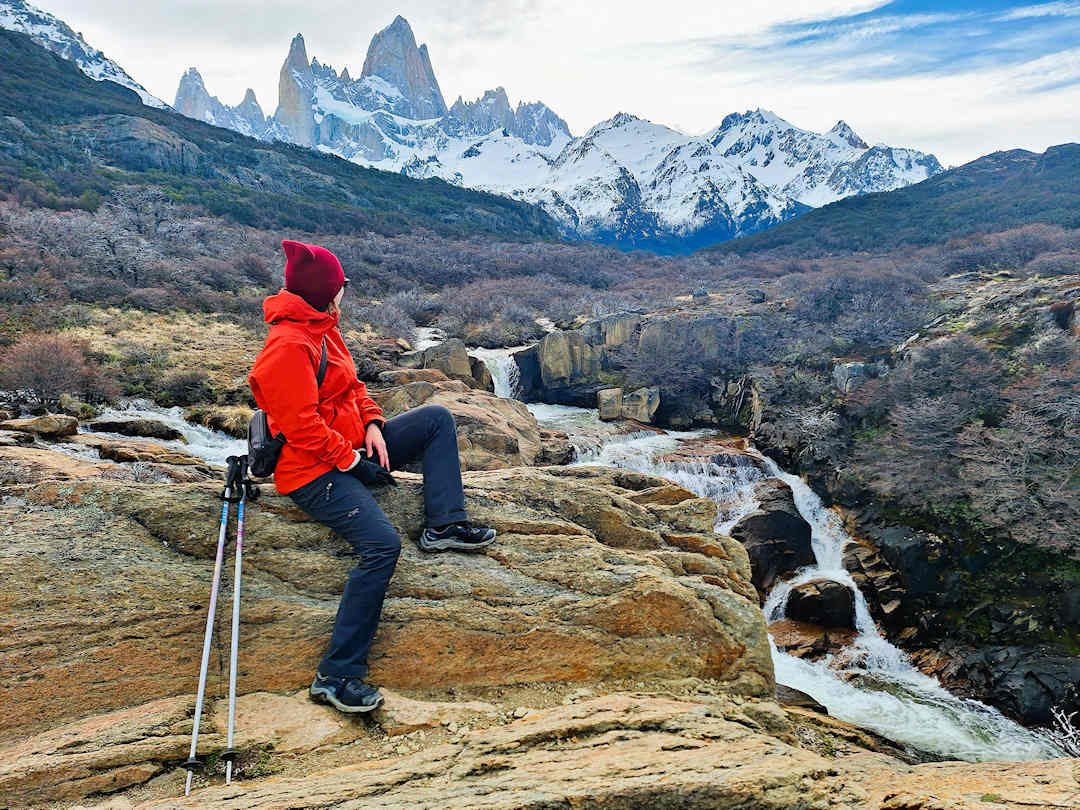
On your return to El Chaltén, we highly recommend the little detour to Cascada Escondida (our feature image was taken there). In the late afternoon, we had it all to ourselves (the viewpoint is not signposted; most hikers just continue on the main trail).
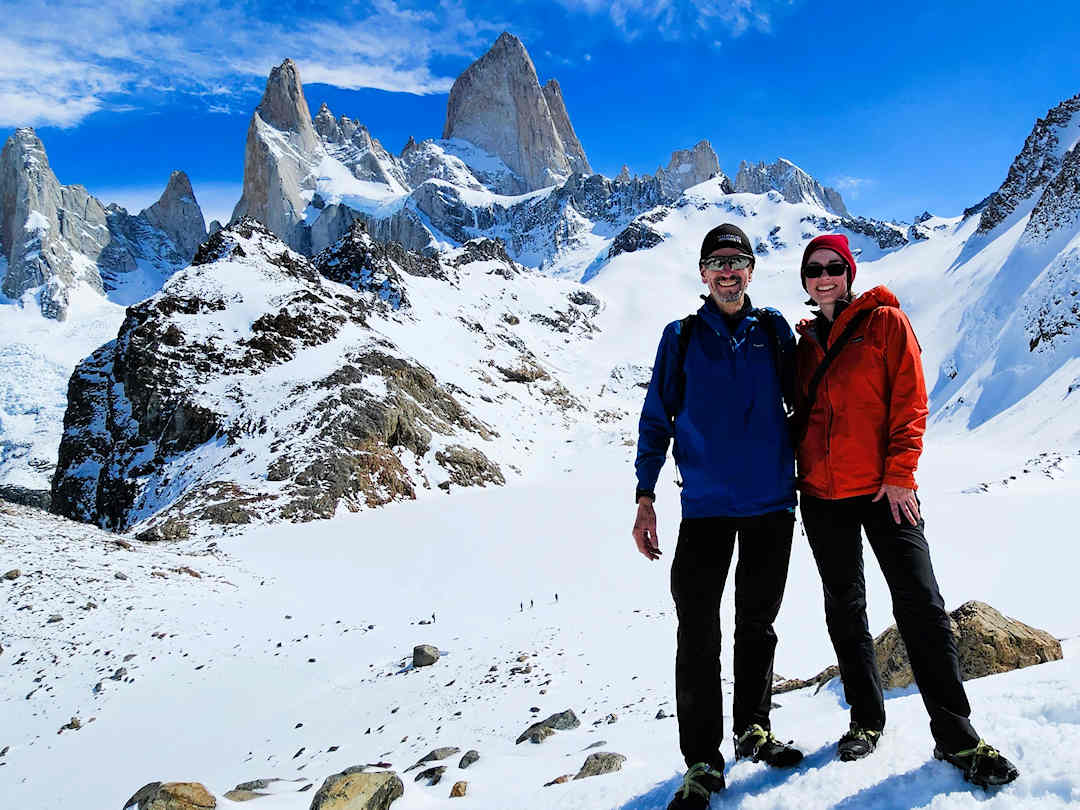
Mount Fitz Roy with a frozen Laguna de los Tres - It's a long and tiring hike, but so worth it (especially on a gorgeous day)
Another must-do is the Sendero Laguna Torre. This 19-kilometre out-and-back trail climbs roughly 800 metres, following first the canyon of the Fitz Roy River (with views of multi-tiered Margarita Waterfall [Google Maps location] pouring down the mountainside) and then a long glacial valley to Laguna Torre [Google Maps location], dotted with floating icebergs from Glaciar Grande and towered over by Cerro Torre [Google Maps location] (Fitz Roy’s slightly smaller but no less impressive cousin).

Laguna Torre with floating icebergs - sadly on the day of our hike, iconic Cerro Torre hid behind the clouds
Insider Tip
If you only have time (or clear weather) for one long hike, choose the Sendero Loma del Pliegue Tumbado (to the viewpoint only – there is no need to climb all the way to the summit). At around 19 kilometres (out and back) with a more gradual 1,000 metres incline, it offers sweeping views of Cerro Torre, Laguna Torre AND the Fitz Roy massif on a clear day. It’s also less busy than the Sendero Laguna de los Tres/Fitz Roy.
If you’re looking for an easier hike, we recommend the Sendero Chorrillo del Salto. This flat 7-kilometre track leads to another striking waterfall [Google Maps location] – a great one to do on your arrival/departure day (or when the weather isn’t good enough to attempt one of the longer, more strenuous hikes). Stick to the road coming from town and only join the trail where you can (some parts were underwater when we visited).

Chorrillo del Salto, an easy hike to do on arrival/departure day (as long as it's not too windy)
All the above hikes can be done independently, without a guide/tour.
Food and Water
Bring all the food you need for your hikes – there is nowhere to buy supplies once you’re on the trails. Check our recommendations below on where to stock up on groceries and snacks.
The water from mountain streams and lagoons is generally safe to drink along the trails. Bring a reusable water bottle, and for sources with visible sediment or tannins—such as Río Fitz Roy near Agostini Campsite [Google Maps location] and some lagoons—we recommend using a portable water filter or treatment method.
Water quality can vary depending on recent rainfall and glacial runoff, so having a simple treatment option gives you flexibility on longer hikes. Avoid taking water from rivers near town. There have been documented concerns about pollution in El Chaltén’s waterways (see this Guardian report).




Water from the mountain streams in Los Glaciares is potable, but bring a filter to remove sediments/tannins if you take water from the lagoons
Toilets
(Long-drop style) toilets are available at several points within the park, including:
- Fitz Roy/Laguna de los Tres Trail: Laguna Capri Campground [Google Maps location], Poincenot Campground [Google Maps location] and the picnic area near the Río Blanco bridge [Google Maps location];
- Sendero Laguna Torre: the picnic area at Mirador Cerro Torre [Google Maps location], near the intersection with the Madre e Hija trail [Google Maps location], as well as the Agostini Campsite [Google Maps location]; and
- Just before the waterfall on the Sendero Chorrillo del Salto [Google Maps location].
Most are poorly maintained; the cleanest we found were at Chorrillo del Salto and Campamento de Agostini. Always bring your own toilet paper, as most don’t have any, and hand sanitiser.
Leave no trace
There are no bins along the trails, so pack out everything you bring in. Carry an empty bag for your rubbish and dispose of it properly once back in town.

Los Glaciares National Park has a Leave No Trace policy - that includes organics
What to do in El Chaltén if you can’t or don’t want to hike
El Chaltén is not only about hiking. If you’re looking for something active to do on your rest days, here are some options:
And on bad weather days, when it’s unwise to hike (or join any other outdoor activities), there is still plenty to keep you occupied. Here are three suggestions:
- Learn more about El Chaltén’s history and Los Glaciares’ flora and fauna by visiting the Town Museum, housed in the first school [Google Maps location] – open Monday-Friday 9:00-14:00; the Climbers’ Chapel [Google Maps location] – open Monday-Friday 9:00-14:00 – and the National Park Visitor Centre [Google Maps location] – open daily 9:00-17:00 (admission is free to all) – and/or joining a guided tour of the Madsen House Museum;
- Pamper yourself with a day at Spa Yaten; or
- Chill by the fire at your accommodation with a good book and a hot cuppa.
How to get to El Chaltén and how to get around (without a rental car)
Getting there
El Chaltén is 210km north of El Calafate (approximately 3 hours by bus). For up-to-date timetables across all operators (Chaltén Travel, Marga Taqsa and Cal-Tur), it’s best to check Busbud. You can also book your ticket through Busbud (and pay by credit card). If you arrive in El Calafate by plane (IATA code: FTE) or bus on the same day you travel to El Chaltén, leave yourself some buffer, in case your flight or earlier bus is delayed.
All buses between El Calafate and El Chaltén also stop at El Calafate Airport [Google Maps location] (about 20 minutes after leaving/before arriving in El Calafate). Fares are around ARS45,000 per person (as of October 2025) – whether travelling from/to El Calafate town or airport.

Chaltén Travel, Marga Taqsa and Cal-Tur are the three main bus companies travelling between El Calafate and El Chaltén
Some services, such as Chaltén Travel’s double-decker buses, have onboard toilets and/or stop for a toilet break at La Leona [Google Maps location] on the way to or from El Chaltén (ours did on the way to El Chaltén but not on the way back).
If you have the option, choose seats on the left-hand side as you travel from El Calafate (on the right when you return). These seats have the nicest views, overlooking Lago Argentino and Lago Viedma. We could see the Viedma Glacier and icebergs in the lagoon. If you’re travelling to El Chaltén on a clear day, keep your eyes out for Fitz Roy in the distance. The road meanders as it crosses the Las Vueltas River, so both sides of the bus get glimpses alternatingly (if clouds do not hide the peak).

Pick a bus seat on the left to El Chaltén (on the right from El Chaltén) for the best views - you may even see Viedma Glacier on a clear day
Getting around
El Chaltén is compact and very walkable. It is divided into a lower part (at river level) and an upper part. You can reach all accommodations, restaurants, shops and most trailheads on foot.
If you plan to start the Laguna de los Tres hike from Río Eléctrico, several companies offer transfers to Río Eléctrico, including Zona Austral, Chalten Travel, Receptivo Chalten and South Road. You can book your spot online or via WhatsApp. Expect to pay around ARS13,000 per person.
Where to stay in El Chaltén
Accommodation in El Chaltén is among Patagonia’s most expensive (and least value for money). The best options go first, so book ahead, especially if you plan to stay longer. We also recommend choosing a place with a kitchen/ette. While supermarket food is more expensive here (given the town’s remoteness), not eating out for every meal still saves you a lot of money.
We also recommend picking a property that’s not too exposed to the omnipresent wind. Ours was, and it wasn’t much fun, as our cabin rattled all night and fine dust from the unpaved roads found its way inside the cabin. Knowing the wind exposure and the layout of the town, these are places we would consider booking (instead) if we were to return:
Instead of staying in town, you could combine your hikes over multiple days, staying at campsites within the park, for example:
- Campamentos Poincenot and Laguna Capri on the Sendero Laguna de los Tres/Fitz Roy, and
- Campamento de Agostini on the Sendero Laguna Torre.
The campsites are basic: You just find a flat and large enough spot for your tent among the trees. All have (long-drop style) toilets – at varying degrees of cleanliness, and access to water from streams and/or lagoons. No electricity, no phone reception. Open fires are prohibited in the National Park, but you can use your gas stove in designated areas.
The campsite staff will collect your camping fee (ARS20,000 per person per night), so bring cash. Alternatively, you can reserve your spot online. The latter is recommended in peak season, especially in January.

Campsites in Los Glaciares National Park are basic but (largely) sheltered from the wind
What to bring to El Chaltén
El Chaltén’s weather is famously unpredictable, so pack for all conditions.
Layers are essential – you’ll want to add or remove them depending on wind exposure and temperature. Always include a windproof outer layer, as gusts can be fierce, even on sunny days.
If you’re hiking after a few days of rain (which is pretty much all the time), waterproof footwear helps — Paul wore his Xero Shoes Scrambler Trail Low WP, which handled the mud well, gave good grip on uneven sections, and dried quickly after wet patches, while I wore Salomon X Ultra 360 hiking shoes for more structure and support. The Xero Shoes feel more like a trail shoe than a traditional hiking boot, so if you prefer more ankle support or expect prolonged exposure to wet conditions, a mid- or high-cut hiking boot may be the better choice.
We also recommend hiking poles for any trail with higher elevation gain (and crampons, pending the season you’re trekking in and the altitudes you’re heading into).
I made the mistake of not bringing a beanie, as I usually wear my baseball cap. The cap was useless, though, in El Chaltén’s relentless wind. Luckily, I found a beanie at Viento Oeste – a good place to check out any gear you may have missed (they rent equipment, too – see below).
Also don’t forget to pack sunscreen. When the sun is out, it’s fierce. And if you’re at Laguna de los Tres when it’s enveloped in snow and ice, the reflection multiplies its impact. I can speak from experience: despite reapplying halfway through, I still ended up with a hint of raccoon eyes.
Luggage-wise, we recommend a travel backpack over trolley suitcases (the latter are no good on El Chaltén’s many dirt roads).

When the sun is out, it's fierce - Don't forget to put on (and re-apply) sun screen
No Signal. No Backup. Carry This.
There’s no mobile reception across large parts of Los Glaciares National Park. If you’re heading onto longer or more remote trails, carry a personal locator beacon or satellite communicator – and know how to use it before you need it.
We use the Garmin inReach Mini 3 because it allows two-way messaging, live tracking, and weather updates—not just an emergency signal. It’s part of how we manage risk on multi-day hikes. Before any trip, we test the device by sending a message through Garmin’s system to confirm it’s working and connected.
A simpler option like the Ocean Signal rescueME PLB1 has no subscription and is highly reliable in a true emergency, but it only sends a one-way distress signal.
Whatever you carry, test it properly, make sure everyone in your group knows how it works, and treat it as a backup—not a substitute for planning and judgement. El Chaltén has only a basic medical centre, with the nearest hospital in El Calafate.
Amenities in El Chaltén
Travel Money
Most supermarkets, restaurants and even bakeries in El Chaltén accept credit cards, so you won’t need much cash. However, some accommodations still insist on cash payment. If yours does, change USD into ARS/Argentine pesos (or send money to yourself via Western Union) before you arrive – either in Buenos Aires or El Calafate. Or bring crisp USD100 notes if your accommodation accepts those (our host, who wanted to be paid in USD, made a fuss when we gave her USD20 bills).
If you need cash once in town, you can exchange USD to ARS at some restaurants and hostels (such as Nomade Resto Bar [Google Maps location], La Waflería [Google Maps location] and Patagonia Travellers Hostel [Google Maps location]) or at Western Union [Google Maps location]. Avoid Banco Santa Cruz [Google Maps location], which has a low withdrawal limit (ARS40,000) and high withdrawal fees (ARS12,000 per transaction).

El Chaltén has a bank branch but don't use it - the withdrawal limit is very low and fees extremely high
Supermarkets and Restaurants
El Chaltén has multiple supermarkets and mini-marts, but only two with a reasonable range and fair-enough prices for such a remote location:
- Lo de Lourdes [Google Maps location], open 08:00–22:00, and
- Maruja Gourmet [Google Maps location], open 09:00–24:00.
For fresh bread and pastries, head to Panadería Lo de Haydee [Google Maps location], open 08:00–21:00.

Maruja and Lo de Lourdes are the best-stocked and most reasonably priced supermarkets in El Chaltén
Considering its size, El Chaltén has a surprising variety of eateries (perhaps a sign of how busy it gets here in peak season). Many have happy hour when you finish your hike/s (a bit like après ski) or special dinner options. We recommend checking out these restaurants:
- Roots Patagonia [Google Maps location] serves a mean Patagonian lamb pie – perfect after a long day of hiking;
- Laborum [Google Maps location] with the best pizza in town – try 50/50 blue cheese and the special (or whichever other standard topping you like) – one is enough between two;
- La Lomiteria El Chaltén [Google Maps location] offers great sandwiches, burgers and fries; while
- Chica Ramen [Google Maps location] is ideal when you crave something different from the usual Argentine fare.

Roots' delicious lamb pie - just what you need after a long day of hiking around El Chaltén
Gear hire
Several outfitters rent gear in town – anything from weatherproof clothing, hiking boots, sleeping bags, mats, tents and gas cookers to poles, crampons and more technical equipment. Hiking poles (bastones) are highly recommended for longer and/or steeper trails, and crampons (crampones) are a must in Spring, Autumn and Winter when trails (in the upper parts) can be icy or mushy.
Crampons go like hot cakes the night before a good weather day. The best chance to secure them is from around 17:30, when hikers return from Laguna de los Tres. If you’re multiple people, split up (each going to a different outfitter) to increase your chances.
During the time of our hikes, we got the following quotes:
- Viento Oeste [Google Maps location] is open 15:00-20:30. Rents crampons for ARS12,000 the pair and poles for ARS2,500 (fixed) or ARS4,000 (telescopic) each.
- Bajo Zero [Google Maps location] is open 16:00-19:30. They rent crampons for ARS15,000 and poles for ARS6,000 (a pair, respectively).
- Patagonia Hikes [Google Maps location] is open 17:00-21:00. You can hire crampons here for ARS15,000/20,000 the pair (pending type) and a pair of poles for ARS5,000 (fixed) or ARS10,000 (telescopic).
Tip When hiring gear, you must leave an ID as security (sometimes even a credit card deposit).

Viento Oeste is one of several outfitters in El Chaltén to hire (or buy) any gear you may need
Luggage storage on arrival/departure day
If you plan to hike on your arrival or departure day, ask your accommodation if they can store your luggage before check-in or after check-out. If that’s not possible, you can also leave your bags at the bus station [Google Maps location]. Some companies, such as Marga Taqsa, offer storage, charging around ARS3,000 per item. This option is especially convenient if you plan to tackle Los Glaciares’ Senderos Loma del Pliegue Tumbado or Mirador de los Cóndores/de las Águilas before leaving town.
Insider Tip
If you are looking for a hike with stunning views close to town (without the steep entry fees and doable on your arrival/departure day), check out the Sendero Mirador del Paredón – when it’s not too windy. Don’t climb up the cliff face but instead turn right, taking the path through the gate/along the river and then left at the fork (after about 1 kilometre). This out-and-back trail is about 5 kilometres in total.

There are no lockers at the bus station in El Chaltén, but the staff at the ticket counters store your luggage for a small fee
Phone/Internet Reception
Movistar and Claro physical SIM cards, and the Airalo eSIM work well in town, providing stable 4G coverage. However, mobile reception disappears completely once you leave El Chaltén and enter Los Glaciares National Park, so download offline maps and notify friends or family before setting out.
Stay connected the moment you land
We use Airalo eSIMs on (almost) every trip to avoid roaming charges and the hassle of buying a local SIM. You can install your eSIM before you travel and get online as soon as you arrive. Airalo works in 200+ countries (we've used it across the Americas, Europe and Asia), but not everywhere - so check coverage before you buy.
New to Airalo? Use code NEWTOAIRALO15 for 15% off
Already a customer? Use AIRALOESIM10 for 10% off
FAQs
You talk about starting the Laguna de los Tres hike from Río Eléctrico. Is that the same as El Pilar?
Not quite. The trailhead for the Sendero Laguna de los Tres (via the Piedras Blancas viewpoint) used to start at the Río Blanco/Hostería El Pilar [Google Maps location] (hence it was called El Pilar). But these days, only guests staying at El Pilar can access the trail from here. The official start of the trailhead is now at the bridge over the Río Eléctrico [Google Maps location]. That’s where the transfers from El Chaltén will drop you off, and where the ticket booth is. After 3 kilometres of hiking, both trails – from Río Eléctrico and from El Pilar – merge (and continue as one).

The trails to Laguna de los Tres from Río Eléctrico and from Hostería El Pilar merge after about 3km
Is it safe to do the sunrise hike from El Chaltén to Fitz Roy alone (as a female)?
With a group (and the right equipment) yes, but not solo (Los Glaciares is puma habitat, after all, and there is no mobile phone reception if you need help).
Also bear in mind: To get up to Laguna de los Tres, it’s 12.5 kilometres from the trailhead in El Chaltén (with ~1,100m elevation gain, most of it over the last 2.5 kilometres before you reach the lake). It took us (during daylight hours) 3h 30min returning from Laguna de los Tres to El Chaltén (we started at Río Eléctrico). That’s a long time in the dark through boggy and later rocky terrain.
It’s better to hike to Campamento Poincenot on day 1, stay there for the night (BYO camping gear – can be rented in town), and hike up from there before sunrise on day 2 (then return to El Chaltén). From Poincenot, it’s only ~3km to Laguna de los Tres (and you won’t be alone on the trail for long).

To experience Fitz Roy's golden glow at sunrise close up, camp overnight at Poincenot and hike the last 3km in the dark
Is it worth joining one of the day trips from El Calafate to El Chaltén?
We generally recommend spending (at least) a few days in El Chaltén. But we understand that not everyone can.
Most day tours from El Calafate only include one (or several) of the shorter trails – Chorrillo del Salto, Mirador de los Cóndores and/or Mirador de las Águilas. Some tours leave El Calafate super-early and return super-late to squeeze in the Fitz Roy trek. Would it be worth spending 6 hours in a (mini)bus? Only you can answer that. If choosing the latter, it’s also worth asking yourself: Am I fit enough to complete the Fitz Roy trek in the time allocated?
The advantages of a day tour from El Calafate are that you can decide relatively spontaneously, based on the weather forecast, whether to do it or not, and you don’t need to rent a vehicle or rely on the public buses ploughing the route.

The best all-in-one hike - Loma del Pliegue Tumbado - with sweeping views of Cerro Torre, Laguna Torre AND the Fitz Roy massif on a clear day | Image courtesy of Wikimedia Commons
I only have time for one location – Torres del Paine or Los Glaciares/El Chaltén. Which one should I choose?
We were in the same boat – and as you can see, we chose the latter. When we looked at the prices for the W/O-Treks, paying hundreds of USD per person per night to sleep in a tent seemed ludicrous. Yes, the scenery is stunning (we saw glimpses on the bus ride from El Calafate to Puerto Natales), but there is a limit.
El Chaltén is not cheap by any means (and you may actually get better value for money choosing TdP, purely because Puerto Natales and everything around the TdP experience is many years ahead of El Chaltén). But to us, travelling at the end of the off-season, El Chaltén just seemed more appealing (and we don’t regret our decision after hearing from fellow travellers who’d done both, how busy it already was in TdP so early in the tourist season).
If we did it again, we’d compromise and join one of the day tours from Puerto Natales to Torres del Paine. The time spent on a bus is 2 hours less than on a day trip from El Calafate to El Chaltén, which makes TdP day trips much more palatable (at least in our opinion).
Keen to visit El Chaltén but got more questions?
I’ve tried to cover all grounds, but if you’ve got any further questions I haven’t answered above, please let me know, and I’ll try my best to answer them. If you’ve hiked in Los Glaciares recently, what other tips would you add (and what has changed since we were there)?
Before you go, if you liked our article and found it helpful, we would appreciate it if you could share it with your friends and family via the Share buttons below. Even better: Leave a short review on Trustpilot or Google, which would help us further build our online reputation as a (trustworthy and helpful) travel and lifestyle blog.