

This article may contain links to products and services we use and recommend. We may receive compensation when you click on links to those products. For more information, see our Disclosure Policy.

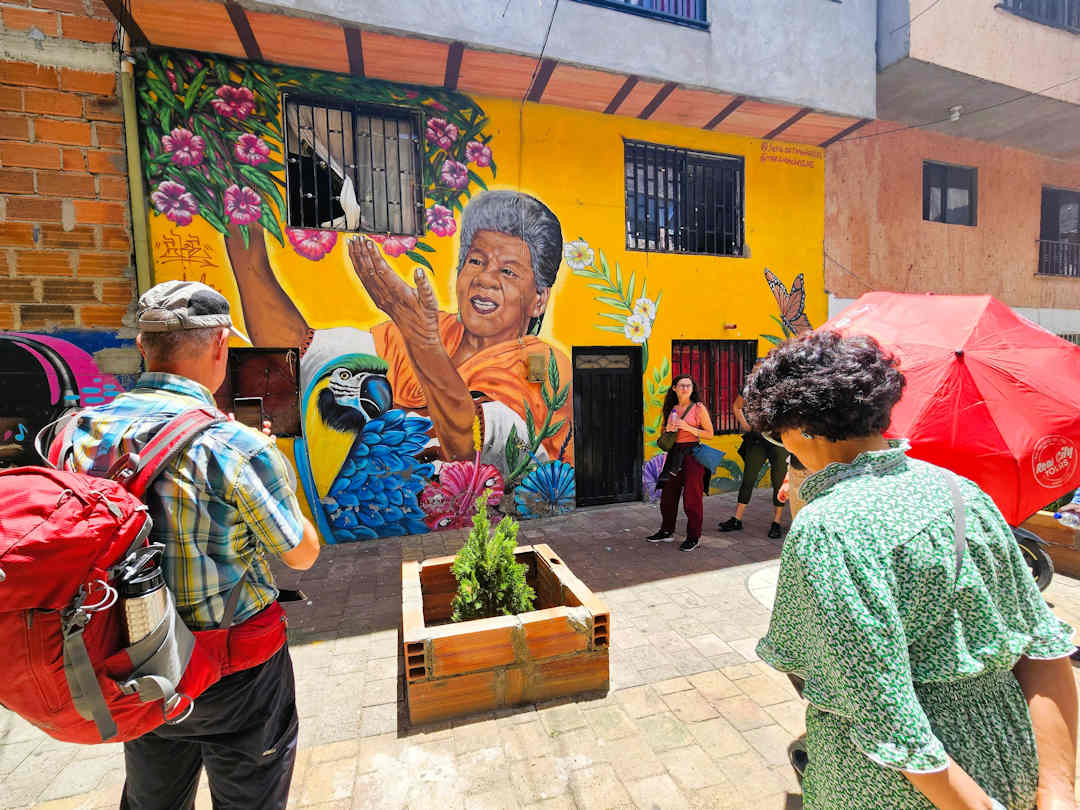
Experiencing Comuna 4 with Real City Tours is not your average Medellín walking tour – it’s a chance to step into the daily life of a community that transformed itself from surviving under precarious conditions on a rubbish dump into a thriving neighbourhood. Unlike the more famous (and intrusive) Comuna 13 tours, this small-group experience feels respectful, personal and deeply authentic. If you’re looking for a meaningful community tour in Medellín that supports local initiatives while reshaping how you see the city, Comuna 4 is the tour to choose.
In case you’re wondering: We paid for this experience ourselves, and we did not disclose (until much later) that we might be writing about it. So you can be sure that the experience we had is what anyone else is likely to experience too.
Are you planning your trip to Medellín?
Book your transportation to/from Medellín, keeping your carbon footprint in mind:
Find your perfect accommodation in Medellín with Booking.com. We recommend these small-scale and centrally located options near public transport:
When managing money across countries, we keep fees low and decisions deliberate. We use XE to check exchange rates, Wise to move and spend money internationally, and PocketSmith to track where it all goes.
Buying travel insurance can feel overwhelming. Start by reading our buyer's guide to finding insurance that suits your needs. Then compare options on the Insubuy marketplace (with all the information you need to find the one that's right for you).
Explore the wonders of Medellín with the best tours and activities powered by GetYourGuide, GuruWalk and Viator. We recommend these options:
Background – Comuna 4: From Margins to Community
Comuna 4’s story is a poignant example of Colombia‘s history of internal displacement (second only to Syria in scale) – brought to life on our tour by Heroína, a well-respected community leader.
In the early 1960s, (then six-year-old) Heroína and her family fled the violence in her home province. When they arrived in the growing metropolis of Medellín, the area they chose to settle in was still farmland, dotted with small lakes (but already used as an illegal garbage dump). Like thousands of others, the family built makeshift shelters from scraps and started to rebuild their lives far from home. By the 1970s, the neighbourhood had grown into one of Medellín’s most densely populated barrios – Moravia (the part of Comuna 4 covered on this tour).
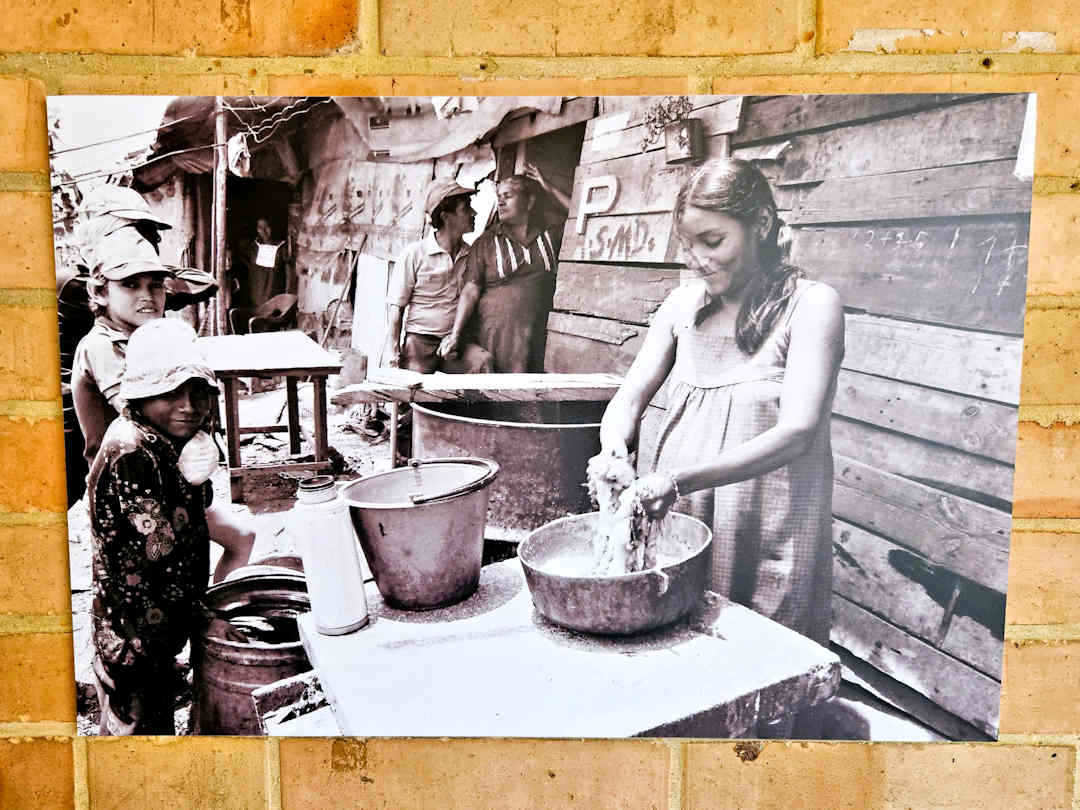
Displaced families resettled in Moravia, building shacks with whatever scraps they could find | Image courtesy of Moravia Community Development Centre
Also, in the 1970s, the government decided to turn the area into Medellín’s official rubbish dump (hoping this would drive the settlers away). But residents stayed. Salvaging food waste and recyclables, they built livelihoods from selling scraps: staples like rice, beans, or milk powder could be bought after selling a few kilos of metal; one brick cost about four times as much.
Over time, families like Heroína painstakingly replaced their shacks with modest brick and mortar homes – built on weekends with the help of neighbours and with a Colombian flag planted on top – to avoid immediate demolition by the National Guard, who would roam the area during the week.
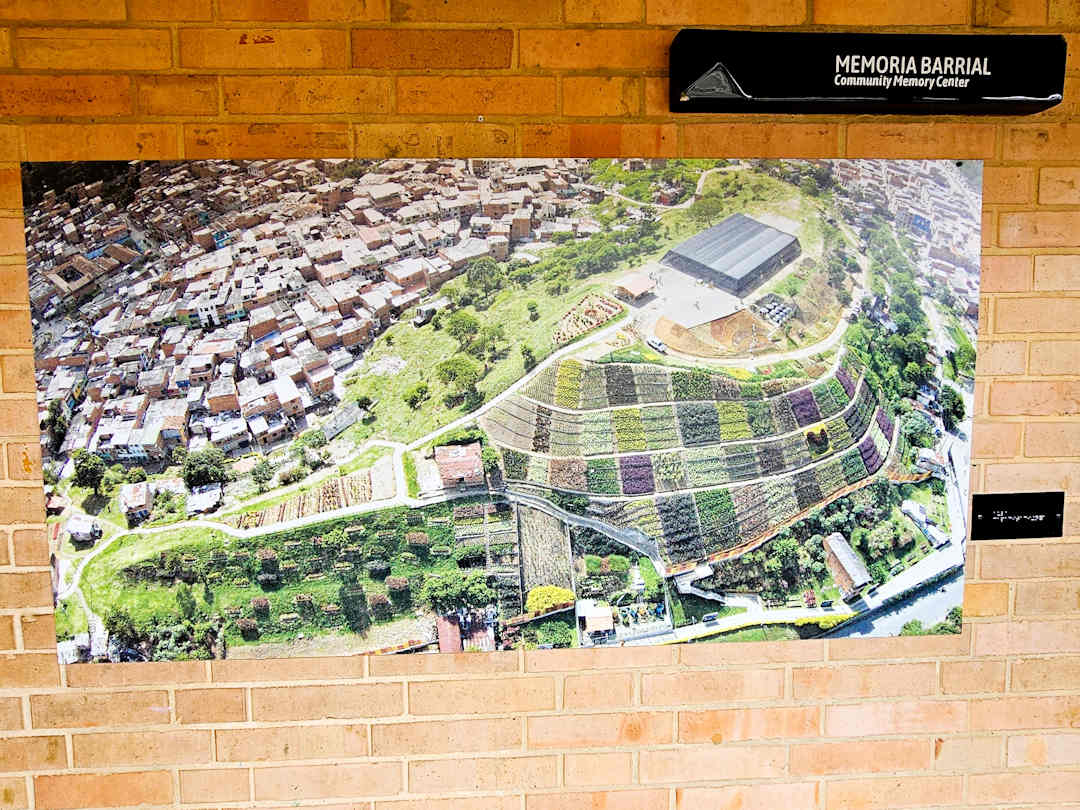
Moravia's hill of waste was transformed into a green oasis during a Macro Project that started in 2004 | Image courtesy of Moravia Community Development Centre
The dump was closed in 1984, but Moravia’s reputation as a problem zone lingered, and drugs and gang violence remained rampant. While Pablo Escobar’s death in 1993 kick-started Medellín’s grassroots transformation, it took until 2004 for a collaborative Macro Proyecto to really begin transforming Moravia. Community leaders, NGOs, local gangs and the government developed a 12-point memorandum. The initiative transformed the toxic hill of waste into a green space, led to the founding of recycling and cleaning cooperatives, and formalised basic services like access to utilities, schools and healthcare. While many of the promises didn’t materialise, this grassroots effort fundamentally changed the face of Moravia.

Our Comuna 4 walking tour took us through four of Moravia's six neighbourhoods: Llanitos, El Morro, Fidel Castro and El Bosque
Today, Moravia is home to some 60,000 residents who live in six barrios – from El Oasis (victim of two massive fires in 2007 and 2017 that destroyed the homes of thousands of people) and Fidel Castro (its name inspired by the Cuban revolution) to El Bosque (Moravia’s commercial hub) and El Morro (the former dump turned community garden that continues to attract new arrivals).
How to get around Medellín by public transport?
Medellín has an excellent public transportation network – the only city in Colombia with a metro – and all our accommodation recommendations are within walking distance of a transportation hub. You need the grey Eventual Civica Card, loaded with credit, to use it. You can buy the card and top it up at any Metro Station (if unstaffed, use the machine – check if it gives change before you put your cash in). The card costs COP10,000, and each ride is COP3,900. Multiple people can use the card, but the transfer is only free for the last person if you change modes (for example, from the metro to the tram or vice versa).
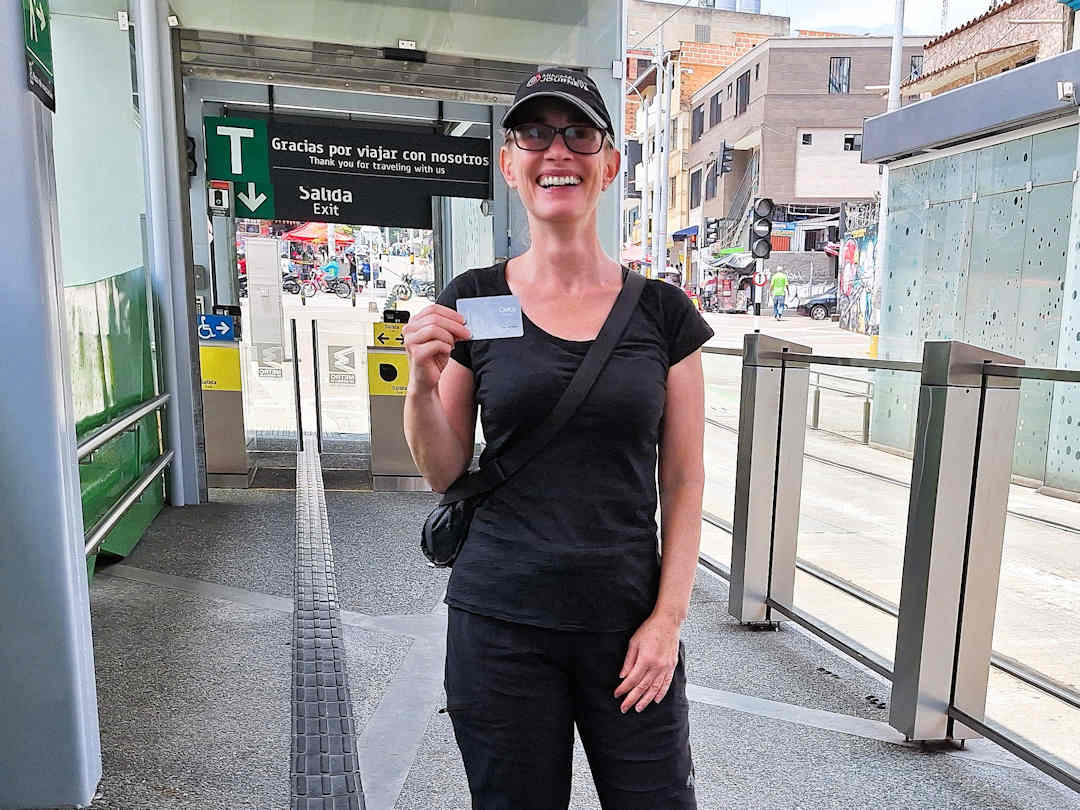
Moravia is easy to reach by public transport; visitors only need a topped-up Eventual Civica Card
What to expect on Real City’s Comuna 4 walking tour
Real City’s Barrio Transformation tour – as it’s also known – is not your typical Medellín walking tour. Contrary to the highly commercialised (and busy) experiences conducted in Comuna 13 (more on those below), the Comuna 4 tour is small-scale and focused on learning and genuine community connection.
Groups are always accompanied by an English-speaking Real City Tours guide and a Spanish-speaking representative from Comuna 4. On our tour, we’re guided by Juan Camilo (Toto)—a teacher, actor, and journalist—and Heroína, a 70-year-old leader who (as mentioned) has lived in Moravia since her childhood.
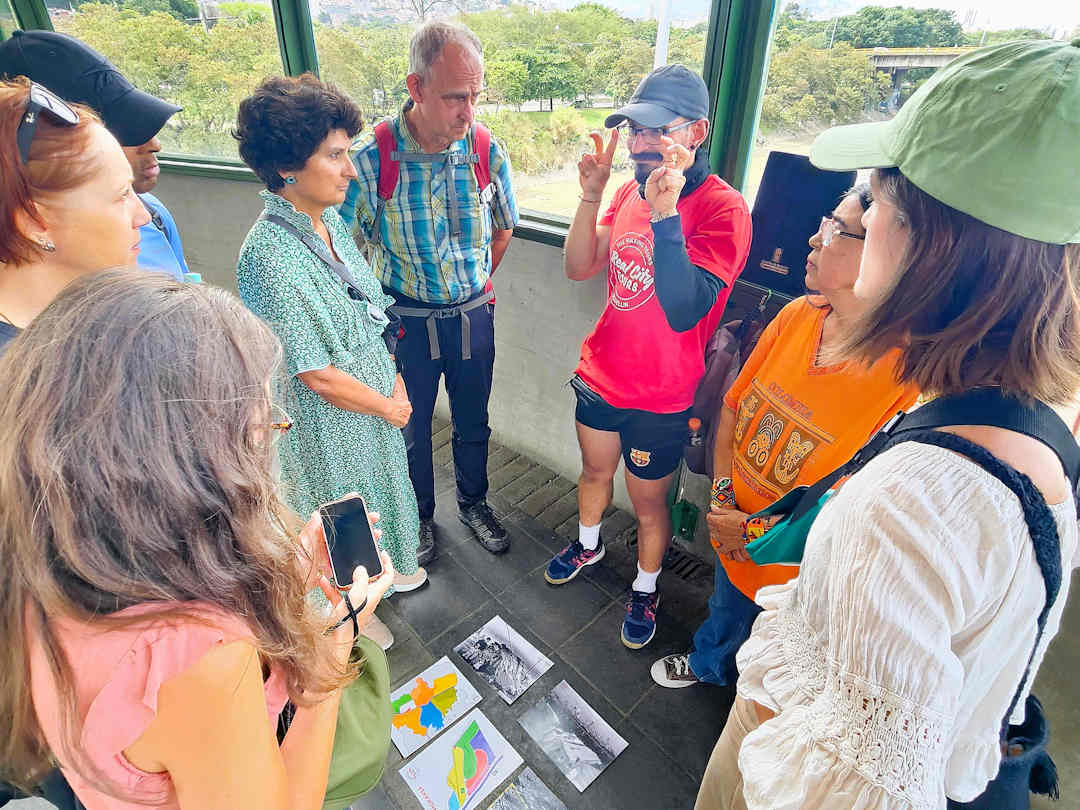
Comuna 4 walking tours start at the Caribe Metro Station - with a brief historic introduction and some guidelines for the tour
Our tour begins at the Caribe Metro Station, just north of Medellín’s city centre. After a brief introduction to Moravia’s history and some guidelines for our visit, we’re on our way.
After crossing the river, our path slowly winds through the streets and alleys of four (of the six) neighbourhoods. We stop in Llanitos, the narrow flat strip between the river and the hill, to learn more about Heroína’s childhood and her family’s hardships.
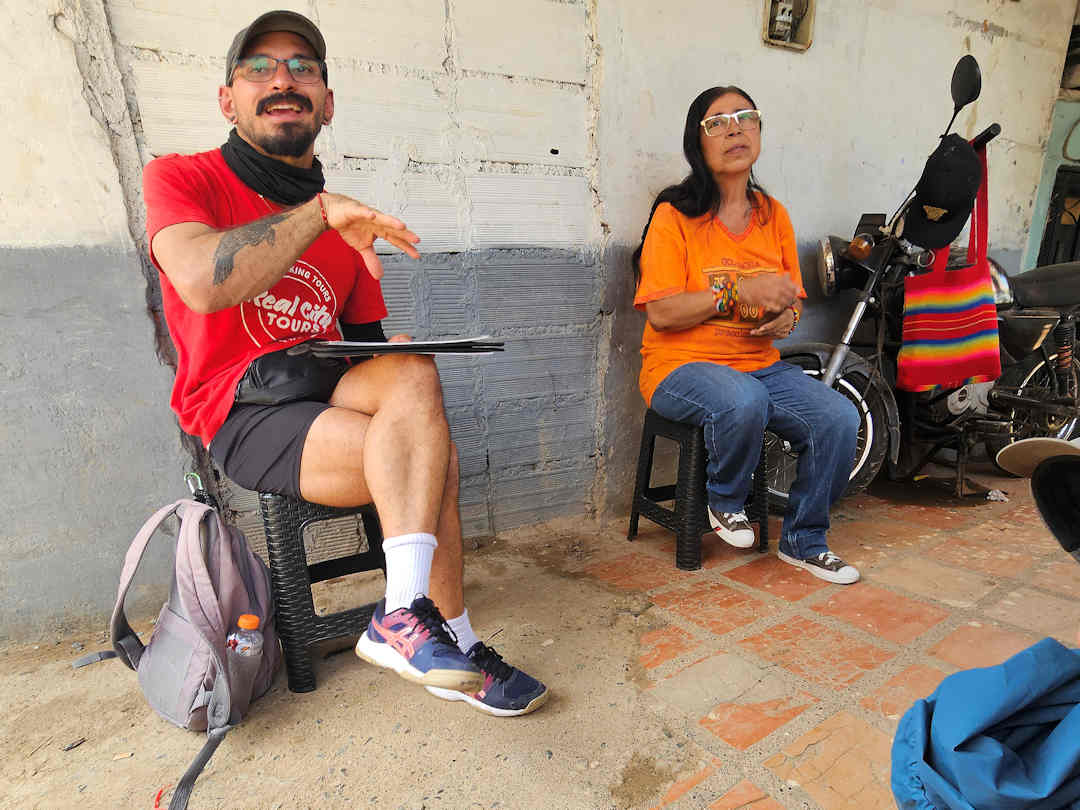
Each walking tour is led by two guides - an English-speaking guide from Real City Tours and a Spanish-speaking community representative
We climb onto El Morro, where posters remind visitors what the living conditions here once were, and then descend into Fidel Castro, home to a giant football field and Heroína’s family, before heading to El Bosque, where we learn about essential community projects (including a school founded by nuns in the 1970s).
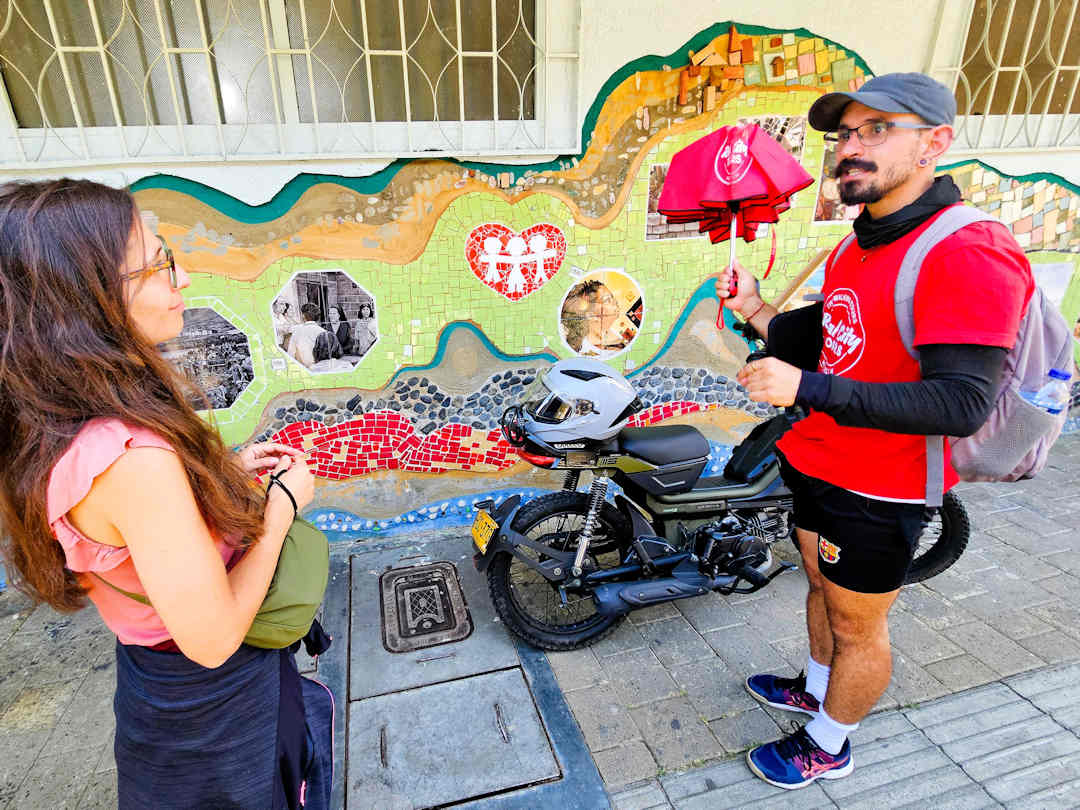
Stops on our tour include the school in El Bosque, founded by nuns in the 1970s, where a colourful mosaic depicts Moravia's history
After pausing for lunch at a small family-run eatery (serving simple but delicious vegetarian empanadas), we finish our visit at the Centro de Desarrollo Cultural de Moravia. Here, we meet Gloria Ospina (daughter of the late community activist Mamá Chila), who often joins Real City tours as the community representative. The Cultural Development Centre is a valued community hub, providing performance and exhibition spaces, and courses to residents, among other things.
The tone of the tour is deliberately respectful. Photography is discouraged in sensitive areas – particularly on El Morro, where new arrivals are wary of outsiders, given the illegal status of their settlement. The focus is on conversation and learning, which creates an atmosphere of authenticity: no photo ops, no staged performances; just the lived reality of a community that has (re)built itself, literally and figuratively, from the ground up.
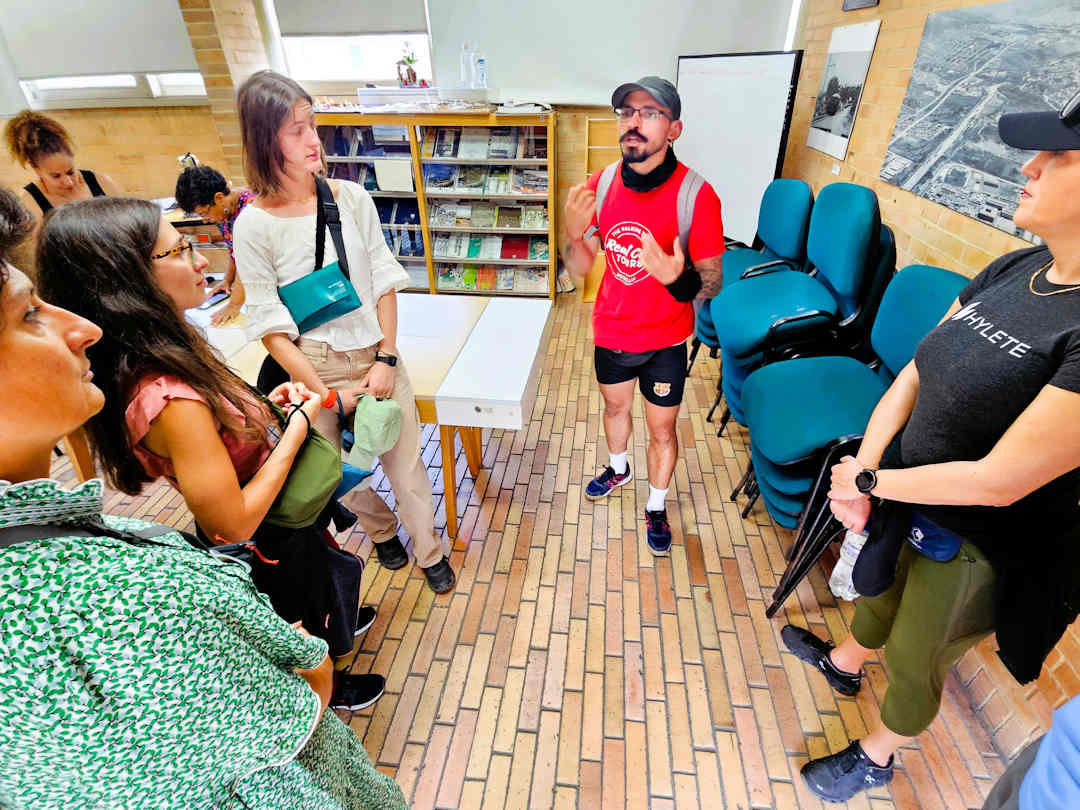
We visited the Cultural Development Centre, a valued community hub with performance and exhibition spaces, and courses for residents
Comuna 13 or Comuna 4 – Which tour should you choose?
You’ve only got time for one community tour and wonder which one to join? The choice was easy for us, but every visitor (and community) is different. So, here are some insights that might help you choose the one that’s right for you:
- Comuna 13 is Medellín’s most famous transformation story. Once dominated by violence, the barrio is now filled with vibrant street art, and outdoor escalators give easy access to panoramic viewpoints. Comuna 13 attracts a massive number of visitors. While the focus remains on urban renewal supported by street art (similar to the Barrio Egipto tour in Bogotá), the experience is very commercialised. One of the people on our Comuna 4 tour had done both and described the Comuna 13 tour as Disney-esque (in comparison).
- The Comuna 4 tour offers a quieter, more personal encounter. Here, the story centres on transforming illegal settlements on a former garbage dump into a thriving community. While you will come across some colourful murals, street art is not the focus here. Groups are small (and few), and photography is restricted, creating a more reflective atmosphere. It is also worth noting that Comuna 4 does not have the fantastic views of the hillside communities – it’s located in a flat part of Medellín, next to the Medellín river.
Social impact of the Barrio Transformation tour
Real City’s Comuna 4 walking tour is more than a walking tour; it features stories about displacement, neglect, reinvention, and hope.
For the community, the tour provides recognition and resources. For decades, Moravia was marginalised and stigmatised; its residents were dismissed as squatters on a dump. Inviting outsiders on their own terms allows the community to share personal stories of survival and transformation. It provides a livelihood for those who participate – from community representatives like Heroína to local businesses like the little eatery that caters for our lunch.
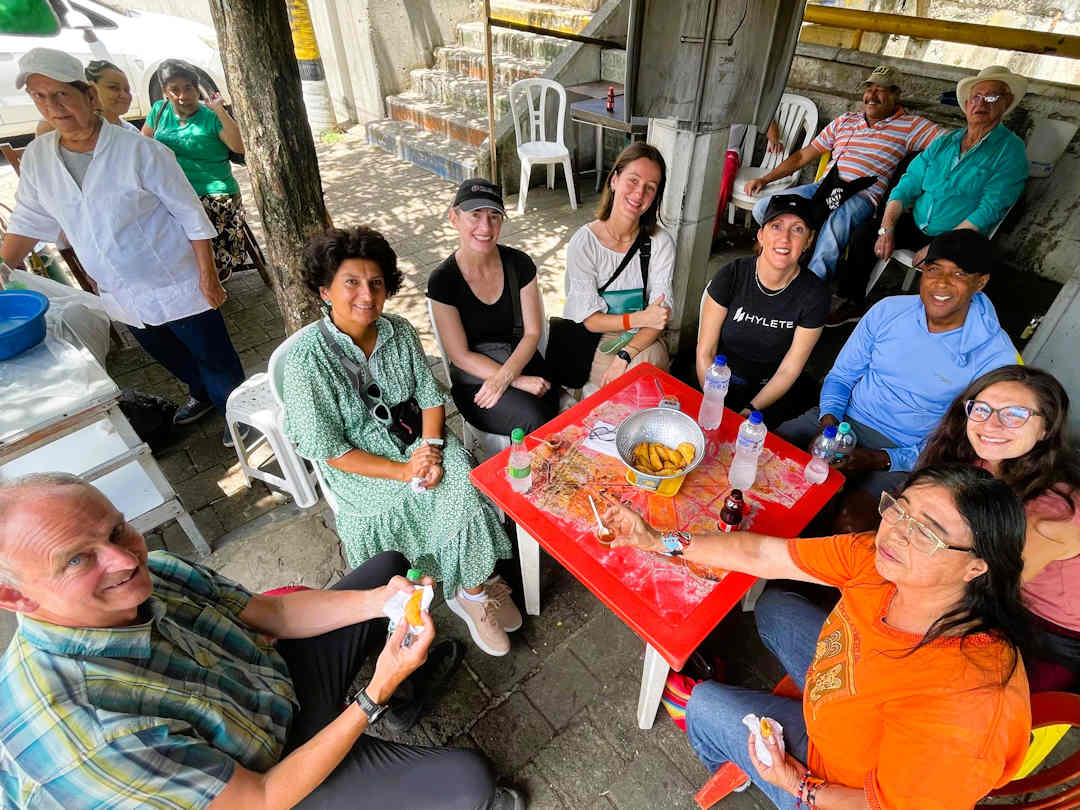
Our tour also included a lunch stop with delicious vegetarian empanadas | Image courtesy of Real City Tours
Hearing how people survived from waste (by scavenging for food and earning a small income from selling recyclables), leaves a deep impression on us visitors, too. Thanks to our English-speaking guide, we are able to ask questions that go beyond the surface – to understand Colombia’s complicated history and how people not only survived the hardships brought about by decades of armed conflict, but managed to build a thriving neighbourhood. Thanks to the tour (and its passionate guides), we leave with a new perspective on (first world) privilege, resilience and the power of grassroots initiatives.
Stay connected the moment you land
We use Airalo eSIMs on (almost) every trip to avoid roaming charges and the hassle of buying a local SIM. You can install your eSIM before you travel and get online as soon as you arrive. Airalo works in 200+ countries (we've used it across the Americas, Europe and Asia), but not everywhere - so check coverage before you buy.
New to Airalo? Use code NEWTOAIRALO15 for 15% off
Already a customer? Use AIRALOESIM10 for 10% off
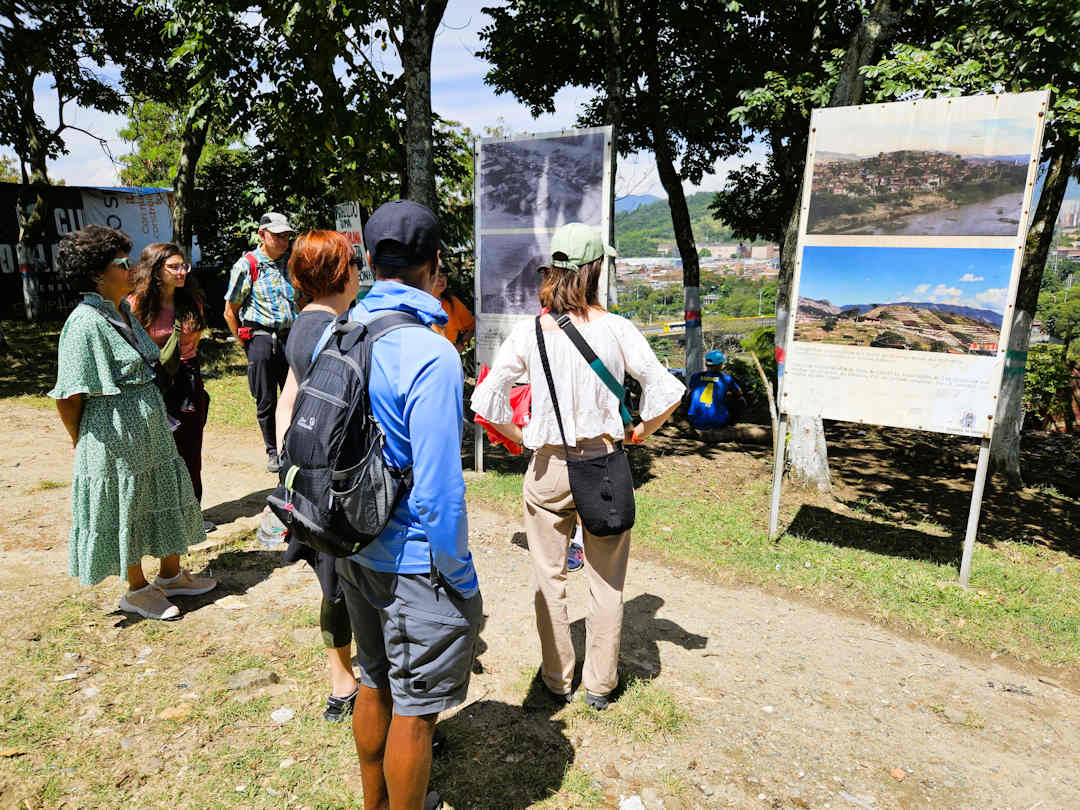
It's hard to believe we're standing on 30+ metres of garbage, but the posters are proof that the area looked once very different
Are there any negative sides to joining a Community Tour?
Apart from the poverty tourism experiences that some Comuna 13 tours offer, there is another dark side to community tours in Medellín.
Many neighbourhoods in Medellín are still controlled by gangs (in fact, we learn on one of our walking tours that there are more gangs now than there used to be in the early 1990s). While armed conflict is significantly reduced, tour guides, graffiti and performing artists, and shop and restaurant owners often (continue to) pay vacuna (extortion fees) to ensure the safety of their families and businesses. Most prevalent in Comuna 13, other neighbourhoods are not immune. And thus, the money you pay for your tour provides livelihoods to your guide/s and other people you’ll meet and finances the gangs.
If you’re in Colombia for a period of time and look beyond the superficial, you will be aware that its history is complicated, and things are never as black and white as they may seem to us outsiders. For many Paísas (people from Medellín), paying vacuna is like paying for utilities, an unavoidable part of life.
Community tourism is a powerful tool for disadvantaged communities (like Moravia or Barrio Egipto) to reclaim dignity and rebuild livelihoods away from crime. While we don’t condone the practice of extortion, the lack of community tourism initiatives in these neighbourhoods would be far worse, as history has shown.
Practicalities: How to book Real City’s Comuna 4 tour
Real City’s Comuna 4 walking tour is offered on Tuesdays, Thursdays and Saturdays, starting at 9:30 and lasting 3 to 3 1/2 hours.
All tours meet at the southern entrance of the Caribe Metro Station [Google Maps location] and finish at the Centro de Desarrollo Cultural de Moravia [Google Maps location]. From the latter, both the Caribe Metro Station and the northern entrance to the Jardín Botanico [Google Maps location] are only a 10-minute walk away – if you want to combine your tour with a visit to the latter.
While only covering about 2.5 kilometres (from/to Caribe) at a gentle pace, visitors walk up and down streets and footpaths, with frequent stairs and, at times, broken pavement. The tour is therefore not recommended for people with limited mobility.
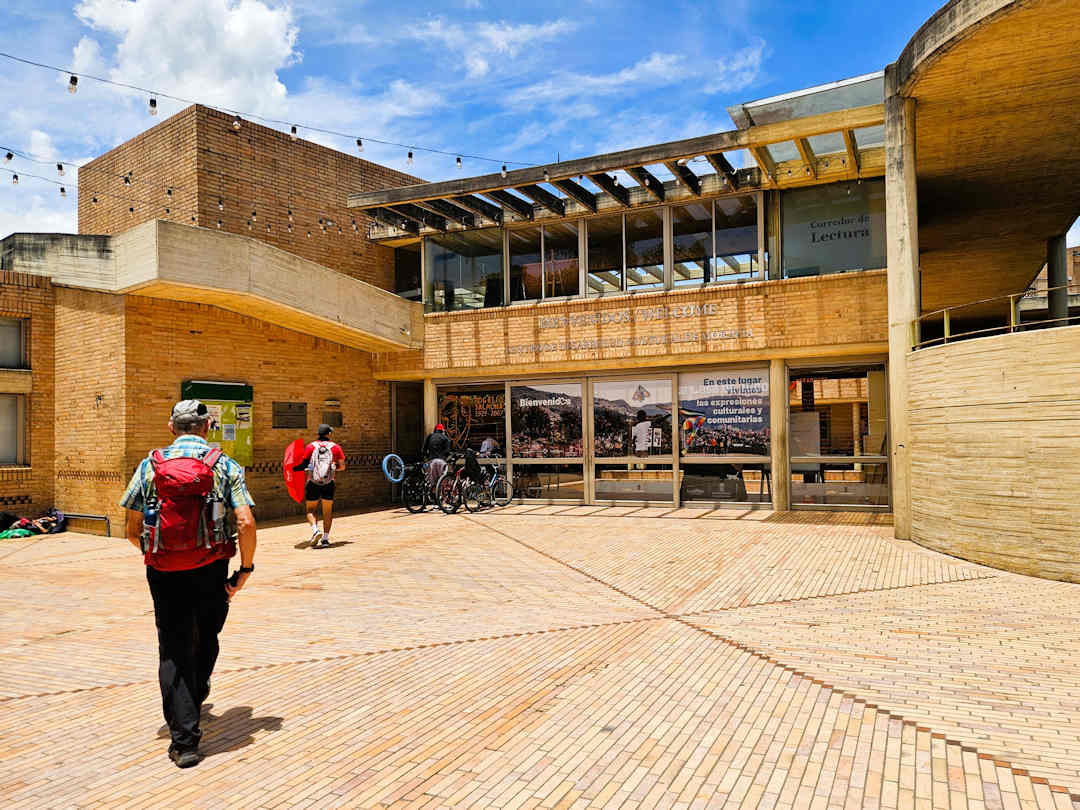
Our Comuna 4 tour finished at the Cultural Development Centre, a short walk away from the Caribe Metro Station and the Jardín Botanico
The tour price includes a bilingual guide from Real City Tours, a (Spanish-speaking) community representative, a simple (vegetarian) lunch and a contribution to community initiatives. Group sizes are kept to a maximum of 8-9 people, so booking a few days in advance is recommended to secure your spot.
The easiest way to book is via Viator or GetYourGuide. In this case, the whole tour payment is processed online.
You can also book directly through the Real City Tours website, though the process is a little more laborious:
• You pay a deposit of 40% of the tour price upon booking (a payment link will be sent to you by Real City Tours).
• The remaining 60% (+VAT if applicable) will be paid in cash at the end of your tour.
Before your tour, you may also need to apply for VAT exemption – simply done by uploading copies of your passport photo page and entry stamp via the link provided.
Is Comuna 4/Moravia safe to visit?
Joining the Comuna 4 walking tour is considered safe. While it’s probably even safe to visit the community on your own, we wouldn’t recommend it:
- You would miss all the insights and stories you hear from your guides.
- Your presence would be less impactful (both to you and the people of Moravia); it could even lead to resentment in the more sensitive areas.
So, please, don’t visit on your own. Join the walking tour instead – you won’t regret it.
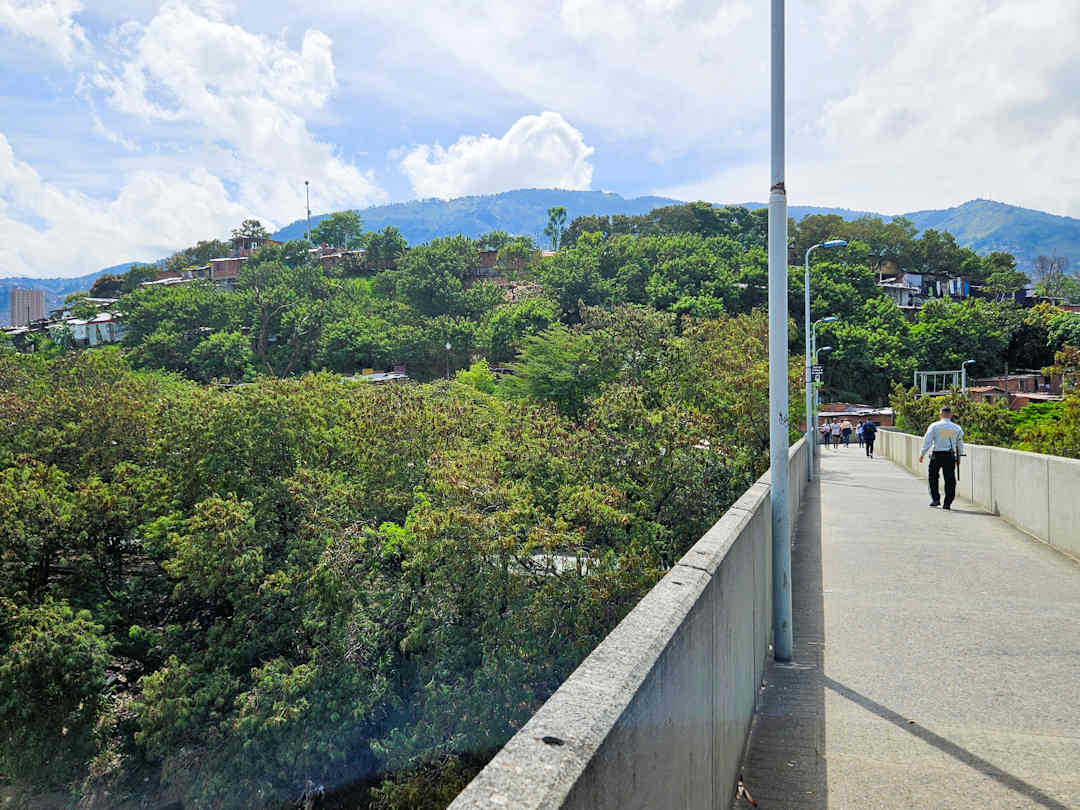
Does this look like a former garbage dump? El Morro is now lush with greenery.
What to bring on the Comuna 4 tour
We recommend wearing comfortable shoes with good traction, as you’ll be walking on a mix of paved streets and uneven surfaces around the neighbourhood. Also, bring some water to keep yourself hydrated. The lunch of empanadas is perfectly timed, and the amount is sufficient to see you through the rest of the tour. But if you get hungry easily, bring a snack. Given that Medellín is known for its (almost) daily bursts of rain, a rain jacket or umbrella is also essential.
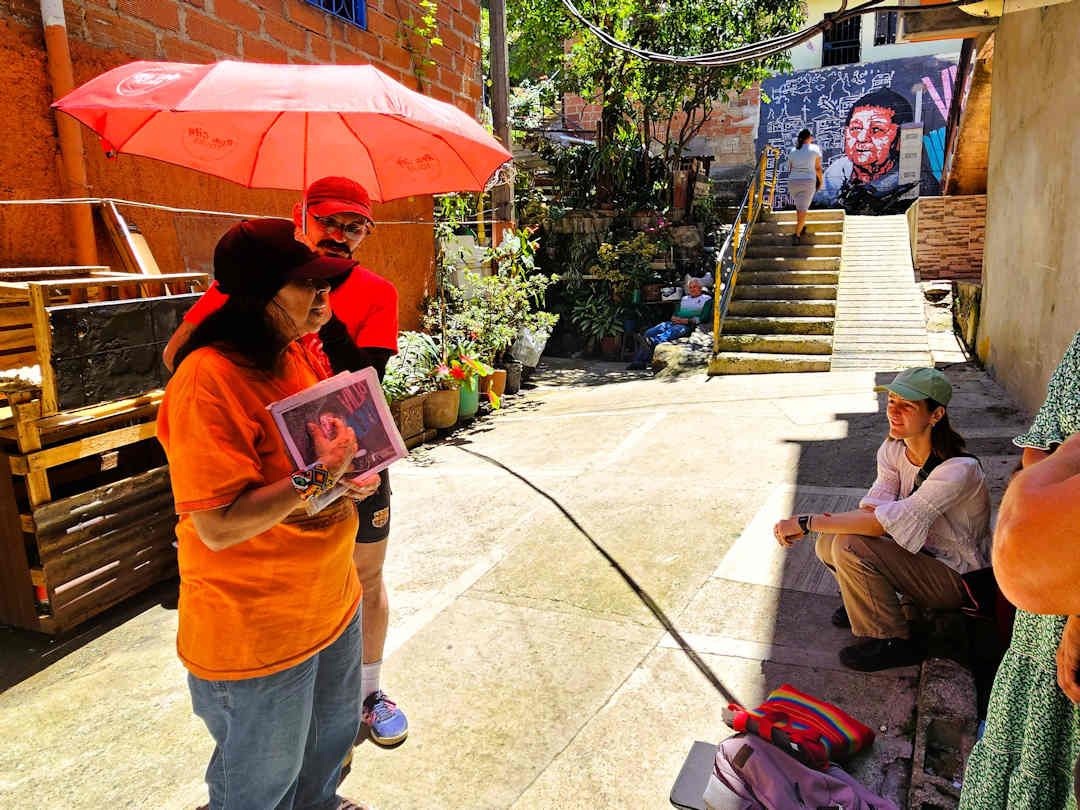
There is not much cover from the elements on this tour - so wear sunscreen and a hat (or bring a rain jacket/umbrella on a rainy day)
Want to learn some Spanish before your trip?
You don’t need fluency to find your way around and connect with locals on your travels. But knowing some Spanish can make everyday situations easier and more meaningful. Busuu offers a structured way to learn the basics of a language before you go, and it’s easy to combine the app with language school studies, too.
Finally, you will also need to bring cash – enough to pay the remaining 60% (+ VAT if applicable) to your tour guide (unless you have already paid online) and to cover any other expenses (for tips, drinks, snacks and souvenirs you might buy during the tour).
How else to support the Moravia community
Part of the income generated from the Barrio Transformation Tour goes directly towards community projects.
You can also donate to the Fundación Oasis Urbano, a German-Colombian community organisation that supports Moravia’s development.
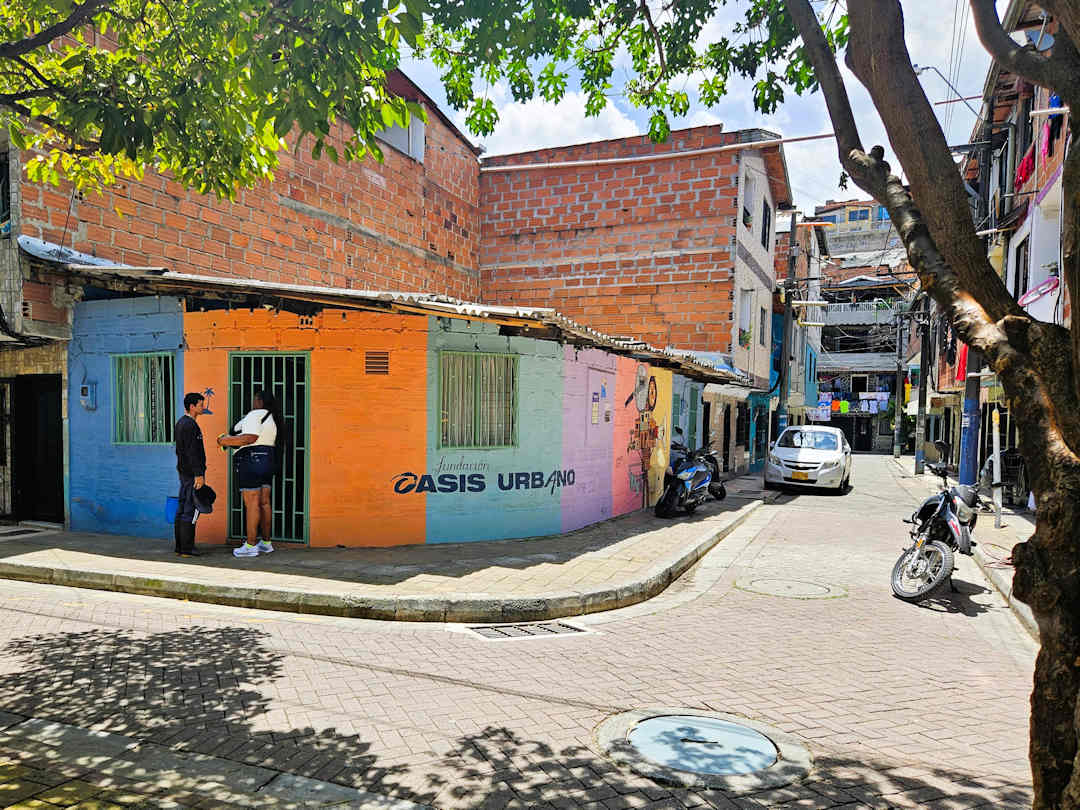
If you want to support Comuna 4 (beyond joining the tour), consider donating your time and/or money to Fundación Oasis Urbano
Ready to join an off-the-beaten path community tour in Medellín?
Still on the fence? Book Real City’s Barrio Transformation Tour or let us know your other questions, and we’ll try our best to answer them.
Before you go, if you liked our article and found it helpful, we would appreciate it if you could share it with your friends and family via the Share buttons below. Even better: Leave a short review on Trustpilot or Google, which would help us further build our online reputation as a (trustworthy and helpful) travel and lifestyle blog.