

This article may contain links to products and services we use and recommend. We may receive compensation when you click on links to those products. For more information, see our Disclosure Policy.

Leaving Italy‘s stall at the 2024 ITB Berlin, the obligatory gelato in hand, another country caught our eyes across the aisle: San Marino. Debating whether San Marino or Liechtenstein was the smaller country, we made a beeline for the stall to settle the matter. Daniela, a staff member of the San Marino Tourism Board, not only answered our question (you’ll find out which country won if you continue reading the article) but also shared a wealth of fascinating insights about San Marino. Her passion for her tiny country was so infectious that we visited San Marino a few months later.
Whether you’re a history enthusiast, a lover of dramatic landscapes, or someone searching for unique travel experiences off the beaten path, our article will cover the best ways to experience this unique destination. It will cover historical and cultural highlights, practical tips, and a tailored multi-day itinerary to help you make the most of your visit.
Are you planning a last-minute trip to San Marino?
Book your transportation to/from San Marino, keeping your carbon footprint in mind:
Find your perfect accommodation in San Marino with Booking.com. We recommend these traditional, small-scale and centrally located options near public transport:
When managing money across countries, we keep fees low and decisions deliberate. We use XE to check exchange rates, Wise to move and spend money internationally, and PocketSmith to track where it all goes.
Buying travel insurance can feel overwhelming. Start by reading our buyer's guide to finding insurance that suits your needs. Then compare options on the Insubuy marketplace (with all the information you need to find the one that's right for you).
Explore the wonders of San Marino and beyond with the best tours and activities powered by Viator. We recommend this Guided Tour of San Marino.
What’s so special about San Marino?
With a mere 61 square kilometres of territory, Serenissima Repubblica di San Marino (Most Serene Republic of San Marino)—as it’s officially known—is Europe’s third smallest country. It ranks just behind the Vatican and Monaco (but ahead of Liechtenstein) and takes fifth place among the world’s tiniest nations.
Established in 301 AD, San Marino is also the oldest republic. It is named after its founder, Marinus, a Dalmatian stone mason (canonised in 1085) who escaped religious persecution under Roman Emperor Diocletian and established a monastery on Monte Titano. While surrounded by Italy and sharing the language with its neighbours, the Sammarinese are a proud and fiercely independent people.

San Marino is named after its founder, Saint Marinus, a stonemason from Dalmatia who fled from religious persecution
Why is San Marino located on Monte Titano? How did this tiny republic manage to remain independent for over 1,700 years? And who are its Captains Regent? The answers reveal themselves as you wander its cobbled streets, explore its ancient towers, and connect with its proud and welcoming locals.

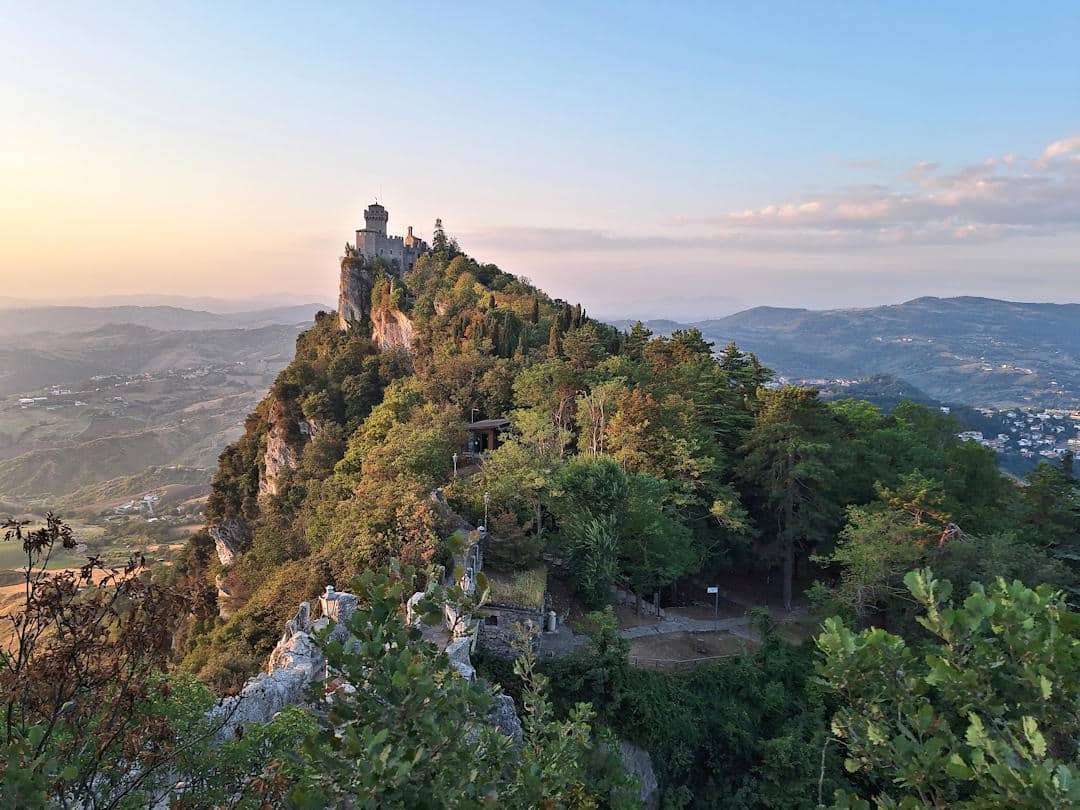
San Marino's Old Town with its three towers on top of Monte Titano and Borgo Maggiore at its foot are UNESCO world heritage sites
Sounds intriguing. How long should I spend in San Marino?
Most visitors to San Marino arrive as day-trippers, often making a brief stop on their way through Italy. While catching a glimpse of the Old Town’s highlights in just a few hours is possible, you’d be experiencing the destination at its busiest. The narrow, cobbled streets can quickly fill with tour groups, and much of San Marino’s unique charm is lost amidst the crowds.
By rushing through, you miss the magic of quiet mornings and evenings when the tourist shops are closed, the streets are empty, and the light is perfect for capturing the historic architecture and stunning scenery. The sunrises over the Adriatic and sunsets over the Apennines are out of this world.

Unless you overnight in San Marino, you'll miss the morning/evening tranquility and stunning sunrises/sunsets from Monte Titano
To truly connect with San Marino’s soul, it’s worth slowing down and staying a little longer. We recommend spending (at least) three nights/two full days here. This allows you to explore the historic sights (without the crowds), enjoy the country’s natural beauty, and experience the Sammarinese way of life without feeling rushed. To help you plan, we’ve crafted a multi-day itinerary with options for all interests.

Day visitors to San Marino also miss the lesser known gems, including the remnants of the old railway between San Marino and Rimini
When is the best time to visit San Marino?
San Marino welcomes visitors year-round, but your experience can vary significantly depending on the season:
- Summers, while popular, can be uncomfortably hot, especially as the Italian peninsula continues to experience rising temperatures (even when we visited in early September, it was scorching). The Old Town is also busiest during this period, making it harder to enjoy its charm.
- Winters, on the other hand, bring cold temperatures (even snow) but are often cloudy, with November being the rainiest month of the year.
Plan your visit for the most pleasant experience in May or mid-September to mid-October. The weather is mild during these times, and you share the tiny republic with far fewer people.

San Marino is a year-round destination, though be prepared for snow if you visit in Winter | Image courtesy of Mark de Jong on unsplash
If a summer visit is unavoidable, visit major attractions early or late. Extend your stay overnight to appreciate the tranquillity that settles in after the day-trippers leave or before they arrive.
To make your visit even more special, check San Marino’s events calendar. We timed our trip to coincide with the Feast of Saint Marinus and the Foundation of the Republic, held on 3 September each year.
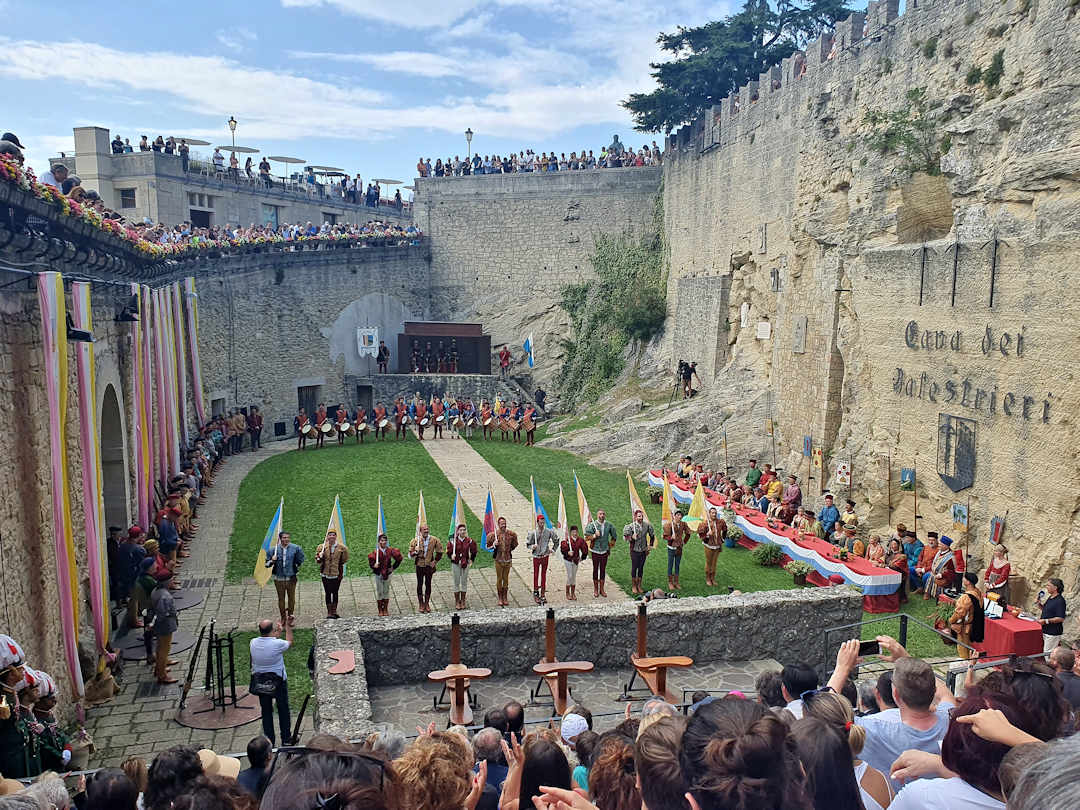
San Marino celebrates its unique heritage with special events throughout the year, including the Feast Days of St Marinus and St Agatha
Map of Accommodation, Points of Interest, Eateries and Transport
Below is a map of the recommended accommodations, points of interest, eateries and transport terminals/stops mentioned in this article.
San Marino multi-day itinerary: How can you best experience and appreciate this unique destination?
Day 1 – History
Begin your day at Porta San Francesco around 09:00. A self-guided audio tour with VoiceMap offers an excellent introduction. Just download the VoiceMap app, purchase the tour for San Marino, enter your code to load it into the library, and you’re ready to go. The tour takes approximately 45 minutes without stops or 2.5 hours with site visits along the route. With only 2km overall, the walk is manageable even for those who are less fit.
During your self-guided tour, visit the Guaita (First) Tower, which opens at 9:30. We spent about an hour and 15 minutes exploring the iconic structure.

The Passo delle Streghe (Witches' Path) connects San Marino's First and Second Towers
While closed to the public, we also recommend the small detour to the Montale (Third) Tower. It only adds about 700 metres/15 minutes overall, but it’s worth seeing all three of the ancient defence structures. You rejoin the tour as you return to the Second Tower.

While not open to the public, the third tower in San Marino is well-worth checking out close up
If the Palazzo is open to visitors (ask a staff member on the ground floor if not sure), do make sure to pop inside. The Sala del Consiglio (Council Hall) is stunning. It’s also worth watching the video on the history of San Marino on the first floor. Depending on the time of year you’re visiting, you may also be able to witness the changing of the guards, which happens hourly from 10:30 to 17:30 from mid-July to mid-September.

The Palazzo Pubblico is not only the seat of San Marino's government; you can also witness the changing of the guards outside
Want a deeper understanding of San Marino’s history and culture?
If you prefer a knowledgeable local to show you around (instead of a narrator on your smartphone), we recommend joining the guided tour at 10:00 and then visiting the towers by yourself. Keep in mind, though, that depending on the season, it may be busier by the time you get to the towers.
After a busy morning of exploration, guaranteed, you’ll have worked up an appetite. For lunch, we recommend Ristorante del Ghetto da Ottavio (closed Tuesdays) [Google Maps] or La Terrazza [Google Maps], with its stunning views and excellent (albeit more upmarket and thus pricey) cuisine.
In the afternoon, visit the Stamp and Coin Museum, right next to the Tourist Information—a great place to learn more about San Marino’s philatelic and numismatic heritage. We are not into stamps or coins, but we found it fascinating and spent about 90 minutes here. It’s one of the must-see attractions in San Marino.

The Stamp and Coin Museum is a must-see when visiting San Marino, even if you're not a collector
During our two-hour experience, Annamaria and Alessandro introduced us to locally produced wines, including two whites, two reds, and a welcome Prosecco, accompanied by delicious boards of cured meats and cheeses, also sourced locally. We spent a lovely evening chatting about San Marino and getting to know our hosts on a more personal level. One of those truly memorable experiences where you arrive as strangers and leave as friends.

We can highly recommend the wine and food tasting at La Cantinetta dello Stradone - a wonderful evening with hosts Annamaria and Alessandro
What is the Tutto San Marino Card, and how can it enhance your visit?
The Tutto San Marino Card is a promotional package created for visitors and provided free of charge by your accommodation in San Marino – ask for it if they don’t give it to you upon check-in. Benefits include:
- Discounted entry to museums: Visit seven state museums for EUR8 (instead of EUR11), including the First and Second Towers, the Palazzo Pubblico, and the Stamp and Coin Museum.
- Savings on private attractions: Enjoy 25% off at private museums, including the Titanus Museum Multimedia Experience.
- Reduced cable car fares: Save on the iconic ride between Borgo Maggiore and the Old Town.
- Shopping and dining discounts: Get 10% off at participating shops and restaurants, including Ristorante Buca San Francesco, a spot we loved so much we dined there twice (without even realising the discount was available).
For more information, check out the Tourism Board website.
Day 2 – Nature and Traditions
San Marino isn’t just a haven for history buffs. It’s also a paradise for nature lovers and those seeking to learn more about its culture and traditions. Avid hikers and mountain bikers will be in their element: Its network of hiking and cycling trails is immense – the Cammino del Titano (loop) hike alone is 44 kilometres long and covers all nine districts of San Marino.
Morning Hike
Don’t worry. We won’t suggest to hike 44km in one day. Instead, we recommend spending your morning doing a 9.5 km intermediate hike that introduces you to the natural beauty and traditions of San Marino.
The trail, taking about four hours and 15 minutes without stops, begins at Porta San Francesco and ends in Borgo Maggiore. Along the way, you’ll explore two scenic trails – the Sentiero di Canepa and Sentiero Gorgascura.

What many visitors don't know: San Marino also has a large network of hiking and cycling trails, including the 44km long Cammino del Titano
- Remnants of the San Marino-Rimini Railway: Walk through the Montale tunnel behind the restored Treno Bianco-Azzurro (White and Blue Train)—which operates on special occasions (for example, Easter, the European Heritage Days and the Christmas of Wonders)—and the Montalbo and Borgo railway tunnels, which were used as air raid shelters during WWII.
- Museo della Civiltà Contadina (Museum of Rural Civilization): Managed by the Consorzio Terra di San Marino (a cooperative of local producers), this small but well-curated museum (EUR3 entry) is open Monday through Friday from 8:30 to 12:30. We spent about 45 minutes exploring the exhibits (explanatory signs are in Italian and English) and chatting to Federica, one of the staff members.
- Natural Wonders and Historic Relics: Pass the waterfalls and old mills of Canepa and Gorgascura and stroll through the charming countryside away from the hustle and bustle of the Old Town.

Located in a restored farmhouse below the Old Town, the Museum of Rural Civilization provides unique insights into Sammarinese life centuries ago
Lunch
Refuel with lunch at Hostaria Da Lino (which serves hearty traditional dishes overlooking Borgo’s Piazza Grande) [Google Maps], or the Funivia Caffè (a relaxed spot with surprisingly delicious street food fare next to the cable car station) [Google Maps].
Afternoon Wine Tasting in Valdragone
While in Borgo, we suggest adding another 3km (one hour without stop) to visit the Cantina San Marino/Consorzio Vini Tipici di San Marino (the local wine growers’ cooperative) [Google Maps]:
- Taste more of the locally grown varieties (there is an excellent brochure explaining the different wines on offer),
- buy a bottle (or a case) of your favourite wine/s and/or
- stock up on some other local produce (more on that below).
You can even fill up your container with the wines on tap.

Sammarinese wines are excellent - You can taste the different varieties right where they're made: at the Consorzio Vini Tipici di San Marino
Afterwards, take a short detour to the nearby viaduct [Google Maps], featuring another restored old San Marino-Rimini railway carriage. From Valdragone, return to Borgo to finish your hike/walk and return to the Old Town via the cable car or the scenic Costa dell’Arnella path.

Remnants of the old Rimini-San Marino railway can be found throughout the republic; among them the restored train carriage on the Valdragone viaduct
What Sammarinese products to bring home (and where to find them)?
Local Specialities
- Tortas Tre Monti and Titano: Delicious (and seriously addictive) filled pastries, handmade since 1942.
- Extra Virgin Olive Oil: Cold pressed from olives that grow between 150 and 450 metres above sea level.
- Sammarinese Wines include whites (including Biancale, Caldese, Ribolla, and Roncale), sparkling varieties, the Moscato-based Oro dei Goti dessert wine, and Reds (including the Sangiovese-based wines Brugneto and Tessano).
- Titanbräu Craft Beer: Brewed since 2010, this beer offers options ranging from Lager and Pale Ale to Wheat Beer and Double Malt.
You can find these products at the Cantina San Marino [Google Maps location], the Museo della Civiltà Contadina [Google Maps location], the Emporio degli Agricoltori Sammarinesi [Google Maps location] and local supermarkets.
Collectors’ Items
San Marino’s (limited-edition) coins and stamps are treasured worldwide. They can be purchased online at the Stamp and Coin Museum shop [Google Maps location].

Tortas Tre Monti and Titano are among the many local products you can take home as souvenirs from San Marino
What else (do we recommend) to see and do in San Marino?
If you’ve got more time (or prefer to swap out some of the items we suggest above), here are some other ideas:
- Museo di Storia Naturale/Natural History Museum [Google Maps]: Located in Borgo Maggiore, this small but well-maintained museum offers free entry and is perfect for travelling with children.
- Titanus Museum Multimedia Experience [Official Website, Google Maps]: While the narration was a bit too fast-paced for us, this establishment provides a good snapshot of San Marino’s unique history with three multimedia presentations.
- Guided eBike or Independent Cycling Tour/s: Join a guided eBike tour of the republic or rent a bike at E-Bike Experience and explore trails like the Ausa Laiala Railway Path.
- Attend a Concert or Performance: Check the schedule at the Teatro Titano to enjoy live music or theatre performances in the heart of the republic.
- Cooking Class at a Local Farm: Learn how to prepare traditional Sammarinese dishes at Podere Lesignano, a family-run farm offering hands-on cooking experiences. While there, we visited the only Shinto shrine in Europe dedicated to the victims of the Great Tohoku Earthquake of 11 March 2011. The farm is accessible by public transport: take the Bonelli bus bound for Rimini to the Strada Paderna roundabout, then walk for 10 minutes.

The Titanus Museum Multimedia Experience provides an excellent, albeit fast-paced, snapshot of San Marino's turbulent history
How do you get to San Marino and get around (without a car)?
San Marino might seem tucked away, but with a bit of planning, getting there is straightforward. Whichever way you come from or mode you take, chances are you’ll travel via Rimini. So, let’s focus on getting you there first.
Getting there
By Plane
The nearest airports to San Marino are:
- Federico Fellini International Airport [Google Maps, IATA code RMI] in Rimini – only 20km north-east of San Marino (and a mere 5km as the crow flies from the centre of Rimini), making it the most convenient option.
- Guglielmo Marconi Airport [Google Maps, IATA Code BLQ] in Bologna and the Ancona Airport Raffaello Sanzio [Google Maps, IATA Code AOI] in Ancona are both about two hours by train from Rimini.
- Venice Marco Polo Airport [Google Maps, IATA Code VCE] – a 3+ hour train ride to Rimini
- Valerio Catullo Airport in Verona [Google Maps, IATA Code VRN] and Milano Malpensa [Google Maps, IATA Code MXP] – both 4+ hours away by train (but the latter usually offers the best airfares).
By Ferry
For travellers from Croatia, Montenegro or Albania, the closest ferry ports to San Marino are Ancona (1+ hour by train/car) and Venice (3+ hours by train/car).
By Train
Rimini FS [Google Maps] is the nearest major railway hub to San Marino. It’s located on the mainline between Bologna and Bari and offers excellent connectivity to other cities like Ancona, Venice, Verona, and Milan. You can book tickets via the Trenitalia website or your usual booking platform/app for train tickets.

Rimini's main train station is the gateway for those travelling to San Marino by public transport | Image courtesy of Wikimedia Commons
Bus from Rimini
Rimini and San Marino once used to be connected by a railway. Unfortunately, after only 12 years of operation, the railway ceased to operate when sections of the track were destroyed during bombings in WWII. While there are discussions to restore the line, it hasn’t happened yet, and the only way to travel from Rimini to San Marino by public transport is to take the Bonelli Bus:
- Where to buy tickets: While booking online is possible via the Bonelli website, don’t bother—it’s first come, first served, even if you book online for a specific time. Purchase your ticket at the Tabaccheria (Tobacco Store) [Google Maps location] opposite Rimini Station (it’s EUR5.50 to Borgo Maggiore or EUR6.00 to the Old Town).
- Where to catch the bus in Rimini: Outside Hotel Napoleon [Google Maps location], a short walk from Rimini Station.
- Where to get off in San Marino: For Borgo Maggiore, alight at Parcheggio Pubblico Adiacente Nuova Rupe [Google Maps location]. On your return, board at Caffè Forcellini 2.0 [Google Maps location]. For the Old Town, remain on board until the final stop at Parcheggio 2 Bus San Marino [Google Maps location].

The bus from Rimini to San Marino departs outside the Hotel Napoleon a short walk from the train station
By Car
We don’t recommend travelling to San Marino by car, but if you’re doing a road trip from anywhere in Europe or prefer renting a vehicle once you’re off the plane, keep these tips in mind:
- Roads: Expect winding roads and impatient local drivers who often overtake in tight spaces or honk at slower drivers.
- Old Town Access: Most Old Town is car-free, and the streets are narrow.
- Parking: If your Old Town accommodation lacks parking, use one of the large paid lots on the Old Town’s outskirts or in Borgo Maggiore.
Getting around San Marino
Cable car
One of the quickest and most scenic ways to travel between Borgo Maggiore (at the foot of Monte Titano) and the Il Cantone Viewpoint (at the northern end of the Old Town) is by cable car. The journey takes just two minutes and offers stunning birds-eye views of Borgo and the Adriatic coast.
- Operating Hours: Starting at 07:45, closing times vary by season.
- Frequency: Every 15 minutes.
Check the official website for schedules and maintenance closures.

The cable car connects San Marino's Old Town at the top of Monte Titano with Borgo Maggiore at the foot of the mountain
Local buses
San Marino’s nine castelli (districts) are well connected to the Old Town via public buses. Route information and timetables are available on the official website. While convenient for residents and travellers staying further away, if you’re based in Borgo Maggiore or the Old Town, you likely won’t need the local buses.
On foot
The Old Town and Borgo Maggiore are best explored on foot. The Old Town, located atop the Monte Titano Massif, features winding streets and staircases connecting the various levels. Walking here is not only practical but also a delightful way to soak in the history and atmosphere. Borgo Maggiore is a smaller, quieter version of the Old Town at the foot of the mountain.
For a scenic route between the two (and an alternative to the cable car), take the Costa dell’Arnella Path [Google Maps location]. This path connects Borgo Maggiore with the Old Town via the historic Porta della Rupe gate.

A picturesque alternative to the cable car is the Costa dell’Arnella Path
Where best to stay in San Marino?
For an immersive and sustainable experience (and ideal for those relying on public transport), we recommend staying in locally owned properties in either the Old Town or Borgo Maggiore:
| Name | Property Features | Location | Book Now |
|---|---|---|---|
| Antica Bifora | Striking 90sqm guest suite with period furnishings in a 14th century villa next to the Palazzo Pubblico, accommodating up to 5 people, a generous breakfast is included | Old Town | Book Now |
| B and B Da Noi | Fully equipped one bedroom apartment accommodating up to 4 people, free onsite parking, within walking distance of the cable car station | Borgo Maggiore | Book Now |
| Casa Cicetta | Small hotel below the First Tower with a variety of options (from double rooms with ensuite and kitchenette to fully-equipped two-bedroom apartments accommodating up to 5 guests) | Old Town | Book Now |
| La Grotta Hotel | 3-Star hotel opposite the Titano Museum with double, triple and quadruple rooms, a generous breakfast is included, subsidised parking deal with P6 available | Old Town | Book Now |

Especially to those who come to San Marino without a car, we recommend to stay in the Old Town or Borgo Maggiore
Stay connected the moment you land
We use Airalo eSIMs on (almost) every trip to avoid roaming charges and the hassle of buying a local SIM. You can install your eSIM before you travel and get online as soon as you arrive. Airalo works in 200+ countries (we've used it across the Americas, Europe and Asia), but not everywhere - so check coverage before you buy.
New to Airalo? Use code NEWTOAIRALO15 for 15% off
Already a customer? Use AIRALOESIM10 for 10% off
Where (and what) should you eat in San Marino?
San Marino has a wealth of (locally owned) restaurants. Here are those we can recommend:
Old Town
- Ristorante Buca San Francesco [Google Maps]: Situated at the gate of the same name, this cosy restaurant serves homemade pasta made with fresh, local ingredients. Show your Tutto San Marino Card for a 10% discount on the à la carte menu.
- Ristorante Bolognese [Google Maps]: Situated next door to/above Buca San Francesco, this spot is always bustling in the evenings but is worth the (short) wait for its delicious regional dishes.
- Ristorante del Ghetto da Ottavio [Google Maps]: A fantastic option for hearty, authentic meals in a welcoming atmosphere. On a hot day, head upstairs for the air-conditioned dining room.
- La Terrazza [Google Maps]: The restaurant with the best views in San Marino, ideal for a romantic night out with your loved one/s. Expect beautifully presented dishes with a contemporary twist on the country’s traditional cuisine.

Part of the Hotel Titano, La Terrazza must be the restaurant with the best views in San Marino
Borgo Maggiore
- Hostaria Da Lino [Google Maps]: A must-visit for traditional, home-cooked meals.
- Time Off [Google Maps]: Overlooking Piazza Grande, this charming bar is perfect for an aperitivo or a relaxed evening with surprisingly delicious food.
- Funivia Caffè [Google Maps]: Known for its street-food-style dishes, including fantastic burgers made with local ingredients.
- L’Angela Veste Piada [Google Maps]: The best place for deliciously wholesome and affordable piadine.

Enjoy an aperitivo with a view, at Time Off overlooking the Piazza Grande in Borgo Maggiore
Local Specialities
San Marino’s traditional dishes reflect its deep historical connection with its neighbours, especially Italy‘s region of Emiglia-Romagna, its northern neighbour. Made with fresh, regionally sourced ingredients, be sure to try:
- Strozzapreti: A hand-rolled pasta, traditionally served with rich, meaty sauces (but also delicious ai funghi/with mushrooms as served at Buca San Francesco).
- Passatelli: A unique pasta made from breadcrumbs, eggs and cheese, served in broth.
- Piadina: A flatbread that’s perfect when filled with local cheeses, cured meats or grilled vegetables.
- Bustrengo: A dense and flavourful fruitcake made with polenta and traditionally prepared during the festive season in December.

Usually served with a meaty sauce, Strozzapreti, a local pasta variety, are also delicious ai funghi/with mushrooms
I prefer to self-cater. Are there any supermarkets in San Marino?
With its various restaurant options, you could dine out for every meal, but we know it’s not feasible or desired by everyone (us included). If you prefer to self-cater during your stay, there are two small but well-stocked supermarkets conveniently located near the accommodation options we recommend:
- Borgo Maggiore: La Sociale [Google Maps]
- Old Town: Alimentari Chiaruzzi [Google Maps].

Local products are stocked by supermarkets and dedicated stores in San Marino, like the Emporio degli Agricoltori Sammarinesi in the Old Town
What else is essential to know when visiting San Marino?
To make the most of your visit and ensure you respect local customs, here are some key things to know about San Marino:
- Entry: San Marino is not a member of the European Union but part of the Schengen Area, so you won’t encounter border checks when travelling between San Marino and Italy.
- Currency: San Marino uses the Euro (EUR), and collectors highly prize the Sammarinese coin sets.
- Water Quality: San Marino’s tap water is safe to drink, so there’s no need to buy bottled water. Pack your reusable water bottle instead and fill it up as needed. Water fountains are in different spots around town (including the walkway between the First and Second Towers).
- Awareness: If you don’t know it by now, San Marino is NOT part of Italy, and Sammarinese deeply value their heritage and independence. Misunderstanding its history or dismissing its cultural identity could cause unintended offence, so be mindful and respectful.

Tap water in San Marino is potable, and you can find water fountains in many places - just bring your refillable water bottle to stay hydrated
Before you go, if you liked our article and found it helpful, we would appreciate it if you could share it with your friends and family via the Share buttons below. Even better: Leave a short review on Trustpilot or Google, which would help us further build our online reputation as a (trustworthy and helpful) travel and lifestyle blog.