

This article may contain links to products and services we use and recommend. We may receive compensation when you click on links to those products. For more information, see our Disclosure Policy.
So, what did we do? We got ourselves a light-weight, on-the-go water treatment kit – which sounds easier than it was (but I guess that’s precisely the reason why you’re here). I did a ton of research before assembling our kit, and I share all my learnings (in layman’s terms) in this buyer’s guide.
What could be lurking in your drinking water?
If you’ve ever scooped up water from a river, mountain stream or even a seemingly pristine lake, you might assume it’s safe to drink. But natural water sources – even those that look clear – can contain a mix of contaminants, including:
- Bacteria (for example, E.coli, Salmonella)
- Parasites/Protozoa (for example, Giardia, Cryptosporidium)
- Viruses (for example, Hepatitis A, Norovirus)
- Microplastics
- Heavy Metals (for example, lead) and Chemicals (for example, pesticides)
- Turbidity (caused by sediments, organic matter and microorganisms).
Whether you’re planning a multi-day trek or want to stay safe while travelling in places where tap water isn’t drinkable, choosing the right water treatment solution is a key decision that could impact the outcome of your trip.

Unsafe drinking water can lead to health issues with potentially significant impact on your trip (and even your life afterwards)
What water treatments exist?
Many travellers (including us at first) assume that using a filter makes any water source safe to drink, but that’s not always the case. While filtration may remove contaminants, purification neutralises harmful microorganisms. Both have their place when making water safe to drink, and understanding the difference can prevent serious health issues on the road. So, let’s dive into each in a bit more detail.
Water filtration removes contaminants
Water filters physically trap harmful substances, but their effectiveness depends on the type of filter. Standard filtration methods include:
- Membrane Filters remove bacteria, parasites, and microplastics (but not viruses, chemicals, or heavy metals) by forcing water through microscopic pores. The lower the micron (µm) number, the more effective the filter—more on that below.
- Activated Carbon Filters remove chemicals and heavy metals as they attach to the highly porous and ginormous surface area of the carbon material. While they improve the taste of your water, they do not eliminate bacteria, parasites, or viruses.
- Electro-adsorption filters: These filters use an electrical charge to capture bacteria, parasites, microplastics, chemicals, and heavy metals. While some also claim to remove viruses, independent tests show they are not consistently effective.
Water purification neutralises microorganisms
Purification methods kill or deactivate microorganisms by affecting their DNA. Standard water purification methods include:
- Heat: Boiling water for at least one minute (3 minutes above 6,500 feet/2,000 metres) kills bacteria, parasites and viruses.
- UV-C Light: Short-wave UV light damages the DNA in bacteria, parasites, and viruses. It is a fast method but only effective in clear water.
- Chemical Disinfectants: These kill bacteria and viruses but require 10-30 minutes (sometimes longer) to be effective.
Still confused? Don’t worry. Here is a nice (high-level) chart of the different water treatment methods created by the Centers for Disease Control and Prevention:

Water treatment comparison chart | Source: Centers for Disease Control and Prevention
How to ensure there are no nasties in your drinking water
While water filtration (and some purification methods) alone is ineffective at removing all contaminants in your drinking water, combining filtration and purification provides the highest level of protection. You could use
- a ready-made all-in-one water treatment device (for example, the RapidPure Purifier+ Multi-Use POD System) or
- a membrane filter (to remove most contaminants), and then boil or treat your water with disinfectant or UV-C light.
Whichever one you choose, if you want to remove cryptosporidium, your membrane filter must be rated 0.1µm (or lower).
Visiting an urban area and not sure if your drinking water is safe?
If you’re in the United States, check the Environmental Working Group (EWG) website with its handy ZIP code checker. When travelling elsewhere, check the FaucetSafe app OR ask your accommodation host.
What should you look for when buying a water treatment device/system?
As mentioned, the type and µm of your water filter of choice determine its effectiveness at removing nasties. The efficiency of water filtration devices against (biological) contaminants is measured against guidelines issued by the US Environmental Protection Agency (EPA). To be considered adequate, your device needs to have the following (independently assessed) ratings:
- Parasites/Protozoa – minimum 3 logs (99.9%) – though if filtering water from stagnant water holes, you’d want to have 6+ logs;
- Viruses – minimum 4 logs (99.99%);
- Bacteria – minimum 6 logs (99.9999%).
I always thought the digits after the decimal don’t matter (they all round up to 100%, right?). Yeah, Nah. When it comes to water quality, every single number after the decimal point counts. This video by GearSkeptic opened my eyes (nerd alert).

On a backcountry hike, you never know what water sources you may find - Play it safe and pay attention to the efficiency rating of your treatment solution
How do water treatment solutions compare?
Below, we break down the most popular lightweight water filtration and purification options on the market, comparing key elements, including effectiveness, weight/dimensions and sustainability considerations, to help you decide the right one for your needs.
Bottles with Inbuilt Filtration
These allow you to drink straight from the bottle, filtering contaminants as the water passes through. They are great for solo travellers on hikes with reliably frequent water sources.


Both brands publish high removal rates based on their own testing (for example, Water-to-Go reports up to 99.97% virus reduction), but these figures are not always directly comparable across manufacturers or test conditions.
In practical terms, these bottles are best suited to travel where water quality is uncertain, but sources are frequent—such as urban environments, day hikes, or destinations with inconsistent tap water.
We haven’t used Water-to-Go ourselves, so we don’t treat it as a primary recommendation. If you’re comparing options like these, focus less on headline percentages and more on:
- the reliability of your water source
- whether virus protection is genuinely needed
- ease of use, cleaning, and long-term durability.

Bottles with inbuilt water filtration are a great option for solo travellers on hikes with reliably frequent water sources | Photo by Ryan Farid on Unsplash
Inline Filtration (Gravity and Squeeze) Systems
Inline filtration connects dirty and clean water carriers, filtering water through gravity (or by squeezing it through the filter). These are useful for treating larger volumes of water at once and are great for multiple people on multi-day hikes, where the frequency and quality of water sources are uncertain.


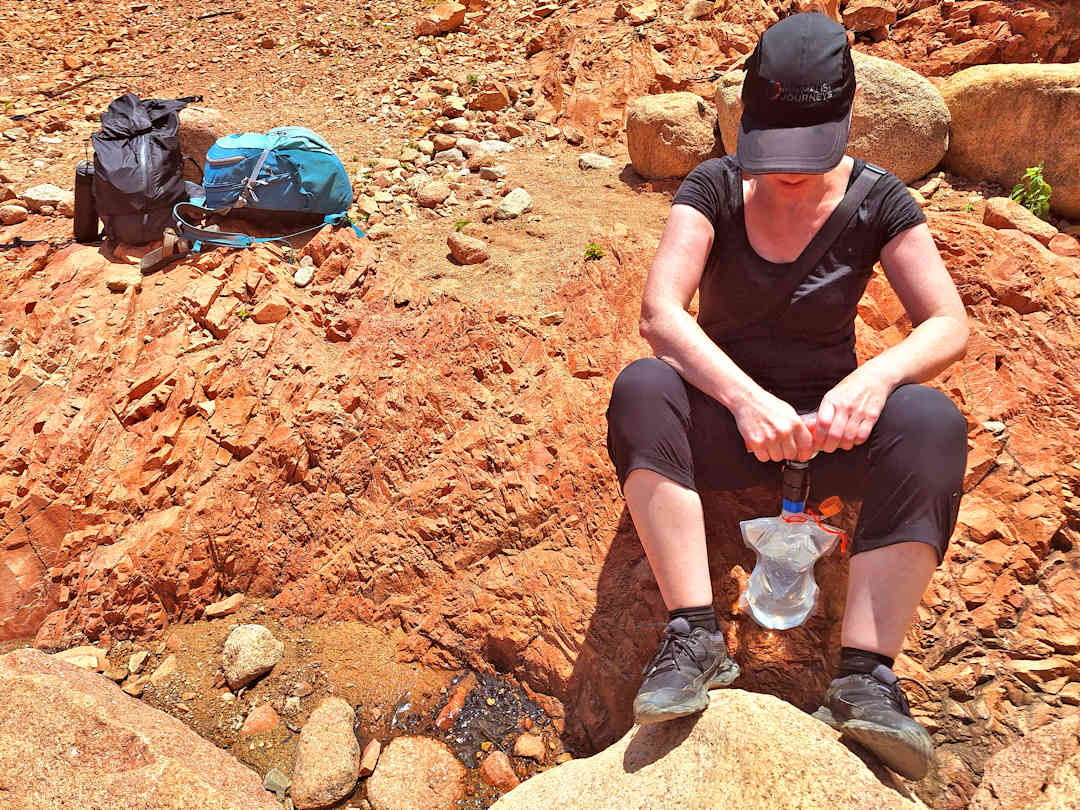
Inline filtration connects dirty and clean water carriers, filtering water through gravity (or squeezing it through the filter).
Water Purification Options
Water filtration removes bacteria and parasites, but not all filters eliminate viruses. Likewise, heat, UV-C light and chemical disinfectants do not remove debris; thus, use your water filtration system first.
All chemical disinfectants leave a taste of the chemical used. While LifeSystems states in their marketing material that Chlorine Dioxide is tasteless, we found that it still has a chlorine taste. Taste neutralisers are available (or you can create your own by dropping a clean slice of lemon into your filtered and treated water).


We created our own inline filtration system from reliable components to be able to process and store more water at once
What water treatment kit do we use (and why)?
To be useful in Socotra, Patagonia and any other destination with questionable water quality, our water treatment kit must:
- Remove as many contaminants as possible
- Ensure the water tastes okay (ideally without any overwhelming chlorine or funky organic taste)
- Allow us to fill multiple bottles and provide water for the camp kitchen
- Be BPA-free, long-lasting and low-waste
- Be super lightweight and compact
- Be easy to use and clean
- Be compatible with standard 28mm water bottles, and
- Be affordable.
- the Sawyer Micro Squeeze Filter (62g);
- a CNOC Outdoors Vecto 1L Water Container (71g);
- an Evernew 1.5L Water Carrier (36g);
- Lifesystems Chlorine Dioxide Tablets (20g); and
- a medium-sized Alpkit Apollo drawstring bag (11g).
Weighing a mere 200g in total, this system allows us to:
- collect and store 1 litre of unfiltered water in the CNOC Vecto;
- store 1.5 litres of filtered and treated water in the Evernew; and
- carry 800ml in our Klean Kanteen water bottle (after filtration and purification).
During our hike in Socotra, we also regularly (re)filled multiple spare 500ml (single-use) water bottles with filtered and treated water, reducing our group’s plastic waste (and the weight our camel had to carry).
The waiting time and light chlorine taste of the chlorine dioxide tablets are the only drawbacks of our DIY system – a small trade-off we’re happy with.
- With a 0.1µm pore size, the Sawyer Micro Squeeze is one of the most effective filters against bacteria and parasites. Since we weren’t sure what kind of water sources we’d encounter in Socotra, we wanted to play it safe.
- If backflushed regularly, the Sawyer Micro Squeeze can filter up to 100,000 gallons, making it a highly cost-effective and environmentally friendly option.
- Hiking in remote areas means we are less concerned about industrial/agricultural runoff; thus, the ability to remove heavy metals or chemicals wasn’t a high priority for us.
- Easy to fill from natural water sources like streams and lakes;
- Lightweight but durable; and
- Compatible with the Sawyer Micro Squeeze.
We went with the CNOC Vecto and Evernew water carrier instead of Sawyer‘s proprietary pouches because:
- The CNOC Vecto has a full-width opening (like a zipper bag), which makes scooping up water much easier than a standard bottle opening.
- The CNOC Vecto can be hung up (to let gravity do its work) or rolled up (to squeeze water through the filter).
- We were a little worried about the CNOC Vecto‘s closing mechanism failing and water leaking into our backpack, but so far, it’s been holding up well.
- The carrier included with the Sawyer Micro Squeeze can only hold 0.9 litres, while the Evernew water carrier gives us 1.5 litres of storage – necessary when you don’t know how far the next water source is.
- The Evernew water carrier is known to be more durable than Sawyer‘s proprietary pouches.
- Lastly, the CNOC Vecto and the Evernew water carrier are compatible with the 28mm Sawyer filter thread.

On shorter hikes, we can reduce our treatment kit by leaving the Evernew water carrier at home (and filling our Klean Kanteen water bottle straight from the filter)
How to keep your water treatment kit in good shape?
Water treatment devices are not cheap, but you can keep your kit in top condition by doing a few simple things:
- Let your kit air out: After each use, we shake out any remaining water, dry all components, and store them in a breathable pouch. Avoid storing your system in a plastic zip-lock bag, as moisture gets trapped inside, creating the perfect environment for mould and bacteria to thrive.
- Backwash regularly: Over time, you will notice the flow rate of your filter reducing. So, whenever we have access to clean water, we backwash our filter – by attaching our clean water carrier (filled with clean water) to the clean side of the filter and squeezing water backwards through the filter until all the gunk is flushed out.
- Deep clean after every trip: We thoroughly clean our water carriers after every trip, using dish soap, vinegar, or bicarbonate of soda. This removes any lingering contaminants, mineral buildup, or biofilm. After washing, we air-dry all components before packing them into their storage bag/breathable pouch.

How do you ensure you've got enough safe drinking water on your (multi-day) hikes?
Before you go, if you liked our article and found it helpful, we would appreciate it if you could share it with your friends and family via the Share buttons below. Even better: Leave a short review on Trustpilot or Google, which would help us further build our online reputation as a (trustworthy and helpful) travel and lifestyle blog.