

This article may contain links to products and services we use and recommend. We may receive compensation when you click on links to those products. For more information, see our Disclosure Policy.

Teotihuacan is one of Mexico’s most iconic archaeological sites. Most visitors tackle the site on a day trip from Mexico City. While doable, we recommend taking your time and staying overnight, as there is much to see and information to process. While organised day tours include a professional guide, we prefer not to be herded from site to site. We meander and take it all in slowly, supplementing what we read on the signs with information from research papers and documentaries.
If you, too, prefer to explore Teotihuacan independently and without a car, our guide covers everything you need to know: how to get to Teotihuacan by public transport, where to stay and, most importantly, how to explore Teotihuacan most efficiently.
Are you planning a last-minute trip to Teotihuacan?
Book your transportation to/from and around Teotihuacan, keeping your carbon footprint in mind:
Find your perfect accommodation in Teotihuacan with Booking.com. We recommend these traditional, small-scale and centrally located options near public transport:
When managing money across countries, we keep fees low and decisions deliberate. We use XE to check exchange rates, Wise to move and spend money internationally, and PocketSmith to track where it all goes.
Buying travel insurance can feel overwhelming. Start by reading our buyer's guide to finding insurance that suits your needs. Then compare options on the Insubuy marketplace (with all the information you need to find the one that's right for you).
Explore the wonders of Teotihuacan and beyond with these recommended tours and activities:
What and where is Teotihuacan?
Teotihuacan (correctly spelt Teotihuacán) is a pre-Colombian archaeological site located approximately 50 kilometres northeast of Mexico City. Famous for its monumental pyramids – especially the Pyramid of the Sun and the Pyramid of the Moon – this ancient city was once among the largest in the Americas, thriving between the 1st and 7th centuries AD.
Teotihuacan’s historical significance lies in its influence on later Mesoamerican cultures, including the Aztecs, who named the city – Teotihuacán means Where one becomes a God (often also stated as the City of the Gods). Recognised as a UNESCO World Heritage site in 1987, its vast urban layout, impressive ceremonial structures and well-preserved murals provide deep insight into ancient pre-Hispanic civilisations.
If you want to learn more about Teotihuacan’s history (and some of the unsolved mysteries), I recommend watching this insightful documentary: Ancient Americas – Teotihuacan: Where One Becomes a God.
Why stay in Teotihuacan (rather than visit on a day trip from Mexico City)?
Staying overnight in Teotihuacan offers both practical advantages and sustainability benefits:
- Early morning or late afternoon access: Exploring the site from opening time (08:00) or later in the afternoon (after 14:00) allows you to experience the site without the day-tripper crowds from Mexico City.
- Flexibility to explore at your own pace: If you stay locally, you can easily take a midday break to rest or escape the heat, returning refreshed later in the afternoon. Retain your entrance ticket, which you’ll also need to access sites outside the main archaeological zone (more on those below).
- Direct economic benefit to local communities: If you stay overnight, you support the local economy (more than any day-tripper) by staying in family-run accommodations, dining at locally owned eateries, and participating in experiences organised by local providers.

Staying at Teotihuacan allows you to access the site early/late (or take a break in between) and support the local community | Image courtesy of Juliana Barquero on Unsplash
How do you get to Teotihuacan (without a car)?
Step 1: Getting to Central del Norte
Buses for Teotihuacan leave from Central del Norte [Google Maps location], Mexico City’s Northern Bus Terminal.
The capital is enormous, and streets can become very congested with traffic. Thus, the easiest (and fastest) way to reach Central del Norte is by using the city’s efficient metro system. Metro line 5 has a station outside Central del Norte. If you arrive at Terminal 1 of the Benito Juárez International Airport [IATA: MEX], you don’t need to change metro lines.
To use the metro system, you must purchase an Integrated Mobility Card (Tarjeta de Movilidad Integrada) and load it with MXN5 per trip. The card itself costs MXN5. You can do this in person at the counter or on the machines in the metro stations.
Tip If you are travelling as a couple (or two friends, parent and child, etc.), you only need one card between the two of you.
Upon arrival at Central del Norte, use the underground walkway to safely cross the road and enter Central del Norte.
If you’re hungry before your bus ride, stop by Los Tres Mostaqueros [Google Maps location], centrally within Central del Norte’s main hall. This eatery offers hearty, delicious and affordable meals, plus friendly and efficient service – quite uncommon for a bus station.

Using Mexico City's efficient metro system requires an Integrated Mobility Card (Tarjeta de Movilidad Integrada), which you can buy at any metro station
Step 2: Travel from Central del Norte to Teotihuacan
Once inside Central del Norte, turn left and walk towards Exit 8 at the far end of the terminal hall. Just before Exit 8, you will find the ticket counter for Autobuses Teotihuacanos [Google Maps location]. Here, purchase your one-way ticket for MXN69 per person. You can buy your return ticket directly onboard using cash.
After purchasing your ticket, exit through door 8 and find your bus on the outside platforms. Buses for Teotihuacan depart approximately every 15 minutes, with the journey to Teotihuacan taking about an hour, pending traffic. Your bus will first travel through San Juan Teotihuacán (shortened to San Juan), then pass Gate 2 of the archaeological site [Google Maps location], before continuing to its final stop at the Central de Autobuses Teotihuacanos in San Martín de las Pirámides [Google Maps location].
Tip On your return to Central del Norte, the bus stop closest to Gate 2 is identified by an easy-to-miss sign on the fence across the road [Google Maps location]. Alternatively, you can take the bus from the Terminal in San Martín de las Pirámides [Google Maps location] or from the main bus stop in San Juan Teotihuacán [Google Maps location].

Public buses to Teotihuacan depart from Central del Norte, Mexico City's Northern Bus Terminal
Where to base yourself in Teotihuacan?
Ancient Teotihuacan is surrounded by several small, modern-day towns:
- San Juan Teotihuacán lies west of the archaeological zone and has the most extensive services and amenities.
- San Martín de las Pirámides, north of the archaeological site, is smaller but provides a local experience with easy site access.
- San Francisco Mazapa and San Sebastián Xolalpa are small towns on the east and southeast of the main site.
Based on proximity to the Main Archaeological Zone and accessibility by public transport, we recommend these accommodation options:
| Name | Property Features | Price Indicator | Book Now |
|---|---|---|---|
| Hotel Cantera Jaguar | Located at the centre of San Juan Teotihuacán requiring a short ride by local bus or Uber | $$ | Book Now |
| La Finca del Abuelo Teotihuacan | Located at edge of San Juan Teotihuacán within walking distance to Gates 1-3. | $$ | Book Now |
| Posada Huitzilin Teotihuacan | Located at the centre of San Martín de las Pirámides requiring a short ride by local bus or Uber | $$ | Book Now |
If you choose La Finca del Abuelo, be aware that dining options nearby are limited. Consider bringing snacks from Mexico City (bananas, muesli bars and/or pastries). Alternatively, hop off the bus in San Juan Teotihuacán, visit Mercado Hidalgo [Google Maps location], and then take a short Uber ride to your accommodation.

If you want to stay near the Teotihuacan archaeological site, we recommend to base yourself in San Juan or San Martín | Image courtesy of Wikimedia Commons
How to explore Teotihuacan most efficiently?
Teotihuacan is a massive site with lots to see, but not much shade. Thus, it’s essential to be strategic in your exploration approach to avoid backtracking. Even with careful planning, following our self-guided itinerary/route, expect to walk at least 7 km (not including the distance between your accommodation and Gates 1/3). Download the GPX file to import into Garmin, Strava, etc.
Begin your day early—the archaeological site is open from 08:00 to 17:00 and the museums from 09:00 to 16:30. Arriving at the archaeological site when it opens means you’ll have a quieter experience for a few hours (until the day trippers arrive from Mexico City).
Tip If you are joining the GuruWalk Tour, do the itinerary in reverse, leaving the two sites outside the main archaeological zone for the afternoon.

To explore Teotihuacan's main archaeological site without backtracking, enter through Gate 1 and exit through Gate 3 (or reverse)
Main Archaeological Zone
Enter through Gate 1 [Google Maps location], buy your ticket at the counter (MXN100 per adult), then continue walking straight ahead (East).
The Citadel and Temple of Quetzalcoatl
The first main site you’ll reach is the Citadel/La Ciudadela, an enormous ceremonial plaza, measuring around 400 meters per side, surrounded by numerous stepped platforms. Its central feature is the Temple of the Feathered Serpent/Templo de Quetzalcóatl [Google Maps location], built around 200 AD. The temple has intricate, still partially coloured stone carvings of feathered serpents and Tlaloc (the rain/water god), which are best admired from the platform/adosada in front of the temple. Archaeologists discovered numerous sacrificial burials underneath the temple, confirming its religious and ceremonial importance to the city’s residents.

The Temple of Quetzalcoatl is adorned with stone carvings of feathered serpents and Tlaloc (the rain/water god) - best admired from the viewing platform in front of it
Avenue of the Dead
After admiring the Temple of Quetzalcóatl, return to the main thoroughfare you crossed before entering the Citadel and turn right, facing North.
About 40 metres wide, the Avenue of the Dead/Calzada de los Muertos extends all the way to the Pyramid of the Moon in the distance. Flanked by temple platforms, residential complexes and palaces, the avenue played a key role in the civic life of the Teotihuacanos. It was often used for processions (imagine thousands of people marching along the avenue to the Pyramid of the Moon to witness ritual sacrifices to appease the gods).
The southern part of the avenue (until you reach the Pyramid of the Sun) is not a flat road by the way, but segmented into sections by staircases and narrow terraces (not unlike the citadel you just visited).

Flanked by temple platforms, the Avenue of the Dead stretches for several kilometres south to north, all the way to the Pyramid of the Moon
Western Plaza
Adjacent to and about halfway along the Avenue of the Dead, the Western Plaza/Plaza Oeste is a complex that features various residential and ceremonial structures. These structures surround a large central plaza with three pyramidal bases (to the North, South, and West) that look down onto an altar in the middle of the plaza. This complex provides valuable insight into everyday life and administrative practices in Teotihuacan. Excavations have also revealed various layers of construction, identifying different periods in Teotihuacan’s history.

Excavations at the Western Plaza revealed different building stages: an earlier platform with serpent heads was covered, and the carvings replaced by jaguar heads
Museum of Teotihuacan Culture
The Museum of Teotihuacan Culture/Museo de la Cultura Teotihuacana provides essential background information on Teotihuacan’s history, so don’t skip it. Exhibits talk about the urban planning and different phases of the development of Teotihuacan, the social and economic context in which the Teotihuacanos lived, their religious and burial practices, and so much more.
The museum displays comprise a large-scale model of the ancient city and artefacts such as pottery, obsidian tools, jade ornaments and figurines from various stages of Teotihuacan’s history.

Exhibits at the Museum of Teotihuacan Culture include this large statue/altar of the fire god Xiuhtecuhtli
Tip If you’re hungry, thirsty, or need a bathroom break, there are toilet facilities, vending machines and picnic tables between the museum and Gate 5.
Just before gate 5, turn left. Walk along the path and through the wall opening [Google Maps location]; then turn left again (facing west). The Pyramid of the Sun/Pirámide del Sol is now towering above you on your right. Keep walking westwards along its southern perimeter.
Pyramid of the Sun
The Pyramid of the Sun/Pirámide del Sol, completed around 200 AD, is the largest structure in Teotihuacan and one of the largest pyramids in the Americas. It measures about 225 meters per side at its base and is almost 70 meters high. Its exact function remains uncertain, but archaeological evidence suggests it was a significant religious and ceremonial structure once surrounded by water. It may have been dedicated to the rain/water god Tlaloc or the fire god Xiuhtecuhtli.
While climbing the pyramid is no longer permitted for conservation reasons, its scale and impressive architecture remain a testament to Teotihuacan’s engineering capabilities. Admire the pyramid from its Western side (Square of the Sun/Plaza del Sol – Google Maps location), then return to the Avenue of the Dead and continue your walk north.

No longer accessible to visitors, the Pyramid of the Sun is the largest structure in Teotihuacan and one of the largest pyramids in the Americas
Stay connected the moment you land
We use Airalo eSIMs on (almost) every trip to avoid roaming charges and the hassle of buying a local SIM. You can install your eSIM before you travel and get online as soon as you arrive. Airalo works in 200+ countries (we've used it across the Americas, Europe and Asia), but not everywhere - so check coverage before you buy.
New to Airalo? Use code NEWTOAIRALO15 for 15% off
Already a customer? Use AIRALOESIM10 for 10% off
Mural of a Puma
After around 300 metres, you pass the Mural of a Puma/Mural del Puma on your right [Google Maps location], a well-preserved example of Teotihuacan’s mural artistry. Murals were crucial to Teotihuacan culture, vividly depicting gods and other mythical creatures, and animals and plants in vibrant colours – both in religious and domestic buildings. This mural features a feline figure (commonly identified as a puma) surrounded by water.
Stop here briefly, then continue north along the Avenue of the Dead until you’ve reached the Pyramid of the Moon/Pirámide de la Luna [Google Maps location].

Along the Avenue of the Dead, about 300 metres after the Pyramid of the Sun, is this well-preserved mural of a Puma
Plaza and Pyramid of the Moon
The Pyramid of the Moon/Pirámide de la Luna with its giant plaza is situated at the northern end of the Avenue of the Dead, overtowered by sacred Cerro Gordo behind it, serving as a dramatic focal point, especially as you approach from the Avenue of the Dead.
Constructed slightly later than the Pyramid of the Sun, around 250 AD, archaeologists believe this pyramid was dedicated to the Great Goddess of Teotihuacan, associated with fertility and creation. Excavations have uncovered human and animal bones, and other offerings beneath the pyramid, confirming its ceremonial importance.
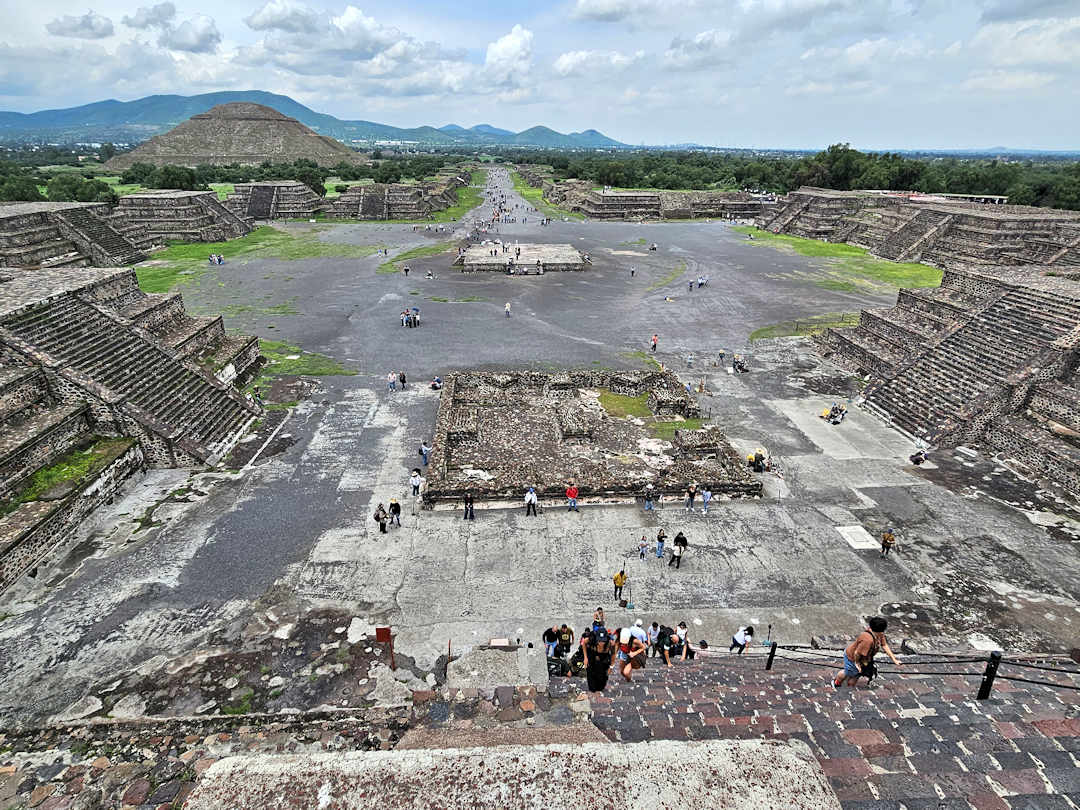
This pyramid is still accessible to tourists, and we recommend to climb up to the platform, as the views from there give you a good sense of the enormous size of Teotihuacan (our feature image was taken from up there). But be very careful: the steps are steep and uneven, and there are some sheer drops once you’re on the platform, so watch your every step, especially when taking photos.

Interntional or not? Reaching the Plaza de la Luna in front of the Pyramid of the Moon, visitors can no longer see the sacred Cerro Gordo behind it
Want to learn some Spanish before your trip?
You don’t need fluency to find your way around and connect with locals on your travels. But knowing some Spanish can make everyday situations easier and more meaningful. Busuu offers a structured way to learn the basics of a language before you go, and it’s easy to combine the app with language school studies, too.
Once you return to the Plaza de la Luna in front of the pyramid, head towards Gate 3 (South-West) – don’t worry, you’re not exiting yet.
Walk up the steps to the left of the Palace of the Feathered Butterfly/Palacio de Quetzalpapálotl, turn left at the top and visit another (lower) platform overlooking the Plaza of the Moon and the Avenue of the Dead [Google Maps location]. Then turn around and continue to head towards Gate 3 (West).

A platform to the south-west of the Plaza de la Luna gives you another perspective of the Avenue of the Dead and the Pyramid of the Sun
Palace of Quetzalpapálotl and Palace of the Feathered Conch Shells
To the south-west of the Pyramid of the Moon are two significant palatial complexes: the Palace of the Feathered Butterfly/Palacio de Quetzalpapálotl and the Palace of the Feathered Conch Shells/Palacio de los Caracoles Emplumados. Built around 450-500 AD, the Palace of Quetzalpapálotl was built on top of the much older Palace of the Feathered Conch Shells, believed to be built around 200 AD. Both palaces feature ornate pillars with intricately carved motifs and colourful murals of butterflies, birds, marine life and flowers. At the Palace of the Feathered Conch Shells, you can even see parts of the sophisticated drainage system that was in place in Ancient Teotihuacan.
As you walk towards Gate 3, on your right, visit first the Palace of the Feathered Butterfly/Palacio de Quetzalpapálotl [Google Maps location], then – below it – the Palace of the Feathered Conch Shells/Palacio de los Caracoles Emplumados [Google Maps location]. The entrances are about 30 metres apart, both accessible from the walkway towards Gate 3.

Check out the intricate interiors of the Palace of Quetzalpapálotl...

... and the colourful murals at the Palace of the Feathered Conch Shells
After visiting both, exit through Gate 3 (but hold on to your entry tickets).
Sites outside the Main Archaeological Zone
Ancient Teotihuacan extended far beyond the boundaries of the Main Archaeological Zone, and there are (at least) two other structures (ancient and modern) that are worth checking out. If you’ve only got time/energy for one – make it the latter, the Palace of Tetitla. Whichever one/s you visit: show the staff your ticket for the Main Archaeological Zone as you enter.
To get to the first, continue from Gate 3 to the roundabout and take the second road on your right (skipping the interpretive path). Continue walking along the road for about 300 metres to the entrance of a parking lot – this belongs to the Mural Museum.
Walk across the parking lot and climb onto the roof of the building in front of you (it’s shaped like a pyramid with a flat top) via the ramp or the steps. Then walk down the ramp or steps on the other side. The museum entrance is to your right as you come off the stairs or to your left if you took the ramp down (yep, they didn’t make it easy to find).

The Beatriz de la Fuente Mural Museum is outside the main archaeological zone, a few hundred metres north of Gate 3
Beatriz de la Fuente Mural Museum
Named in honour of Mexico’s pre-Columbian art historian Beatriz Ramírez de la Fuente, the Museo de los Murales Teotihuacanos preserves fragments of original Teotihuacan murals that once adorned temples and palaces – feathered felines, birds and deities. The museum explains ancient mural-creation techniques and symbolism, and provides insights into astronomical and religious practices in Ancient Teotihuacan.
Due to the museum’s location, most people don’t bother visiting, but we found it to be a good complement to the Museum of Teotihuacan Culture and worth the slight detour.
Once you finish your museum visit, retrace your steps to the road and return south to a restaurant you choose (you’ll be hungry by now).

The museum comprises this stunning example depicting Tlaloc...

... and this intricate mural of feathered jaguars
Where to eat when visiting Teotihuacan?
A (wo)man gotta eat, right? So, if you find yourself hungry after your exploration, here are our suggestions for lunch (or dinner).
Dining spots near the Archaeological Zone (from North to South)
- Restaurante Rustica [Google Maps location]
- El Ranchito [Google Maps location]
- La Caverna [Google Maps location]
- Mezcaleria Conejo en la Luna [Google Maps location].
Dining spots in the centre of San Juan or San Martín
- Mercado Hidalgo [Google Maps location]
- Restaurante Clotilde [Google Maps location]
- Desayunos La Central [Google Maps location]
- Mercado San Martín de las Pirámides [Google Maps location].
Palace of Tetitla
Refreshed after lunch, we also recommend visiting the Palace of Tetitla/Palacio de Tetitla, located around 200 metres west from the perimeter of the main site and about halfway between Gates 1 and 2 [Google Maps location].
The Tetitla compound is one of several significant residential-palatial complexes. Excavations have revealed interconnected courtyards, layered rooms and drainage systems, which gives you a good idea how Teotihuacanos lived about 1,500 years ago. Its most striking feature is a series of vivid murals set against a deep red background, featuring images of the Great Goddess and other mythical creatures, as well as every day and ceremonial scenes.
If you’ve booked a second night, enjoy the rest of the afternoon relaxing at your accommodation. Otherwise continue your onward journey.

Don't miss the Palace of Tetitla and its masterpiece, the mural of the Great Goddess of Teotihuacan
What to pack for your Teotihuacan exploration?
Teotihuacan’s scale and exposed layout make it essential to bring the right stuff with you to be comfortable:
- Comfortable closed-toe shoes with good grip – Paths are uneven, and staircases are steep, so you’ll want something stable and secure underfoot. I typically use lightweight trail shoes for this kind of terrain – they’re more than enough for Teotihuacan and far more comfortable than heavy hiking boots. While we’ve seen people visit in flip-flops and sandals, don’t do it – you’ll get sore feet and blisters in no time.
- Layers of clothing – Mornings can be cool and overcast, while afternoons may turn hot and sunny. A lightweight rain jacket is also recommended.
- Reusable water bottle – Stay hydrated while avoiding single-use plastic. We didn’t see any water fountains in the Main Archaeological Zone, so make sure you have enough to last the whole day.
- Snacks – While you can buy snacks in vending machines at Gate 5, we recommend bringing your own to tide you over until you stop properly for lunch. Muesli bars, dried fruit, or nuts are ideal.
- Sun protection – A wide-brimmed hat, sunscreen (ideally reef-safe), and sunglasses are also important, as the sun is fierce and Teotihuacan has limited shade.
- Offline copy of our itinerary and map – While there is mobile reception, we recommend having an offline copy handy as you walk around the site.
Love exploring without a car?
Our Panama Canal Guide shows you how to reach the locks and museum using buses and the Metro, step by step — ideal for independent, budget-conscious travellers.
Before you go, if you liked our article and found it helpful, we would appreciate it if you could share it with your friends and family via the Share buttons below. Even better: Leave a short review on Trustpilot or Google, which would help us further build our online reputation as a (trustworthy and helpful) travel and lifestyle blog.