

This article may contain links to products and services we use and recommend. We may receive compensation when you click on links to those products. For more information, see our Disclosure Policy.

The bus ride from El Calafate in Argentina to Puerto Natales in Chile is one of Patagonia’s most scenic overland journeys, and a much-frequented route for independent travellers who want to experience both Los Glaciares and Torres del Paine National Parks. We made the trip with Bus-Sur, crossing the Paso Río Don Guillermo border in 2025. In this guide, we share exactly what to expect – from booking your tickets and navigating immigration and customs to where to sit for the best views.

Map of Points of Interest, Eateries and Transport
Below is a map of the recommended points of interest, eateries, and transport terminals or stops mentioned in this article.
Booking your ticket
As departure times vary daily, it’s best to check the schedule across all the bus companies serving the route on Busbud. Though bear in mind that timetables are only released a few months in advance. Busbud also lets you purchase tickets online with your credit card. Once you know the departure time and operator, you can also book your ticket/s directly on the bus companies’ websites – Bus-Sur, Marga Taqsa and Turismo Zaahj are the main companies ploughing the route – or in person at the Bus Terminal. Advanced booking is recommended during peak season (November to March).
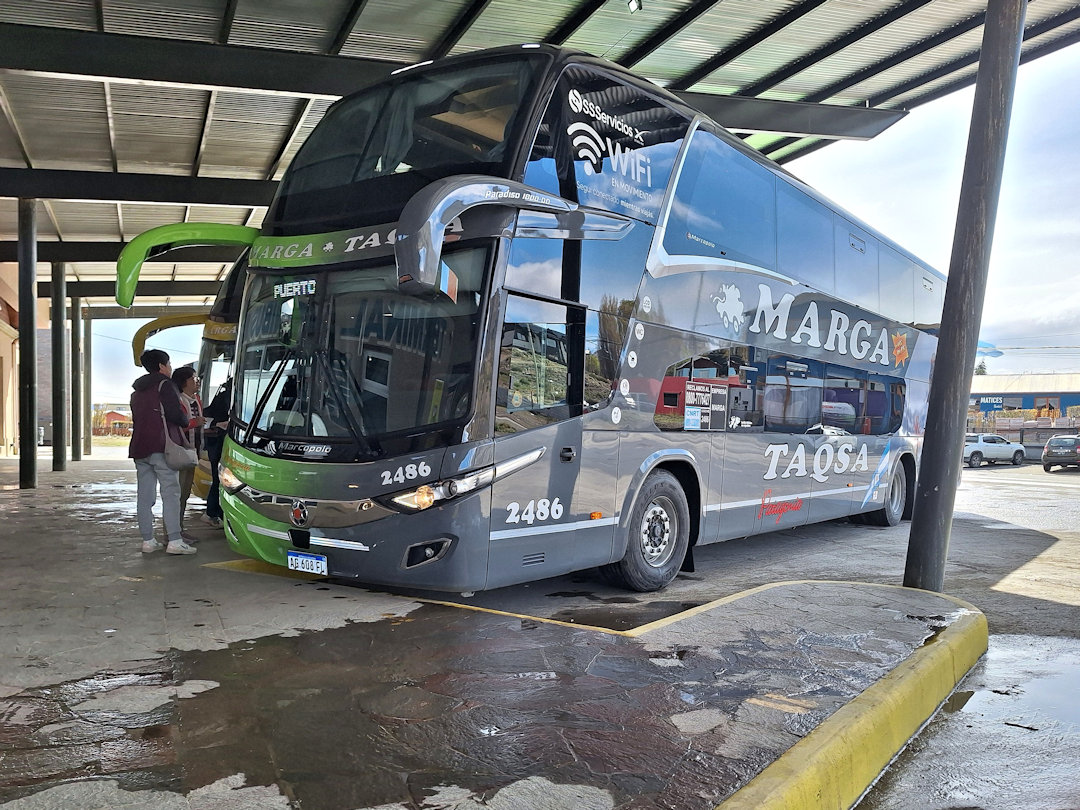
Bus-Sur, Marga Taqsa and Turismo Zaahj are the main companies servicing the El Calafate-Puerto Natales route
Which are the best seats on this journey?
During the booking process, you can not only select the type of seat you want but the seat itself. Try and book front-row seats or the seats right behind the stairs (as there is no one in front of you). If possible, choose right-hand seats (in driving direction) – the scenery is better on the right as you travel south. We were lucky to get front-row seats at the top right.
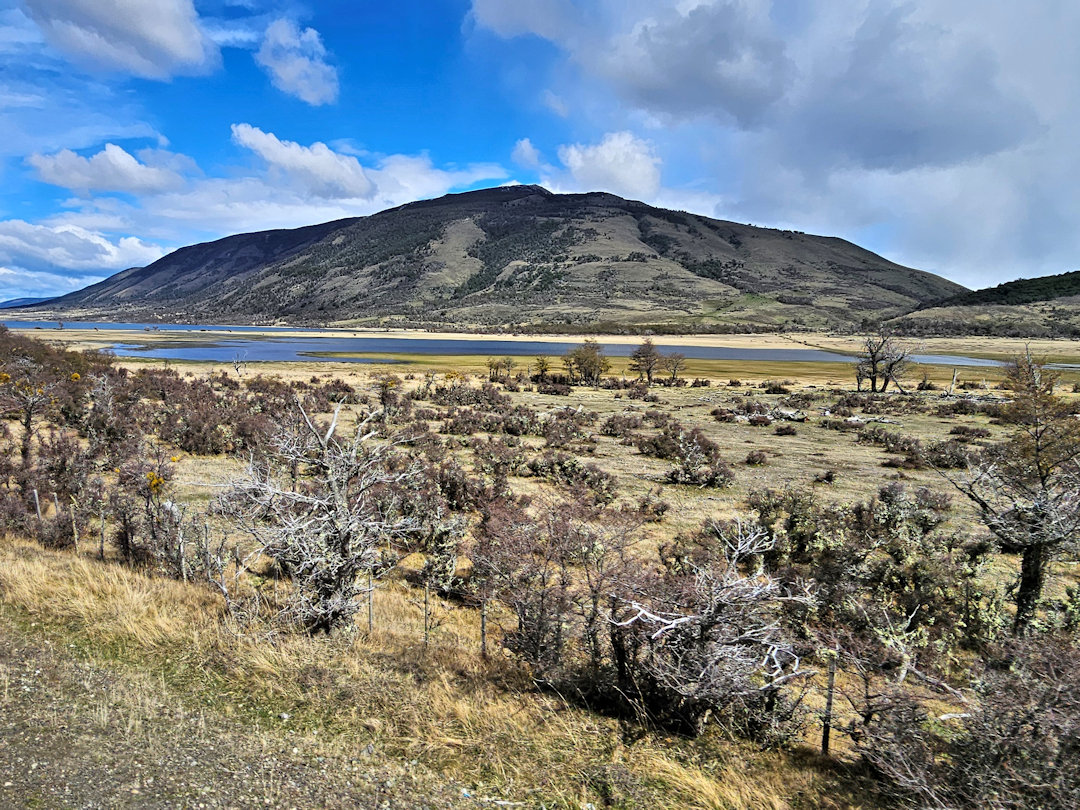
Travelling south from El Calafate to Puerto Natales, seats on the right-hand side have the best views
Departure logistics in El Calafate
Buses to Puerto Natales depart from El Calafate’s Main Bus Terminal [Google Maps location] – the same one is used by the buses connecting El Calafate with El Chaltén.
Arrive at least 30 minutes before departure to allow time for two essential steps:
- First, pay the station fee (ARS3,000 per person as of October 2025 – usually not included in your ticket price) at the designated counter – you’ll be given a paper receipt;
- Then, check in at your bus company’s counter (Bus-Sur shares a counter with Andesmar), presenting your booking confirmation (printed or digital) and the station fee receipt (hold on to the latter – ours were checked again when we boarded).
Facilities at the terminal include clean toilets and food stalls where you can buy a coffee or snack before your trip.
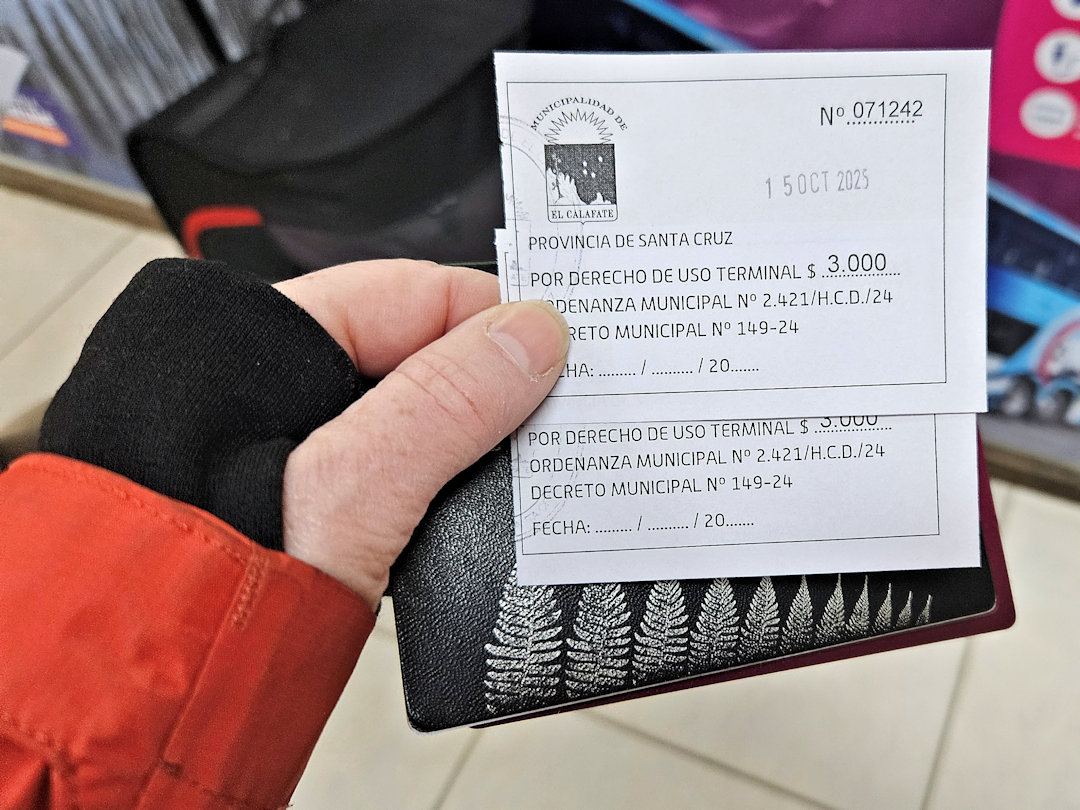
In El Calafate, you are charged a bus station usage fee which is (normally) not included in your bus fare
The overhead storage space on our bus was relatively narrow, barely fitting my travel pack. Larger bags need to go into the luggage compartment at the back of the bus (but keep any valuables with you). While some tickets’ fine print states a weight limit, our luggage weight was not checked.

Before boarding your bus to Puerto Natales, you need to check in at the counter of the bus company you are travelling with
Learning Spanish before your trip?
You don’t need fluency to travel well, but knowing some Spanish can make everyday situations easier and more meaningful. Busuu offers a practical way to practise the language before you go, so you can decide how much effort is actually worth it before committing to classes or courses.
On the Road: What the ride is like
Onboard facilities
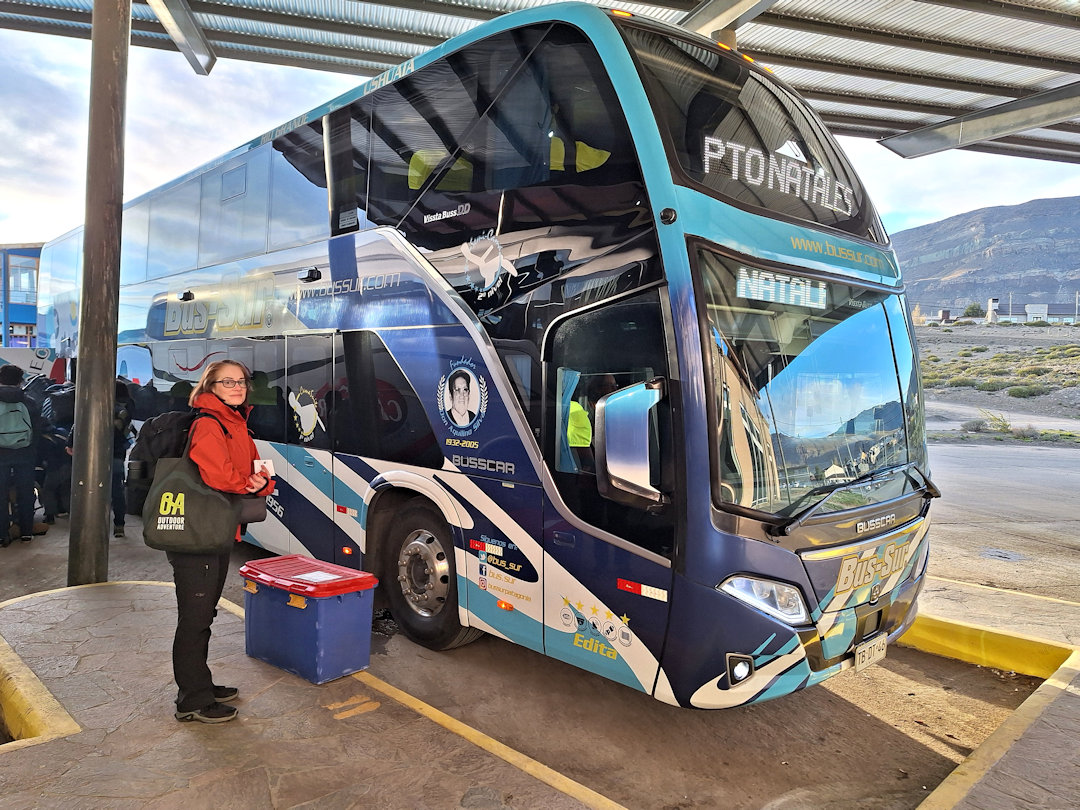
Our Bus-Sur coach was a clean, modern double-decker with comfortable, reclining semi-cama seats upstairs and cama seats downstairs. Being air-conditioned with curtains and blinds to block out direct sunlight, the temperature stayed pleasant throughout the trip.
Each passenger had generous legroom, with leg rests that folded out from the front row. A toilet was available on the bottom level (we didn’t use it, so can’t comment on the standard or cleanliness – bring your own tissues and hand sanitiser, just in case).
We were pleasantly surprised by the free and super-fast onboard Wi-Fi – we measured 90Mbps download and 23Mbps upload speeds.
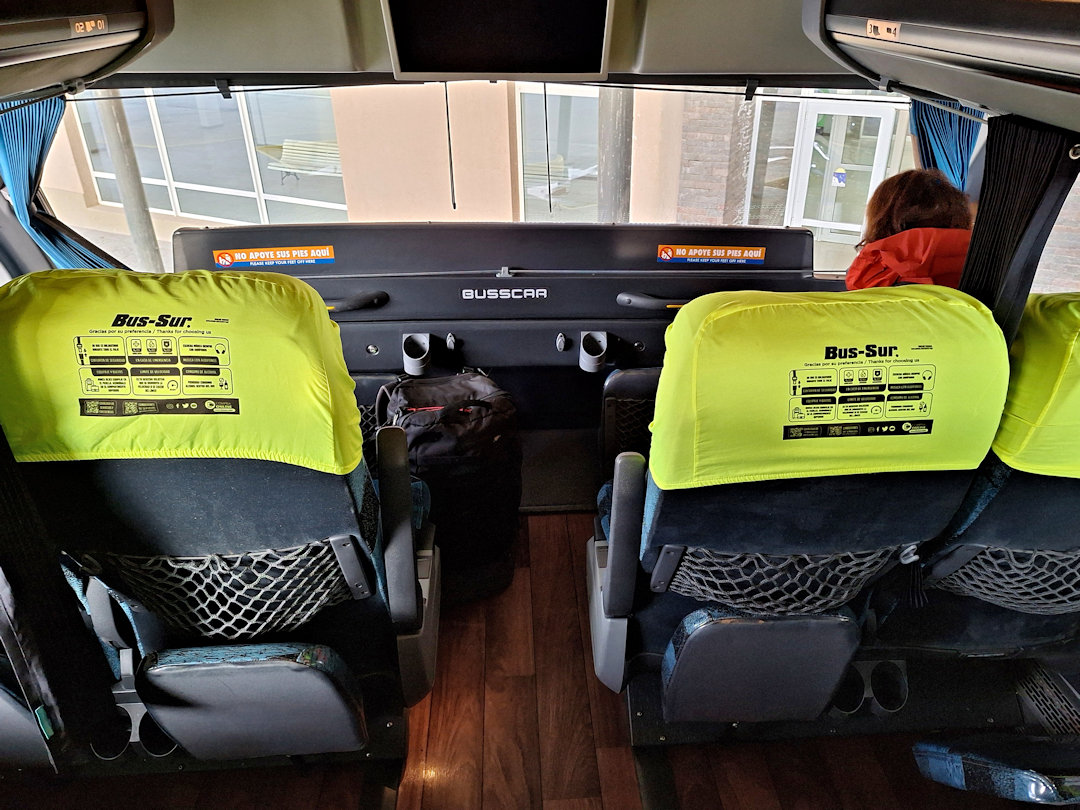
Our Bus-Sur double decker bus was modern, clean and comfortable, thanks to reclining seats, footrests, AC, onboard toilet and wifi.
Travel time and scenery
Expect about six hours in total. It’s roughly two hours from El Calafate to a short rest stop at La Esperanza [Google Maps location], a service station with toilets, then another two hours across the steppe to the border.
The border formalities usually take about 1 hour in total – about 20 minutes on either side – before the final hour to Puerto Natales.

The secenery between El Calafate and Puerto Natales is stunning - on a clear day

Keep a look-out for wildlife - we encountered a few guanaco herds and many birds (including condors and rheas)
Border crossing process (Paso Río Don Guillermo)
Most of the journey on the Argentinian side is along the (paved) Ruta 40. The bus eventually turns off Ruta 40 and travels along a gravel road for the final few kilometres, until it reaches the Argentinian border post. Driving over cattle grates and past grazing sheep, it felt more like a farm visit than crossing an international border.

More like visiting a farm than approaching an international border: the gravel road to Cancha Carrera
Argentina Exit (Cancha Carrera)
Our two bus drivers got off and entered the small immigration building first. After a while, all passengers were asked to disembark with their passports (our luggage remained on board). The immigration building has two counters, with a waiting space in front. As a bus from Chile arrived at the same time as ours, each counter processed one bus, and travellers crossing in private cars had to wait.
Toilets are to the left of the immigration building (as you look at it). Bring tissues and hand sanitiser; when we went through it, there wasn’t even running water.
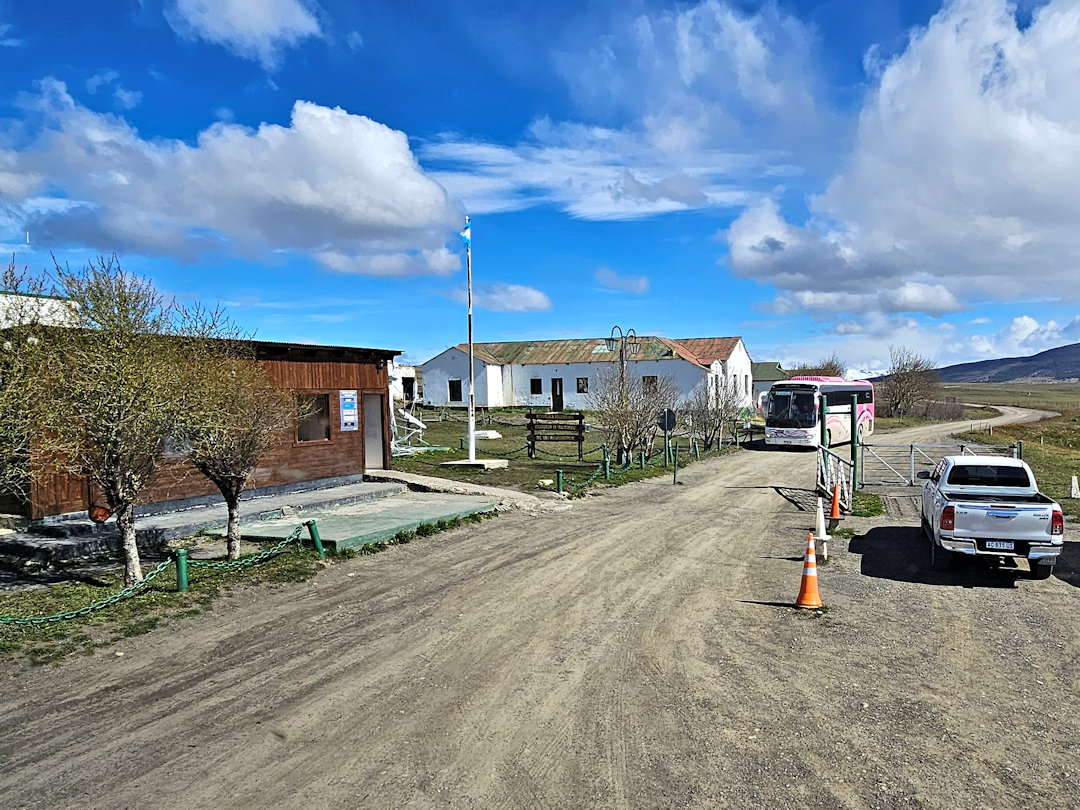
The Argentininan border post is not more than a couple of buildings in the middle of nowhere

You know you've crossed into Chile when the road becomes paved (even without the welcome sign)
Chile Entry (Cerro Castillo)
At this post, we got off with ALL our luggage (including the bags in the back of the bus). You enter a (more solid) building with immigration counters on the left and a giant X-ray machine on the right.
First, we joined the immigration line. Here, you receive your PDI (an entry slip/tourist card, which you need to keep until you exit Chile). We weren’t asked how long we’d stay, nor did we have to prove our onward travel.
Next is the biosecurity and customs check: You need to show your completed declaration to the officer (more on that below) and then send your luggage through the X-ray machine. Bins are available behind the machine to dispose any restricted items.

At the Chilean border post, you receive your PDI, and all your luggage is being checked for biosecurity purposes
What’s with Chile’s Biosecurity Rules?
Chile’s Servicio Agrícola y Ganadero (SAG) enforces some of the strictest biosecurity regulations in South America – to protect local ecosystems and agriculture from pests and diseases.
Travellers must declare all food, plant and animal products when entering the country. Fresh fruit, vegetables, herbs, seeds, nuts, honey, dairy products and meat are prohibited, while commercially processed, sealed and packaged snacks are usually allowed. Failure to declare prohibited items may result in fines. If you visit Australia or New Zealand, you’re subject to similar rules (for the same reasons).
Within 48 hours before crossing the border, you need to complete an affidavit online. If in doubt, declare the item and speak to the inspector at the X-Ray machine if it’s okay to bring them in (they were friendly and polite). We declared muesli bars, peanut cookies and tea, which were all fine (even Paul’s Nutella sandwich made it through), but other passengers had to hand in their apples.
If you’ve got accommodation in Cerro Castillo, you can walk into the village straight from the border (it’s around 500 metres away).
Arrival in Puerto Natales
From the border, the bus travels along Ruta 9 (which connects Puerto Natales with Torres del Paine National Park to the north and Punta Arenas to the south). If you’ve got a flight booked from Puerto Natales (IATA: PNT), the bus passes the airport around 45 minutes after the border crossing – just let the driver know you want to get off.

The bus from El Calafate to Puerto Natales also passes Puerto Natales Airport
Buses arrive at the Terminal Rodoviario in Puerto Natales [Google Maps location]. The terminal has toilets (free at the time of our visit), food and souvenir stalls, and several tour operator and bus company counters where you can organise your onward travel or tours to Torres del Paine National Park.
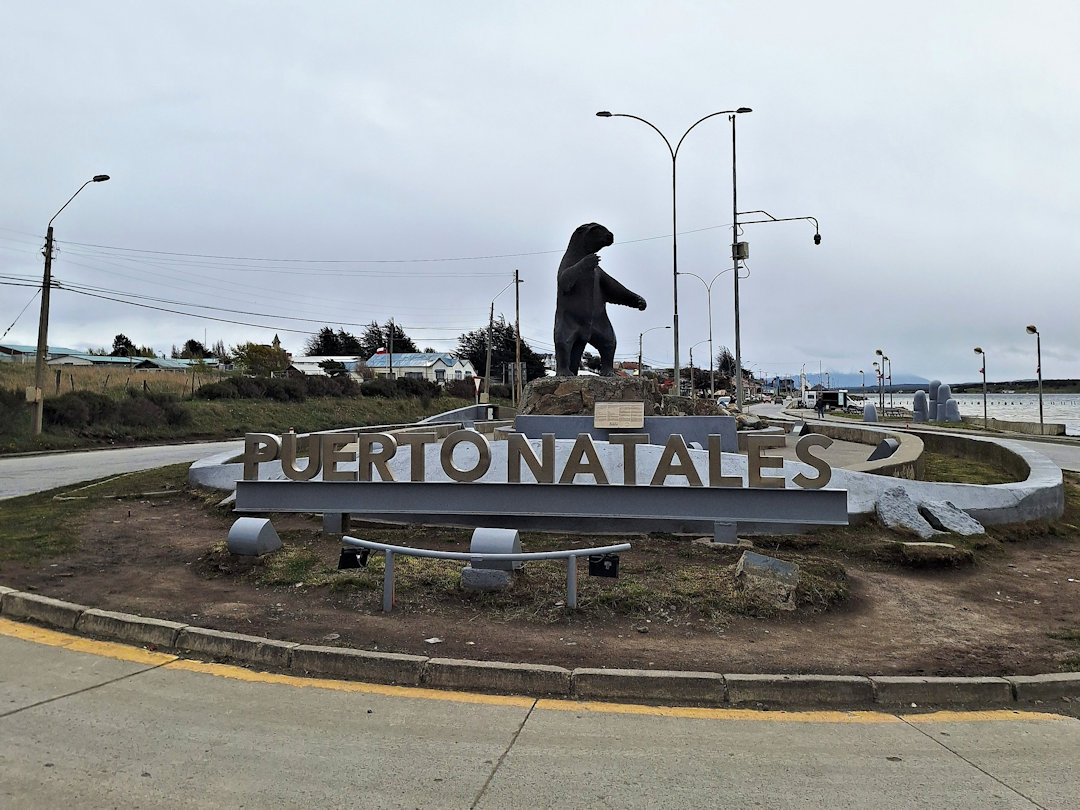
The bus reaches Puerto Natales about an hour after crossing the border
Essential logistics in Puerto Natales
Travel Money
If you need cash, there is a BancoEstado ATM inside the terminal (we didn't use it, so we can't speak to the withdrawal limit or fees). If you can, head to the BancoEstado branch at Plaza de Armas [Google Maps location], which has three ATMs (accessible 24/7). The middle one worked for us (charging CLP5,500 for CLP400,000 - the lowest we've found in Chile).
Some tour operators in the bus terminal double as money exchanges, though we found the rates abysmal. We also checked the exchange rates offered by the rental car companies surrounding the bus terminal (which offer slightly better rates). If you have leftover ARS (or USD/EUR you want to change), we found the best rates at the Casa de Cambio opposite the Unimarc carpark [Google Maps location].
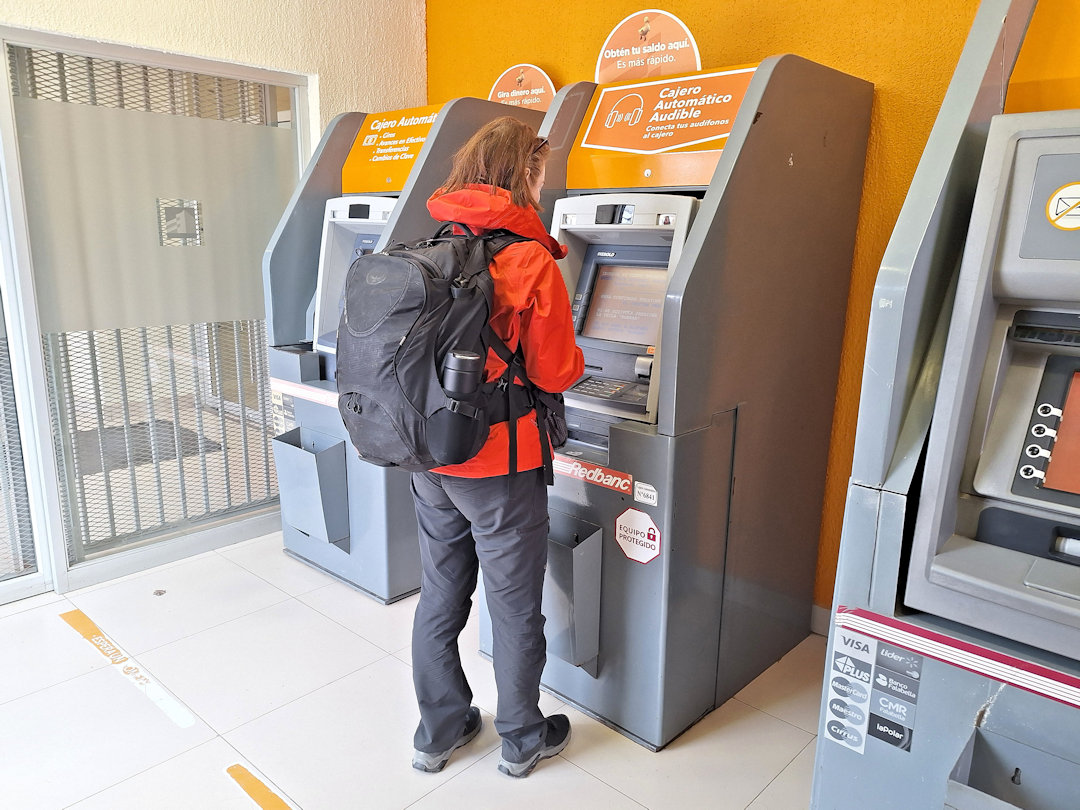
To withdraw money in Puerto Natales, we recommend the Banco Estado ATMs at Plaza de Armas
Where to eat and stock up on groceries/snacks in Puerto Natales
Puerto Natales is a mecca for foodies - you'll be spoilt for choice. Its culinary scene was even recognised by the World Food Travel Association in November 2024, which named it the Culinary Capital of Chile.
Here are our top picks (in alphabetical order):
- Alveoli Bakery [Google Maps location] - They not only sell delicious sourdough bread and to-die-for filled croissants, but also serve yummy sourdough pizza in a covered and heated beer garden-style courtyard.
- Café Artimaña [Google Maps location] - Cosy, friendly restaurant serving yummy homemade pasta and risotto dishes. Meat lovers will enjoy the Pobre Artimaña.
- Last Hope Distillery [Google Maps location] - Super-friendly, Australian-owned bar with onsite distillery - arrive early as the place gets busy. Offers free tours of the facilities at 17:30. You can even create your very own gin (by joining the Gin Lab at 15:00).
- Patagonia Black Lamb [Google Maps location] - Come here for delicious empanadas and brisket or pulled-pork burgers; the bakery is run by a passionate couple (Sebastian and Debbie) whose love for food is clear to see.
- Restaurante Jechef [Google Maps location] - A cosy family-run restaurant where every meal is made fresh from local ingredients, refined, yet well-priced. Bring a bit of time, and you won't be disappointed.
To stock up on essentials, head to the Unimarc Supermarket [Google Maps location] for groceries and Itahue Frutos Secos [Google Maps location] for nutritious snacks.

Paradise for foodies: Puerto Natales was named the Culinary Capital of Chile in 2024
Where to stay in Puerto Natales
Puerto Natales is THE base for exploring Torres del Paine National Park (a roughly 2-hour drive north). But it’s also a lovely destination in its own right. If you’re planning to stay here (for a night or a few), here are our recommendations – all centrally located:
Things to see and do around Puerto Natales
Here is our selection of day activities around Puerto Natales and Torres del Paine National Park organised by the regional operator:





Planning to continue by ferry to Puerto Edén, Caleta Tortel or Puerto Yungay? Read our step-by-step guide to the TABSA ferry from Puerto Natales to Caleta Tortel for routes, booking tips and what to expect on board.
Are you planning to travel between El Calafate and Puerto Natales?
What other questions do you have which we haven’t addressed above? And if you’ve taken the bus recently (whichever company) please let us know what tips you would add.
Before you go, if you liked our article and found it helpful, we would appreciate it if you could share it with your friends and family via the Share buttons below. Even better: Leave a short review on Trustpilot or Google, which would help us further build our online reputation as a (trustworthy and helpful) travel and lifestyle blog.