


This article may contain links to products and services we use and recommend. We may receive compensation when you click on links to those products. For more information, see our Disclosure Policy.

Caleta Tortel is one of the most remote villages in southern Chile, tucked away along the Carretera Austral between the Northern and Southern Patagonian Ice Fields. Often underappreciated by overlanders travelling along the Carretera Austral, it was one of our favourite places in Chilean Patagonia – a proverbial great things coming in a small package. In this travel guide, we share how to get here, what to expect and how to appreciate this very special place.
Where is Caleta Tortel, what makes it so special, and who is it (not) for?
Tucked into Chile’s remote Aysén Region at the mouth of the Río Baker (Chile’s largest river), this close-knit Patagonian coastal community of about 500 people is unlike anywhere else we’ve been: Around three-quarters of the village stretches along a rocky peninsula, where houses on stilts – known as palafitos – are linked by roughly 7km of wooden walkways – called pasarelas (a typical example of Chilotan architecture) – and steep (sometimes precariously-looking) stairs built into the hillsides (that can be slippery, especially when wet). These boardwalks, some suspended above the rocks and some plonked right into the bay’s milky-green glacial waters, shape how you experience Tortel: entirely on foot.
Founded officially in 1955 after millennia of exploration by the indigenous Kawésqar sea nomads (whose descendants still live here and in Puerto Edén) and centuries of seasonal logging settlements, Tortel’s community is deeply connected to its natural surroundings and history.

First explored by Kawésqar sea nomads thousands of years ago, Caleta Tortel's more recent history is deeply linked to the local timber logging industry
Who is (likely) going to enjoy Tortel? People with a love for slow travel, for outdoor adventure and for places that are different – full of character and history; people who get pleasure out of the small things others overlook.
And who should stay away? Given Tortel is made up (largely) of wooden boardwalks and stairs, it’s (sadly) not a destination suitable for people with mobility issues and anyone unwilling or unable to carry their own luggage. Tortel is also not for you if you have cynophobia (more on that below).
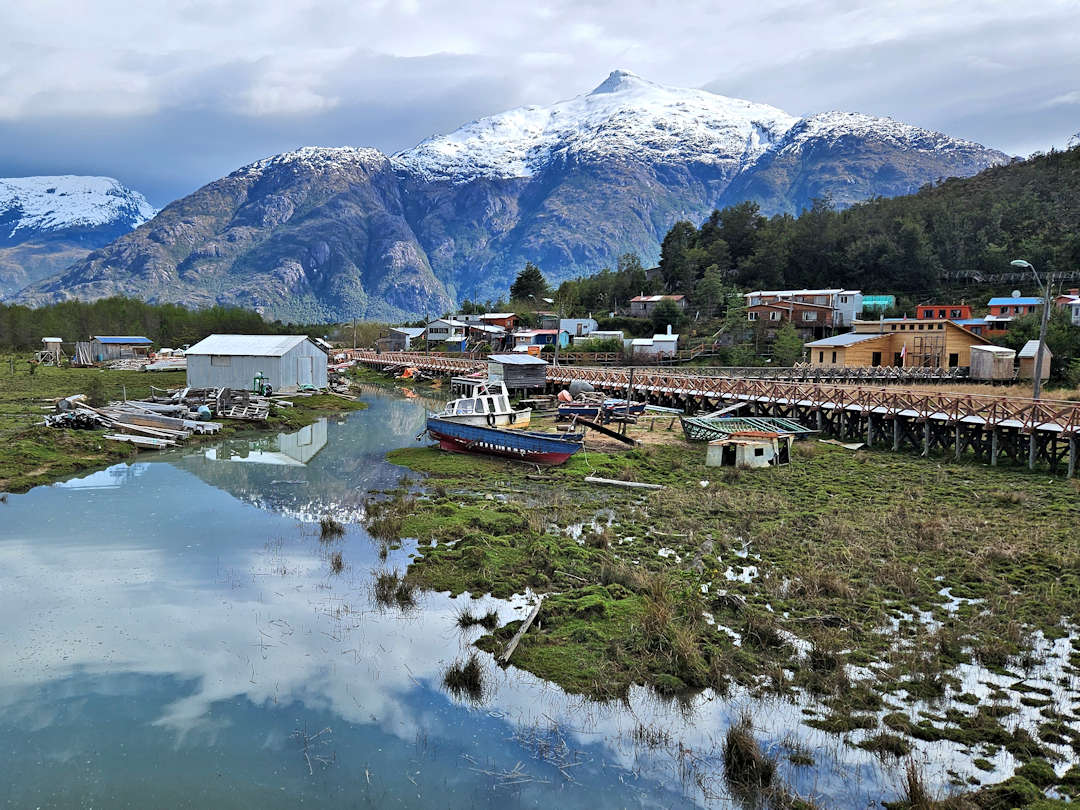
Largely made up of wooden boardwalks and steep staircases, Tortel is not suitable for people with mobility issues (and travellers who can't carry their own luggage)
Tortel: a stand-out example for sustainable tourism development
What stood out to us when visiting Tortel was the Tortelinos‘ shared commitment to caring for their environment:
- Waste and recycling bins are placed throughout the village, and signs encourage visitors to keep Tortel free of cigarette butts.
- The boardwalks are clean, and even dog poop is regularly cleared.
- Restaurants prioritise locally sourced produce, supporting nearby growers and fishermen.
- Almost everyone we met is actively involved in local associations that ensure any development reflects community priorities.
This collective effort helps protect Tortel’s character and ensures the village evolves on its own terms, shaped by the people who live here rather than third-party agendas.
Map of Accommodation, Points of Interest, Eateries and Transport
Below is a map of the recommended accommodations, points of interest, eateries, and transport terminals or stops mentioned in this article.
What’s the weather like in Tortel (and when is the best time to visit)?
Given its location in one of the wettest and windiest parts of Patagonia, you should expect rain in Tortel at any time of year. Even in summer, daytime temperatures are modest (13-14°C/55-57°F), while winter highs sit only just above freezing. The air also feels humid year-round, thanks to Tortel’s position between the Pacific Ocean and the ice fields of the Andes.
According to Weather Atlas, September and October have the lowest rainfall totals (around 30mm/month), followed by January to March (around 40mm/month). February, September and October (~14) also tend to have the fewest rainy days. So, while there is no perfect time to visit Tortel, October or January to March appear to offer the best odds.
We stayed in Tortel for a week in the second half of October and had only one and a half properly sunny days. The rest was a mix of daily rain and short dry spells that sometimes lasted an hour, and sometimes only a few minutes. That kind of stop-start weather is exactly why a dependable rain jacket is worth packing here, especially if you want to keep exploring Tortel’s boardwalks and nearby trails when conditions shift. Sandra wore the Patagonia Women’s Torrentshell 3L Rain Jacket, while Paul wore the men’s equivalent throughout our time in Patagonia, and both proved well worth wearing on wet days in Tortel.

Wind and rain are a constant in Tortel, any time of the year - if it's sunny (or just cloudy), count yourself lucky
How much time should I spend in Tortel?
Tortel rewards those who give it time. While Prince William famously spent eight weeks in Tortel as part of a Raleigh International Expedition in 2000, when he was 18, helping to repair the pasarelas and teaching English to local kids, most visitors won’t have that luxury.
Even so, Tortel isn’t a place to rush. We stayed here a week and really enjoyed it: the rugged landscapes, the village dogs, the silence at night and experiencing the slow life in a rural community during a time when there were hardly any other tourists.
While you likely won’t have a week (let alone eight), we recommend spending at least one night here, preferably three, so that you have two full days for all that Tortel has to offer (we share our recommendations below).

Tortel is worth a few nights' stay, with free activities in/around the village, and a few paid but worthwhile (half)day excursions nearby
How to get to Tortel (by public transport)
By Road
Until 2003, the village was accessible only by boat or air (not unlike Tortuguero in Costa Rica). Today, a gravel road (X-904) connects Tortel to the Carretera Austral (Ruta 7), providing overland access.
(Almost) Daily buses operated (alternatingly) by Buses Aldea and Los Glaciares connect Tortel with Cochrane (around 125km north-east), while Buses Andres Silva provide a weekly service from/to Villa O’Higgins (at the southern end of the Carretera Austral and about 150km away). Find up-to-date timetables here.

(Almost) Daily buses connect Tortel with Cochrane in the north and weekly buses with Villa O'Higgins in the south
By Sea
Tortel can also be reached by sea, using the TABSA ferry between Puerto Natales and Puerto Yungay, which stops at Caleta Tortel along the way. We share more about our experience in our TABSA ferry guide.
Travel in this part of Patagonia is shaped by weather and logistics. Ferry schedules can change, and remote destinations like Tortel have limited transport options. For longer trips through southern Chile, we recommend having travel insurance that covers ferry cancellations, weather delays and trip interruptions. If you are unsure what type of policy to look for, read our guide on how to find travel insurance that suits your needs. When comparing providers, we usually check options through Insubuy, which allows you to compare policies that include trip interruption and medical evacuation coverage.
What to do if your ferry arrives early in the morning
The TABSA ferry from Puerto Natales arrives anytime between 23:00 and midday the following day (pending weather and other conditions). We disembarked our ferry at 7:30, but a week later, the ferry arrived even earlier, at 5:00. So, you just never know.
If you stay in Tortel for a night (or more), the best option is to ask your host whether early check-in is possible, or at the very least, if you can drop your luggage at your accommodation. If that’s not an option, the public library to the right of the pier has a small covered porch with free Wi-Fi. Check here (using Google Maps) which restaurant might be open early for breakfast (though don’t take stated opening times as gospel). Chanito is a good option (more on it below), but there may be others pending the day/time of your arrival. It’s also worth asking a local picking up passengers from the ferry for their recommendation.
Also important: Go to the bathroom before you disembark. Public toilets are (only) available behind the tourism office by the rotonda [Google Maps location]. Pick up the key from the tourism office or the little shop next door (Hijos de Pionero) when they’re open. A small fee (CLP 500) is being charged.
However you arrive, it’s important to pack light. Because Tortel is a remote destination with limited transport connections, it helps to pack carefully and avoid bringing unnecessary gear. If you want to see exactly what we carry on longer trips through places like Patagonia, you can explore our minimalist travel packing lists. Without conventional streets, even small trolley suitcases are difficult to manoeuvre in Tortel. A backpack or duffel bag makes moving around Tortel far easier and less frustrating.
If you drive here in a rented vehicle and travel with the kitchen sink (literally and figuratively), leave everything you don’t need during your stay locked in your vehicle (out of sight), but make sure to keep valuables on you.

The public library to the right of the ferry pier offers a small covered porch and free wifi
What to see and do in Tortel
Tortel offers a few free activities in and around the village, and a few paid but worthwhile half-day excursions nearby. We share suggestions for both below.
Interpretive walk around Tortel, to the El Faro and Antena viewpoints and the Open Air Museum
One of the best ways to appreciate Tortel is to explore its boardwalks. Interpretive signs and plaques, written in Spanish and placed along the pasarelas and viewing platforms, explain the history of the area, and its fauna and flora (including, where applicable, its uses by the indigenous people).
Following the boardwalks along the shoreline – especially the Pasarelas Costanera, Interpretativa and Padre Antonio Ronchi – takes you to different parts of the village and the ever-changing views over the bay:
- Follow the signs to Mirador El Faro [Google Maps location], then continue along the Pasarela Interpretativa toward the Casa de la Cultura and the Open Air Museum [Google Maps location].
- Before you enter the museum, head right and up the long staircase into the hillside, all the way to the Mirador Antena [Google Maps location] with its little blue-roofed cabin (and panoramic views over the bay). Watch your every step, though (up and down), as the wooden staircase is uneven and can be very slippery.
- Once back down, browse the museum exhibits in the various open halls.

Following the interpretative walk and browsing the open air museum is a great introduction to Tortel's fauna/flora, history and culture
Cerro Vigía/La Bandera and Playa Ancha Loop Hike
For a deeper experience beyond the village itself, the Cerro Vigía and Playa Ancha loop hike offers a rewarding half-day adventure. The hike takes you to multiple viewpoints atop the hill behind Tortel with gorgeous panoramic views over the Baker River Delta, surrounding mountains and Caleta Tortel, followed by a walk (along wooden paths) to Playa Ancha at the mouth of the Río Baker.
The trail is about 7km long and moderately difficult – a mix of (basic) board walks, rocks and (at times very) marshy/boggy forest trails. Doing it anti-clockwise is the best option. It’s not super-well sign-posted but easy enough to follow – just keep an eye out for the (first yellow, then green and finally red) wooden arrows on poles. The trailhead starts half-way along the boardwalk that leads to the aerodrome [Google Maps location].

On a nice day, make sure to hike up Cerro Vigía for stunning panoramic views over the Baker River Delta and surrounding mountains
Expect to hike about 3 hours and be prepared to get muddy at any time of the year — waterproof footwear helps, but grip and drainage matter just as much. Paul wore his Xero Shoes Scrambler Trail Low WP here, which handled the mud well and dried quickly after wet sections, while I opted for hiking shoes with more structure and support. The Xero Shoes feel more like a trail shoe than a traditional hiking boot, so if you prefer more ankle support or expect prolonged exposure to wet conditions, a mid- or high-cut hiking boot may be a better fit. Hiking poles are highly recommended, too. Also, bring some water and snacks.
While it’s gorgeous on a clear day (as you can see from our photos), we don’t recommend doing the hike when it’s raining and visibility is limited.
BE AWARE You may have some four-legged hiking companions. We had four sweet, playful dogs join us for the whole hike (and all the way back to our accommodation, where they zonked out exhausted on our porch afterwards).
What’s with all the dogs in Tortel?
Speaking of four-legged companions… Anyone coming to Tortel will notice the large amount of dogs roaming around the boardwalks – some have collars, some don’t. They welcome you as you get off the ferry and join you on your walk/hike/run (two even accompanied Paul on his 21km run one day – the WHOLE way).
All the dogs we encountered were extremely friendly, well-fed, loved a cuddle, were playful with each other and not at all aggressive towards humans (very different to some of the dogs we encountered near El Calafate’s Bus Terminal). Just watch out for the occasional dog poop on the boardwalks. Not all of them do their business in the bushes, but locals do clean up after them (eventually).

Visitors to Tortel will notice the many free-roaming dogs - according to this sign, all of them have a home
Isla de los Muertos/Island of the Dead
On the opposite site of the Baker River Delta (to Tortel) lies one of the area’s most historically significant and quietly haunting sites: La Isla de los Muertos/the Island of the Dead.
This small island is the final resting place of dozens of seasonal timber workers from Chiloé Island, who arrived here in the summer of 1905/06 to log cypress trees but never made it home. When the boat meant to collect them failed to return, many died during the harsh winter that followed. Today, the site is protected as a national monument and offers a sobering glimpse into the human cost behind Tortel’s early logging history. Intrigued and want to learn more? We recommend reading Ben Wilcox’ Notes from Patagonia.
Reaching the island involves a 30-minute boat ride, followed by an easy one-kilometre walk along wooden boardwalks through the forest. The full excursion takes around 2 1/2 hours. Along the way, guides explain not only the logging history of the area and the events that (are believed to) have taken placen here, but also the surrounding landscape, and its unique flora and fauna. Book tours online, with Turismo Katalalixar (via WhatsApp +56 9 5181 9348) or via the Waeskar Expediciones website.

A short boat ride takes you across the Baker River Delta to the Isla de los Muertos, one of Tortel's more haunting historical sites
Glacier Tours
Tortel sits between the Northern and Southern Patagonian Ice Fields, giving visitors access by boat to both the Steffen Glacier (in Laguna San Rafael National Park) and the Jorge Montt Glacier (in Bernardo O’Higgins National Park).
Steffen Glacier
Day excursions to the Steffen Glacier, the southern-most of the Northern Patagonian glaciers, combine a 2-hour boat ride through the Steffen Fjord, with an easy 2-hour boat ride/hike upriver along the Huemules River basin to the glacier lagoon. Ask at the tourism office by the rotonda which outlet offers tours to the Steffen Glacier during the time of your visit.
Jorge Montt Glacier
Full-day tours to the Jorge Montt Glacier, one of the fastest-retreating glaciers in the Southern Hemisphere, involve a 2-hour boat ride through the fjords to the glacier lagoon full of floating icebergs. Pending your tour and weather conditions, you may be able to access the coast by tender and walk along the glacier moraine.
Expect to pay from ~CLP150,000 per person for tours to Jorge Montt Glacier. Tours usually include lunch and a whiskey on the rocks with glacier ice. Book a tour online, with Turismo Katalalixar (via WhatsApp +56 9 5181 9348) or via the Turismo Canales Australes website.
Both glacier excursions typically take 7-8 hours, and departures depend on weather conditions and minimum passenger numbers.
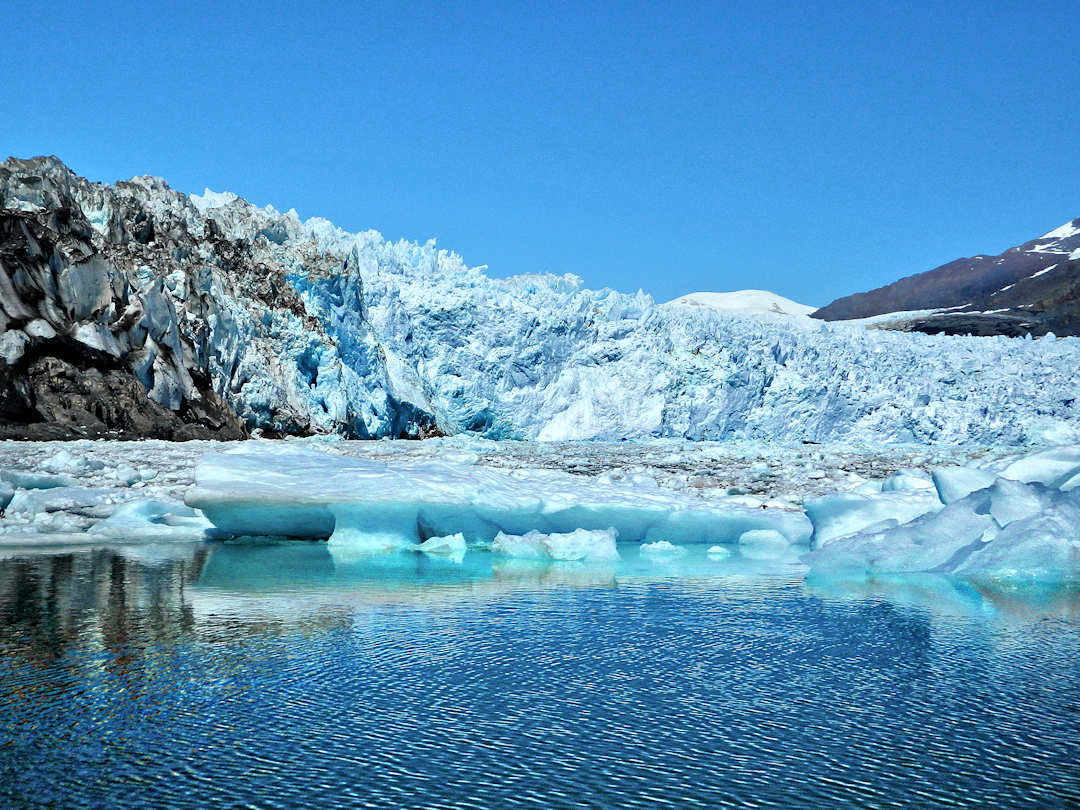
Full-day excursions from Tortel include tours to the Steffen and Jorge Montt Glaciers | Image by Jose Cardenas Vejar on Wikimedia Commons
Where to stay in Tortel
Accommodation in Tortel is small-scale, locally owned and reachable only on foot. Here are our recommendations (ordered by distance from the ferry pier):
- Hostel Costanera [Google Maps location]: A cosy hostel run by well-travelled couple (and former Santiaguinos) Francisca and Javier, with shared and private rooms and a lovely living room with bay views. Open September to May. Book online.
- Cabañas José Santos [Google Maps location]: Diana and Fabián offer basic but cosy self-contained cabins on the hill near the Mirador El Faro viewpoint. Open year-round. Contact Diana via WhatsApp: +56 9 7571 8680.
- Entre Hielos Lodge [Google Maps location]: A small boutique hotel (run by Maria and Noel) with beautifully decorated ensuite rooms and a cosy shared lounge overlooking the bay. Breakfast is included; three-course dinners (by chef Felipe) and excursions are available. Not open year-round. Book online.
- Cabaña Ámbar [Google Maps location]: A modern, well-equipped self-contained cabin overlooking the bay. Near the rotonda/bus terminal and accommodating up to five people. Open year-round. Contact Bernarda via WhatsApp: +56 9 9672 2883.
- Cabaña Baguala [Google Maps location]: Basic but clean and well-equipped self-contained cabin near the rotonda/bus terminal. Also offers an onsite restaurant (see below). Book via WhatsApp: +56 9 4090 1983.

Accommodation in Tortel is small-scale, locally owned and reachable only on foot
Where to eat and stock up on groceries/snacks in Tortel
Whether you want to dine out or self-cater during your stay, here are our recommendations (in alphabetical order).
Dining Out
Don’t believe the blog posts that state there is no good food in Tortel. That’s simply not true. It’s quite the opposite, actually. And considering its remoteness, we found dining out in Tortel to be surprisingly affordable, too. You just need to know where to go.
- Calafate Restaurant [Google Maps location]: A superb restaurant overlooking the bay with a weekly three-course menu lovingly prepared with fresh local ingredients by Francisca and Víctor. Open Tuesday-Saturday 13:00-22:00.
- Kuspe Patagonia [Google Maps location]: A cosy family restaurant just past the rotonda (on the X-904) with delicious pastries and a menu that changes daily. Open 13:30-22:00 (and some early mornings, too).
- La Baguala Restobar [Google Maps location]: Diner-style eatery that serves delicious Chilean fare at a very reasonable price. Close to the rotonda, it operates even during the low season. Open 12.30-16:00 and 19:00-21:30.

For such a small and remote place, the variety, quality and affordability of dining options in Tortel is outstanding
Groceries and Snacks
Given Tortel’s small size and remoteness, don’t expect a Unimarc supermarket (or its variety of products). That said, the small grocery stores dotted around the village offer a decent choice, and we always found ingredients for our meals. Just be prepared to pay more than at other locations around Chile.
- Almacen Mercadito [Google Maps location]: This is the grocery store to your left as you enter the rotonda area from the road. It’s got a nice deli counter, and it’s also the place where you buy your tickets for Buses Aldea to Cochrane.
- Chanito [Google Maps location]: The owners sell delicious bread rolls, Calzones Rotos and a variety of cakes through the shop window facing the rotonda, and set lunches inside. Open 8:00-21:00.
- Supermercado Bellavista [Google Maps location]: The best-stocked little supermarket in Tortel (in our opinion at least). They also sell yummy homemade breads. Open Monday-Friday 9:00-21:30 and Saturday/Sunday 10:00-21:30.
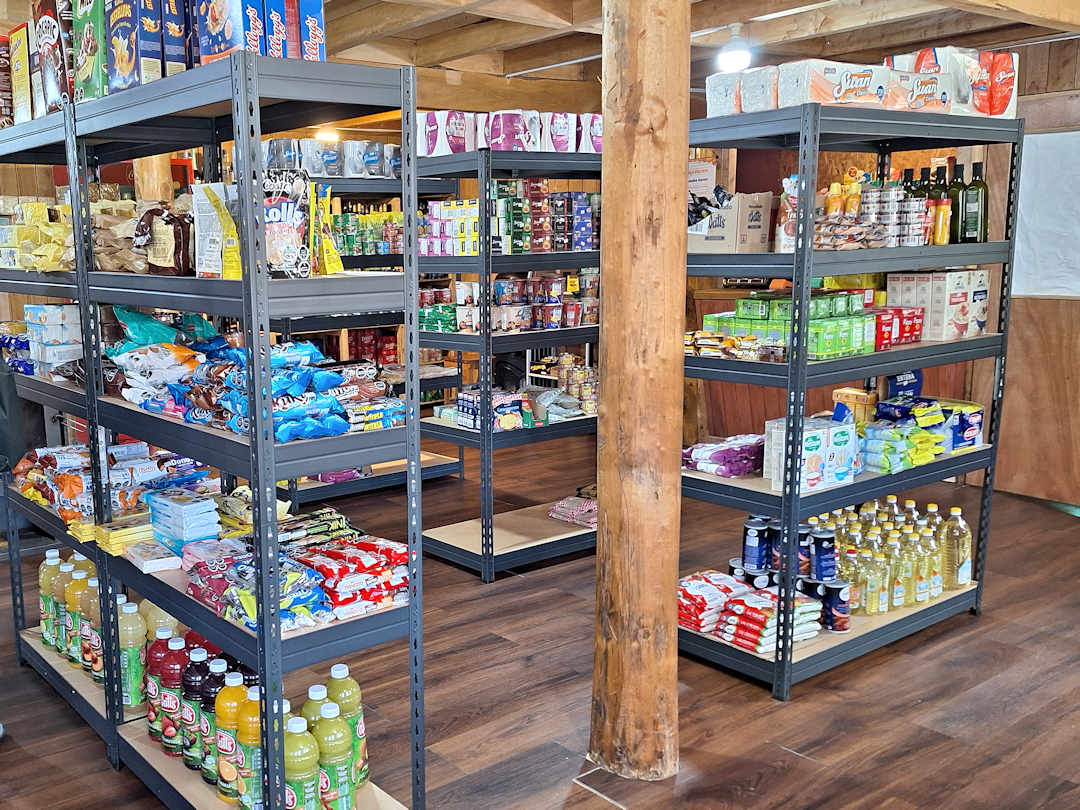
Serving locals just as much as tourists, grocery stores in Tortel offer a decent variety of products and produce

A quirk of Tortel: You need to ring the bell (button by the door) to enter (most) stores and restaurants
FAQs
Do I need to bring cash when visiting Tortel? Are there any ATMs?
There are no ATMs in Tortel. However, supermarkets and restaurants (largely) all accept credit cards. Look for the Caja Vecina sign (Banco Estado’s rural banking service) or ask before you walk in. Our accommodation was the only place we had to pay in cash, which we withdrew at the Banco Estado ATM in Puerto Natales (before we jumped on the ferry). If you come from Cochrane, we recommend withdrawing money from the Banco Estado ATM there.
Is the tap water in Tortel safe to drink?
According to our host, it is safe to drink. Even if it looks slightly brown, it tastes fine, and we had no issues.
That said, in remote places like Tortel, water quality can vary depending on rainfall and supply. If you want extra peace of mind—especially for longer stays or sensitive stomachs—consider using a portable water filter or treatment kit.
I heard only Entel works in Tortel. Is that true?
Nope. That’s a myth. Our smartphones (even via Airalo eSIM) worked fine in Tortel (and up to 2.5km along the X-904). The download and upload speeds we measured were: 7.63 and 2.66, respectively – not huge but sufficient.

Wastewater in Tortel has been treated for the past few years - this plaque at the treatment plant explains how it works
I need to do my laundry while in Tortel. Is there a laundromat?
If you stay at Cabañas José Santos for more than two nights, Diana will be happy to do it for you free of charge (up to 2kg). Otherwise, Lavandería La Estrella is located by the middle steps to the upper town [Google Maps location] and seems to accept credit card payments. Contact them on WhatsApp +56 9 9094 1337.
I plan to drive to Caleta Tortel. Where can I park my vehicle?
There is a small parking lot around the rotonda in the upper town [Google Maps location]. You may also find a parking space along the road by the COPEC petrol station [Google Maps location].
I heard there is no sewage system in Tortel. Is this true?
That was true until a few years ago. These days, Tortel has a sewage system – you can see a map of it on the outside wall of the Treatment Plant [Google Maps location].
What happens with the waste in Tortel?
As you walk around Tortel, you’ll see waste and recycling bins (separating cans, glass jars, glass bottles and plastics) in multiple places. Do your bit by separating your rubbish and dropping it into the correct bins.
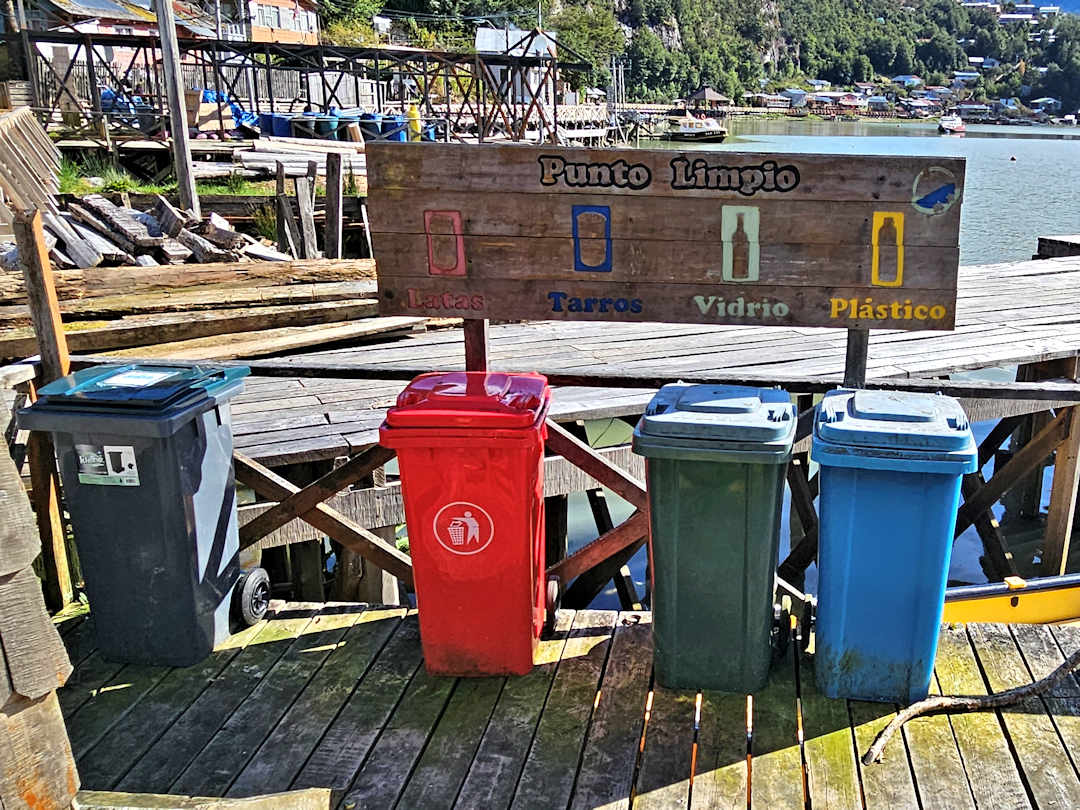
Make sure to do your bit as a visitor by separating your waste and dropping it in the right bins
Help Us Keep This Information Accurate and Relevant
We’re committed to providing trustworthy, up-to-date guidance for intentional living and responsible travel. If you spot outdated information or have helpful updates, we’d love to hear from you.
Before you go, if you liked our article and found it helpful, we would appreciate it if you could share it with your friends and family via the Share buttons below. Even better: Leave a short review on Trustpilot or Google, which would help us further build our online reputation as a (trustworthy and helpful) travel and lifestyle blog.