

This article may contain links to products and services we use and recommend. We may receive compensation when you click on links to those products. For more information, see our Disclosure Policy.

Finished hiking in Torres del Paine or Los Glaciares National Park and want to continue exploring Chilean Patagonia without your own vehicle? While buses get you to Puerto Natales, travelling north from here means hopping on a flight (or a ferry). If you have the time, take the latter – it’s truly one of a kind. The ferry is well-known among overlanders. But backpackers (without a vehicle) can take it too. Travelling the route mid-October 2025, we’ve put all our learnings into one comprehensive guide. Here is everything you need to know: how to book, what to expect, and more.
Are you planning your TABSA Ferry ride?
Book your transportation to/from and around Puerto Natales, keeping your carbon footprint in mind:
Find your perfect accommodation in Puerto Natales with Booking.com. We recommend these small-scale and centrally located options:
When managing money across countries, we keep fees low and decisions deliberate. We use XE to check exchange rates, Wise to move and spend money internationally, and PocketSmith to track where it all goes.
Airport Transfers
Book reliable airport transfers in advance for peace of mind. With Suntransfers, enjoy door-to-door service at 500+ airports worldwide. Professional drivers, real-time flight tracking, flexible booking options, and 24/7 support ensure a smooth journey from the moment you land.
Buying travel insurance can feel overwhelming. Start by reading our buyer's guide to finding insurance that suits your needs. Then compare options on the Insubuy marketplace (with all the information you need to find the one that's right for you).
Explore the wonders of Torres del Paine with the best tours and activities powered by Nomades. We recommend these options with local providers:
What is the TABSA ferry?
TABSA (short for Transbordadora Austral Broom S.A.) is a ferry service provider operating several routes across Chilean Patagonia.
Our article focuses solely on the route linking Puerto Natales with Caleta Tortel. Most foot passengers (us included) get off here, while those with vehicles continue to the ferry’s final destination: Puerto Yungay (on the Ruta 7/Carretera Austral). This TABSA service runs weekly from April to October and every six days from November to March. The journey takes anywhere from 42 to 50+ hours, depending on weather conditions and other factors.
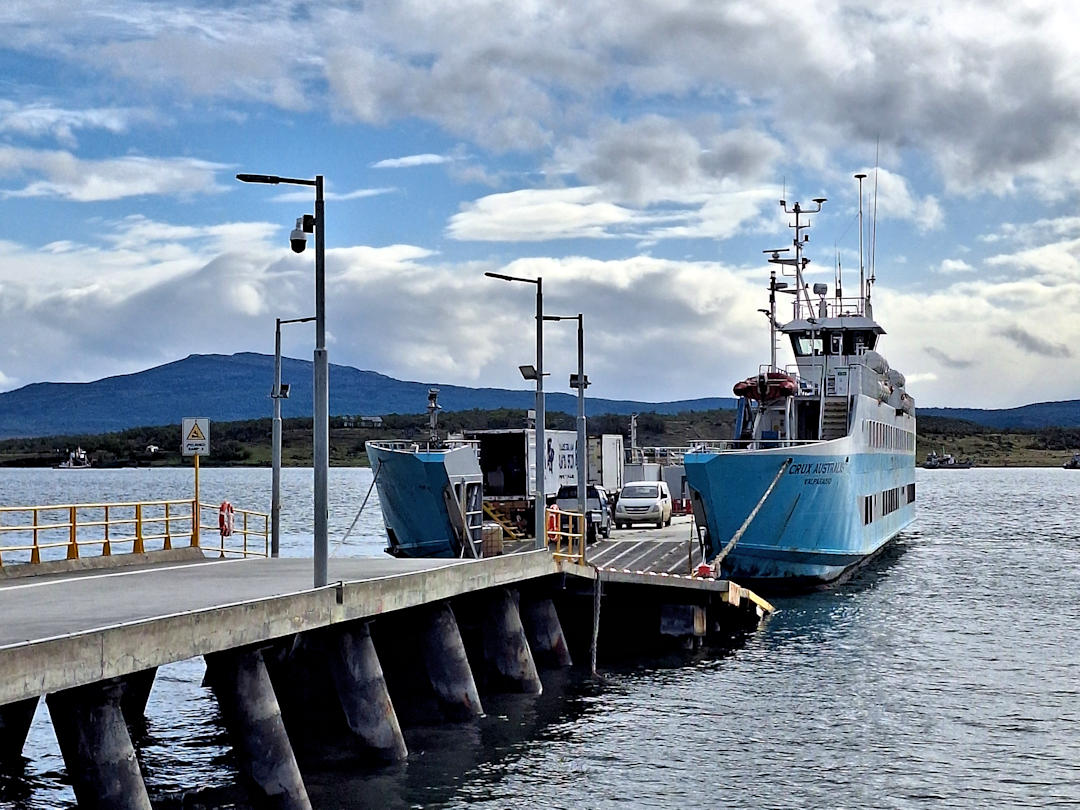
The Puerto Natales-Puerto Edén-Caleta Tortel-Puerto Yungay route is serviced by the Crux Australis, a passenger/ro-ro cargo vessel built in 2009. Measuring 69 by 16 metres, about 3/4 of the space is taken up by a (single-level) loading deck and 1/4 by the passenger quarters over two levels: with outdoor decks at the front and back of the second level (fore and aft in seamen’s terms), and a full-length top deck (with the bridge and lifesaving equipment).
On the loading deck, there are three vehicle lanes; the fourth lane houses fixed shipping containers for weather-sensitive cargo.

The Crux Australis servicing the Puerto Natales-Puerto Yungay route, is a passenger/ro-ro cargo vessel
Who is the ferry (not) for?
For locals, the ferry provides a valuable connection to and between relatively isolated Patagonian communities (with deliveries of building materials, fuel and firewood, food staples, and more – from puppies to white goods).
For travellers like us, it provides a road connection between Rutas 9 and 7 (the Carretera Austral), allowing vehicles to travel (almost) the entire length of Chile, and offers a rare opportunity to see the Patagonian fjords (in one of the most remote regions on earth) at an affordable price.
The TABSA ferry is not a cruise (far from it): if you need comforts beyond the basics, it’s not for you (more on what’s included/what to expect below). The ferry ride is also not for you if you travel with the kitchen sink. While there is a storage room for passenger luggage on board, once you get off in Caleta Tortel, you’ll have to manoeuvre your luggage along wooden walkways and up and down stairs to get to your accommodation/onward transportation.

Travellers with a lot of luggage beware: Tortel is a settlement with wooden boardwalks and stairs; the nearest bus is 1km away up a steep hill
How to book your ferry ride
The ferry has a capacity of 144 passengers (including those with a vehicle), and every passenger must have an assigned seat. Tickets can be purchased online as soon as the ferry schedule has been published on the TABSA website. While our ferry (in mid-October) had plenty of space, it may be very different during peak season (November to March). We therefore recommend booking as soon as you know our dates.
Up-to-date prices are also published on the TABSA website. Passenger fares include a reclining seat, a blanket, shared toilets and showers, three meals per day (B/L/D) at set times, and water/juice/coffee/tea at any time. During the booking process, you can pre-select your seat/s – more on the seating options below.

TABSA's Puerto Natales-Puerto Yungay service offers a unique opportunity to experience Southern Chile's fjords and remote communities
How to get to Puerto Natales (by public transport)
Most people choose Puerto Natales as a base from which to explore Torres del Paine National Park (located 2 hours’ drive north). Puerto Natales has a small airport (IATA: PNT) with flights to/from Puerto Montt and Santiago (LATAM and Sky Airline).
Puerto Natales is also in easy reach of Los Glaciares National Park in Argentina, with the bus across the border from El Calafate taking around 6 hours (operated by Bus-Sur, Marga Taqsa and Turismo Zaahj). Buses from Punta Arenas (Bus-Sur or Buses Fernández) take about 3 hours.
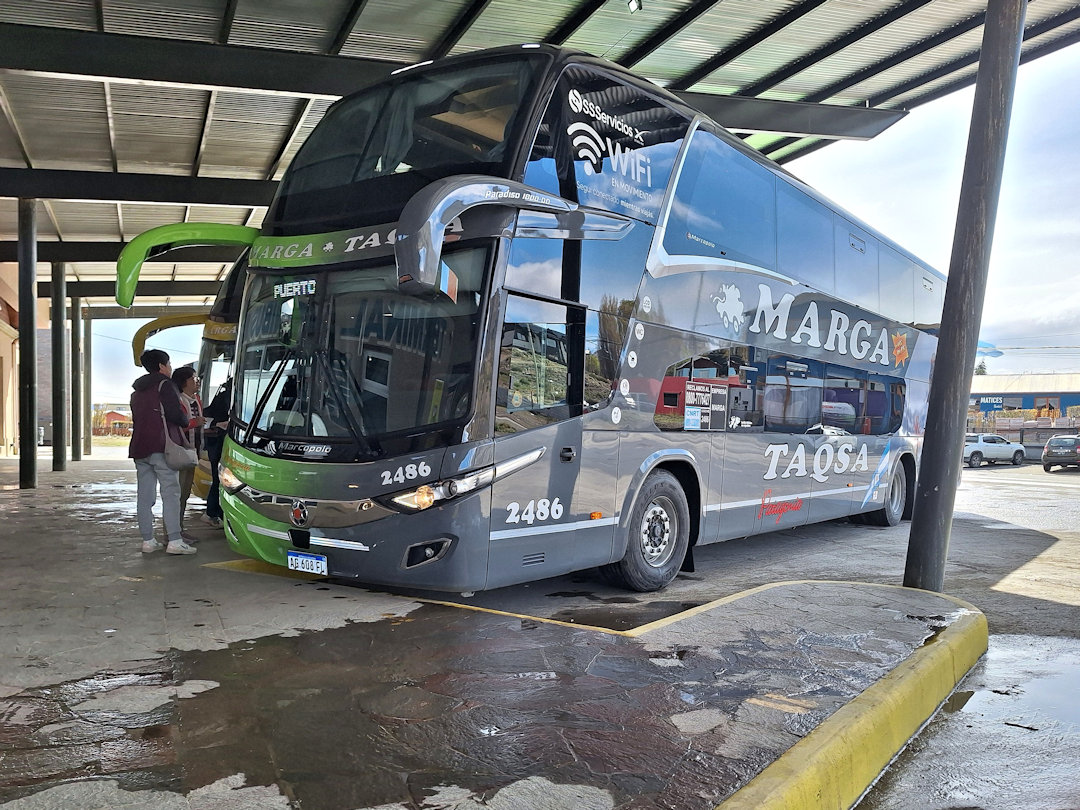
Puerto Natales has bus connections with El Calafate in Argentina and Punta Arenas as well as Torres del Paine in Chile
Buses arrive at the Terminal Rodoviario in Puerto Natales [Google Maps location]. The terminal has toilets (free at the time of our visit), food and souvenir stalls, and several tour operator and bus company counters where you can organise your onward travel or tours to Torres del Paine National Park.
Map of Accommodation, Points of Interest, Eateries and Transport
Below is a map of the recommended accommodations, points of interest, eateries, and transport terminals or stops mentioned in this article.
Essential logistics before your ferry ride
Travel Money
If you need cash, there is a BancoEstado ATM inside the terminal (we didn't use it, so we can't speak to the withdrawal limit or fees). If you can, head to the BancoEstado branch at Plaza de Armas [Google Maps location], which has three ATMs (accessible 24/7). The middle one worked for us (charging CLP5,500 for CLP400,000 - the lowest we've found in Chile).
Some tour operators in the bus terminal double as money exchanges, though we found the rates abysmal. We also checked the exchange rates offered by the rental car companies surrounding the bus terminal (which offer slightly better rates). If you have leftover ARS (or USD/EUR you want to change), we found the best rates at the Casa de Cambio opposite the Unimarc carpark [Google Maps location].
Travel Money Tips
Securing your currency needs overseas can be expensive, but it doesn't have to be. We've saved a significant amount of money over the years simply by knowing what (not) to do. Here are our key tips:
- How not to get caught out by bad FX rates and exorbitant commissions;
- How to exchange cash on your overseas trip;
- Which debit/credit card is best for your overseas trip; and
- How do you avoid unnecessary fees when withdrawing cash?
If you need to transfer money to pay for your travels upfront, we recommend Wise and XE Money Transfer (we use them interchangeably, depending on which one offers the better FX rate and lower commission).
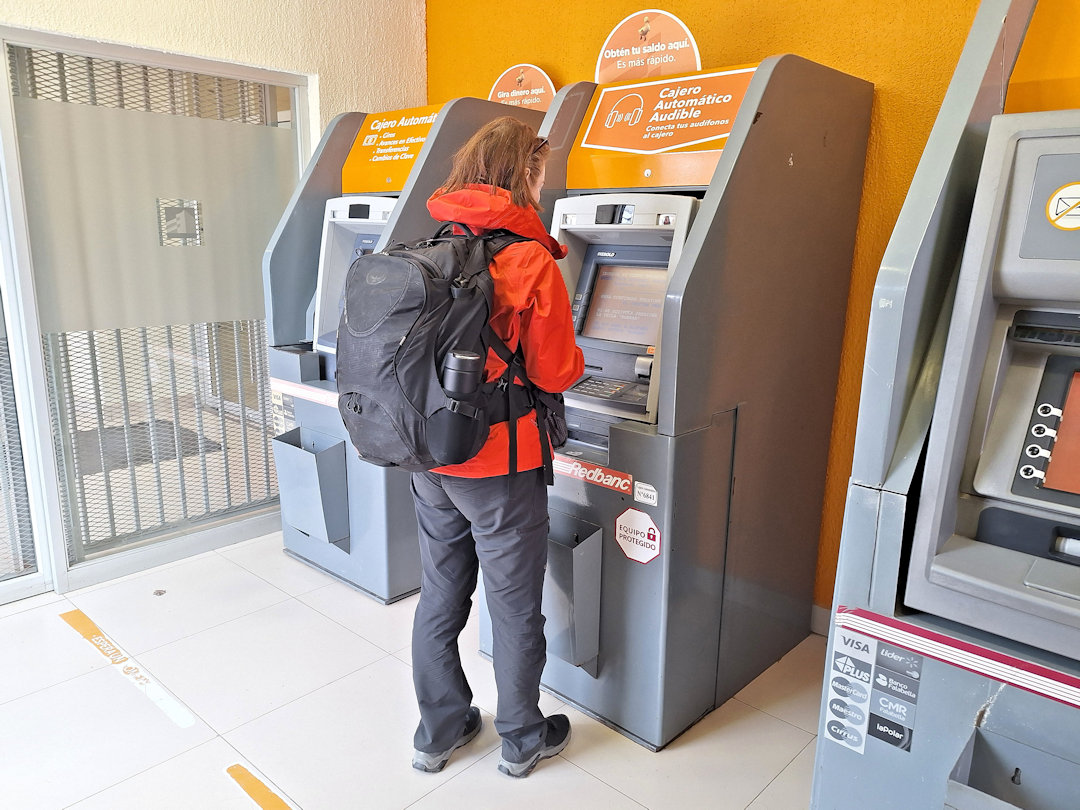
To withdraw money in Puerto Natales, we recommend the Banco Estado ATMs at Plaza de Armas
Where to eat and stock up on groceries/snacks in Puerto Natales
Puerto Natales is a mecca for foodies - you'll be spoilt for choice. Its culinary scene was even recognised by the World Food Travel Association in November 2024, which named it the Culinary Capital of Chile.
Here are our top picks (in alphabetical order):
- Alveoli Bakery [Google Maps location] - They not only sell delicious sourdough bread and to-die-for filled croissants, but also serve yummy sourdough pizza in a covered and heated beer garden-style courtyard.
- Café Artimaña [Google Maps location] - Cosy, friendly restaurant serving yummy homemade pasta and risotto dishes. Meat lovers will enjoy the Pobre Artimaña.
- Last Hope Distillery [Google Maps location] - Super-friendly, Australian-owned bar with onsite distillery - arrive early as the place gets busy. Offers free tours of the facilities at 17:30. You can even create your very own gin (by joining the Gin Lab at 15:00).
- Patagonia Black Lamb [Google Maps location] - Come here for delicious empanadas and brisket or pulled-pork burgers; the bakery is run by a passionate couple (Sebastian and Debbie) whose love for food is clear to see.
- Restaurante Jechef [Google Maps location] - A cosy family-run restaurant where every meal is made fresh from local ingredients, refined, yet well-priced. Bring a bit of time, and you won't be disappointed.
To stock up on essentials, head to the Unimarc Supermarket [Google Maps location] for groceries and Itahue Frutos Secos [Google Maps location] for nutritious snacks.

Paradise for foodies: Puerto Natales was named the Culinary Capital of Chile in 2024
Check-in/boarding (times and process)
The ferry departs from the Rampa Costanera [Google Maps location] in Puerto Natales.
Given the early morning departure time, all passengers, vehicles and cargo need to be onboard by 22:00 the night before. This also means: Every passenger will spend the night before departure on board the vessel, so there is no need to book accommodation in Puerto Natales for that night.
You won’t get dinner on board, though. Have dinner in Puerto Natales before you board (see our recommendations below) or get off after boarding and return before 22:00.

The TABSA ferry departs from the Rampa Costanera in Puerto Natales - boarding commences in stages from 12:00 the day before
Boarding occurs in stages: Cargo is loaded first (from 12:00 to 18:00). This is followed by vehicles (and passengers travelling on them), which board between 18:00 and 20:00 (our ferry had 12 vehicles on board – from motorbike to truck, all are driven on backwards and then secured). Foot passengers board last – from 20:00 to 22:00.
If you want to join a day trip to Torres del Paine National Park, make sure your tour operator can store your luggage and have you back in Puerto Natales (ideally dropped at the ferry terminal) no later than 21:30.




As a foot passenger, you first check in at the TABSA office opposite the pier [Google Maps location]. Have your booking confirmation ready. Just as when travelling by air, the attendant will give you your boarding pass. There are a few seats and toilets for those who arrive early.

All passengers must first check in at the TABSA office next to the pier, where they receive their boarding pass
When called, walk aboard and check in with the onboard attendant – ours was in the passenger lounge at the bottom right (have your boarding pass and ID/passport ready). Once checked in, collect your blanket – we got ours a floor above in the large passenger cabin (issued against your seat number). Blanket in hand, find your assigned seat, and get yourself settled (organise your luggage storage/access, have a shower, etc.).

Foot passengers embark once all vehicles are loaded and secured; show your boarding pass and ID to the onboard attendant
Life aboard the TABSA ferry – what to expect
Seating
Passengers are seated in two passenger cabins, a small one with 30 seats in a 2-1 layout at the bottom level and one large passenger cabin on the second level with another 114 seats in a (largely) 2-2 layout (60 in the front of the cabin and 54 in the back).
Seats are similar to those you find on long-distance buses around South America – they recline to about 160 degrees and have a foot rest that folds out from the seat in front. There are large windows on either side of each cabin, but those on the inside (left side in the direction of travel) overlook the ferry’s loading deck.
There are also 30 non-reclining seats with tables in the passenger lounge at the bottom level (with large windows on either side) – this is where you have your meals (more on that below) and can hang out at other times during your stay on board. The bottom passenger cabin and lounge are wheelchair accessible.

Apart from passenger cabins with reclining seats, the ferry also has a passenger lounge where all meals are served
Sleeping
While all vehicle passengers (including those with campers) have a designated seat, many on our ferry never used theirs – which means, at least at night, you can spread out to other seats: Paul slept in his assigned seat in a reclined position, while I curled up flat over the two (unoccupied) seats behind him.
The sleeping experience is not unlike a long-distance/overnight bus ride/economy flight:
- While your seat reclines more, and you have more space on the ferry, it’s still uncomfortable, and sleep is very interrupted.
- Similar to an overnight flight/bus ride, the cabin light is dimmed (to emergency lighting only) once everyone goes to bed.
- You can also nap during the day whenever the lack of sleep catches up with you.

Don't expect luxury on the TABSA ferry: You sleep on these reclining seats for 3 nights
You also have the usual human noises of shared sleeping arrangements: people snoring, going to the toilet at night, searching for something in their bags, etc. (If you’ve stayed in hostel dorms, you know what I mean.) We had a massive snorer right in front of us on the first night (while being moored in Puerto Natales). Fortunately, the engine noise (which didn’t bother us) drowned out his snoring on the second and third nights.
As you’ll be sleeping (up to) three nights like this, expect to feel slightly jet-lagged when you arrive in Caleta Tortel.
Sanitary facilities
The ferry has four toilets on the bottom level (one wheelchair accessible and another with a baby change table) and four on the second level (two at the front of the boat and two at the back). There are also two showers on the second level (opposite the front toilets). During our journey, one of the showers and the toilet opposite were out of order.
Toilets were always (surprisingly) clean and stocked with toilet paper and soap.
Showers are very compact (you have to step into the cubicle to close the door), but they have ample hot water, and there are hooks on the door to hang your stuff. Soap or towels aren’t provided; you’ll have to bring your own. At least, there was a soap dish next to the shower/above the wash basin.

The ferry has eight toilets (which are cleaned regularly)

... and two showers (which are tiny and gross)
Contrary to the toilets, our shower was never clean/ed (maybe not surprising given we only had ONE for all the people on board during our trip). We both showered just after boarding, and Paul had a second shower the night before we arrived in Tortel.
Rubbish bins were provided in each cabin, in the passenger lounge and all toilets (and regularly emptied) – though there was no separation between recyclables, organics and waste.
Food and drinks
Three meals a day are included in your ticket price. Meals are served in the passenger lounge on the lower deck at set times – in our case, breakfast was served from around 09:00, lunch from about 13:00 and dinner from around 19:00. Discuss any special dietary needs with TABSA before you book your ticket to ensure they can be catered for – we found them quick to respond to our questions.

Breakfast: Ham/Cheese Sandwich and Muffins

Lunch: Soup, Pork Roast and Mash, Yoghurt

Dinner: Soup, Spaghetti Bolognese, Apple
As the passenger lounge only seats 30, you eat in shifts of 30 people (with 20 minutes per shift) – starting with the bottom cabin, then moving on to the second level cabin in groups of 30 from the front of the boat to the back. You’ll be called by one of the stewards, either in person or over the loudspeaker. Once it’s your turn, join the queue at the serving counter at the front of the passenger lounge, take the food tray handed to you by the serving staff and find yourself a seat at one of the tables.
With up to four people to a table, meal times are an excellent opportunity to meet your fellow passengers (and practice your Spanish) – though after 20 minutes, the steward kicks you out (gently) to make way for the next tranche.
What food can you expect on the TABSA ferry?
To give you an idea, here are the meals we had on our journey (extra white bread slices were available at lunch and dinner):
Day One
- Breakfast: Ham and cheese sandwich, and two tiny muffins
- Lunch: Veggie soup with rice, Lentil stew with pumpkin and chorizo, Orange
- Dinner: Veggie soup, Chicken with tomato rice and veggies, Pear
Day Two
- Breakfast: Ham and cheese sandwich, and two tiny muffins
- Lunch: Veggie soup, Pork roast with mashed potatoes and veggies in tomato sauce, Yoghurt
- Dinner: Veggie soup, Spaghetti Bolognese, Apple
Our main courses were always substantial (too substantial for me in fact – I skipped the soup and had a smaller portion at dinner).
Free hot water (for coffee/tea), cold water and juice are available from dispensers in the passenger lounge at all times – bring your own reusable mug (or retain your paper cup for the journey) to reduce waste.
Snacks are available for purchase from a vending machine in the passenger lounge. There is also a coffee shop in the passenger cabin on the second level, but it was never open during our trip.

Free hot water (for coffee/tea), cold water and juice are available at any time - BYO milk powder if you need to
Charging, connectivity and entertainment
You’ll find 220V power outlets (at charging stations) at the front of the small cabin and the middle of the large passenger cabin, as well as in (the ceiling of) the passenger lounge (but no USB sockets).
There is no mobile signal for much of the voyage. But a Starlink dish now provides reliable and unlimited high-speed internet. You can even watch YouTube videos during the journey. While you have internet access, using Starlink makes your devices’ batteries drain much faster, so download audio/e-books, language lessons (Busuu Premium), Sudoku, etc. and operate them offline to conserve battery power.

A Starlink dish provides unlimited high-speed internet throughout the journey
TABSA also offers movies via its app, but we couldn’t download the app on our Australian/New Zealand phones. There are a few large TVs in the passenger lounges, but (apart from the safety briefing) they were never on during our journey. There is also a small library in the upstairs cabin for those who prefer reading a physical book and a children’s room downstairs (ask the crew for access).

There are charging stations in each passenger cabin and a small library in the upstairs cabin
Scenery, landmarks and stops
The ferry travels through the Kawésqar National Park [Google Maps location], Bernardo O’Higgins National Park [Google Maps location] – Chile’s largest, and the Katalalixar National Reserve [Google Maps location]. The landscape is ever-changing – from strange rock formations and waterfalls plunging into the sea, to Jurassic-like forests, snow-capped mountains and mighty glaciers.

The TABSA ferry travels through truly stunning landscapes

As one of the wettest places on earth, there are waterfalls galore
Even on gloomy days, the scenery is mesmerising (maybe even more so). Though (maybe given the hostile weather), we didn’t see as much wildlife as we’d hoped: I spotted a seal and an albatross (and plenty of other birds), and another passenger saw a dolphin.
You can watch from the large cabin windows or step outside onto the outdoor decks at the front and back of the second level or the full-length top deck when the weather allows. Navigation screens in the passenger lounge and midway through the large passenger cabin provide information on the ship’s location, projected course, any other vessels in the area, travel speed and ETA for the next stop.

Navigation screens show the ship’s location, projected course, other vessels in the area, travel speed and ETA for the next stop
And speaking of stops: On day two, the ferry stops in Puerto Edén, a remote Kawésqar indigenous community only accessible by boat. The timetable showed an arrival time of 7:00, but our actual arrival was roughly seven hours later. While cargo for the community is being unloaded, passengers can get off the ship and stroll around the pier, where local women sell home-made goods, including knitwear and apple empanadas (which were delicious).

The ferry stops in Puerto Edén, a remote Kawésqar community

...where passengers can visit the pier while cargo is being unloaded
About 1 1/2 hours north of Puerto Edén, the ferry threads through Angostura Inglesa, the narrowest part on our journey – our path lined with tiny islands covered in otherworldly forests.
Another two hours later, in the middle of the Messier Channel (the second-deepest fjord in the world), the ferry passes the eerie wreck of the Capitán Leonidas, which ran aground here on a (clearly marked) rock in April 1968. Our ferry completed a full circumnavigation of the wreck before continuing its journey north.

About 3 1/2 hours north of Puerto Edén, the ferry passes the wreck of the Capitán Leonidas, run aground on a rock in the world's second-deepest fjord
Weather/climate and ship movement
Expect rain and wind: after all, the ferry travels through one of the wettest (and windiest) regions on earth. On our mid-October sailing, we had persistent rain and strong, cold winds – always from the north/north-west. If you plan to spend time on deck, layer up; with the wind chill, it feels freezing even when it’s sunny.
Thanks to the wind, waves are higher at times (though we experienced no more than 1-2 metres). But because the ferry travels in deep fjords rather than open ocean, the crossing is generally smoother than you might expect. The ship felt surprisingly stable even when the seas were rougher – you may hear small bangs as the bow meets waves, but there’s very little swaying. If you’re prone to motion sickness, bring tablets just in case – I took (precautionary) tablets when waves reached more than one metre/the fjords were wider.

Rain is common, and it will be windy - but even in rougher seas, the TABSA ferry is surprisingly stable
As for the temperature inside, it was always toasty warm (the blanket at night is sufficient). The crew even supplied small heaters by the entry doors to keep those seated nearby comfortable.
Safety on board
At around 22:00, once all passengers are on board, a safety announcement (broadcast in Spanish and English via the TVs in the passenger cabins) kicks off your journey. Life jackets and life rafts are on the top deck (front and back). There is also a dinghy at the back of the top deck.

Life jackets and life rafts are stored on the top deck
Outdoor surfaces have been painted with an anti-slip paint, and stairs are made of a metal grid (and thus also anti-slip). That said, watch your step (especially when outside) as the floor might be uneven. Use the handrails, and take your time climbing and descending stairs. When it’s too windy, a crew member will advise you to stay inside – always follow their instructions.
Smoking is strictly prohibited except in designated areas, and alcohol or drug consumption is not permitted on board.

Watch your step and hold on to handrails as you move around the ship
Disembarking in Caleta Tortel
The ferry arrives at the main dock in Tortel [Google Maps location]. Only pedestrians and cyclists can get off here; passengers with vehicles continue to Puerto Yungay.
Tortel is a unique place: it’s primarily made up of wooden walkways. Only the upper part of town – about 1 kilometre from the pier – is accessible by road. Be prepared to carry your luggage along boardwalks, and up and down steep stairs to your accommodation/your onward bus transportation.

Tortel is a unique place and worth more than a few hours of roaming around
How long to stay in Tortel after the ferry ride?
Tortel is worth more than a few hours of roaming before hopping on a bus to Cochrane – we share our recommendations in a future article. Given the uncertainty of your arrival in Tortel (and the fact that Tortel is worth exploring a bit more), we recommend staying (at least) one night. Ask your hosts for an early check-in – ours provided it, and we were so thankful for the shower and nap in a flat bed. Even if you can’t check in early, ask your hosts if you can drop off your luggage so you can explore Tortel luggage-free.
Onward travel from Caleta Tortel
From Tortel, daily buses run north to Cochrane (for onward connections to Coyhaique), operated on alternating days by Buses Aldea and Los Glaciares. There is also a weekly service to Villa O’Higgins at the southern end of the Carretera Austral, run by Buses Andrés Silva. Find up-to-date timetables here.
Buses leave from the parking lot around the Rotonda [Google Maps location], and bus tickets can be bought here, too: Tickets for Buses Aldea, for example, are sold in the small supermarket backing the COPEC petrol station [Google Maps location].

(Almost) Daily buses connect Tortel with Cochrane in the north and weekly buses with Villa O'Higgins in the south
FAQs
Which are the best seats?
The question on everyone’s mind… In short, it depends – both passenger cabins have (dis)advantages:
The bottom passenger cabin is excellent if you are prone to motion sickness (as you’re close to the ship’s centre of gravity). Its other advantages are that it’s much smaller than the upper passenger cabin (and thus quieter when it comes to human noises), and that you’re being served your meals first. A disadvantage is that your seats are directly above the engine room (and thus, it’s louder in terms of engine noise). The windows also get opaque quickly from the sea spray – you can still see through, but visibility is not as clear as through any of the windows above.

The bottom passenger cabin is smaller but closer to the engine
The upper passenger cabin has (almost) four times as many people, so the chances of human noise throughout the night are multiplied accordingly. Another disadvantage is that you’re being served your meals later (especially if you’re sitting in the back of the cabin). On the flipside, better visibility through the windows (essential at times when it’s impossible to be on deck) is an advantage of the second-level cabin. During bad weather, you also don’t need to step outside to get to the passenger lounge, as it’s connected to the cabin by a set of (indoor) stairs.

The upper cabin is (almost) four times larger than the lower cabin but quieter in terms of engine noise
Another important consideration when selecting your seat/s is the location of your seat/s within the cabin: Try to be as far away from the doors/stairs as possible, as this means fewer interruptions.
We chose two (side-by-side) seats in the bottom cabin with a window towards the loading deck (seats #21 and #22, in the third row from the back). The engine sound didn’t bother us, and our cabin had empty single seats with outward-facing windows, which we occupied during the day. The only thing that was a nuisance was the TV mount between our row and the row in front of us (#18 and #19): Paul knocked his head on it three times (giving him a blood-crusted hump to prove it).

Crux Australis layout provided by TABSA - with some of our own additions
I booked ferry tickets, but can no longer use them. Can I get a refund?
Unfortunately, the ferry tickets are non-refundable, and you can’t use your ticket on any other TABSA service either. Date changes are possible, though, as long as you request them at least 7 days before the ship’s departure (in person at a TABSA office/agent or via email).
Can I buy my ferry ticket at the last minute (online or in person at the pier)?
Our ferry had plenty of space, but we travelled at the end of the low season (mid-October). So, the low season (notwithstanding any public holidays should be alright. There is no wait list (as far as we are aware); once every seat is sold (to passengers with and without vehicles), it’s fully booked for TABSA (even if people don’t turn up). Given that the ferry only operates every 6 days during peak season, you may want to book your trip at least a few days in advance.

The Crux Australis is limited to 144 passengers (with and without vehicle) - Book your ferry ride in advance to avoid missing out
How reliable are the departure/arrival times?
The journey’s timing depends on tides and weather conditions; therefore, TABSA states its arrival times as indicative. If the conditions are beneficial, your ferry may leave Puerto Natales before 5:00 (ours left at 4:30).
ETAs for your next stop are displayed on the navigation screens, but can change at any time during your journey. We finished day one ahead of schedule, but arrived in Puerto Edén seven hours late (14:00 instead of 7:00 on day two). The 7:00 arrival time in Tortel, as stated when we booked our tickets (and shown on signs in the TABSA office upon check-in), turned out to be spot-on in our case. But your journey may be different altogether (the ferry a week later arrived in Tortel at 5:00).
It’s also worth keeping in mind that unforeseen events unrelated to weather can occur: mechanical failure, for example. We therefore don’t recommend organising your onward travel before you reach Tortel (or at least give yourself enough buffer).
If you’ve booked accommodation in Tortel, stay in contact with your host and advise your ETA as you approach Tortel – especially if they offered to pick you up from the pier. We provided updates when we departed Puerto Edén, before we went to sleep on day 2 and again in the early morning as we weaved our way through the channels around Tortel.

The journey from Puerto Natales to Caleta Tortel takes anywhere from 42 to 50+ hours, depending on weather conditions, traffic and other factors
What happens with my luggage during the journey? Are there overhead bins/lockers?
There is a luggage storage room (the first door on your right as you board the ship), which will be locked after boarding is complete (and is thus inaccessible during your journey).
Small lockers (barely carry-on size) are at one end of each passenger cabin (as well as in the passenger lounge on the ground floor). Lockers are free of charge and available on a first-come, first-served basis. You can set your own access code. Some seats also have an overhead metal rack to store stuff on or hang towels to dry – though those are few and far between.

Luggage not required during the journey is stored in a locked storage room

Luggage lockers are available on a first come/first served basis (as numbers are limited)
We recommend bringing only what you need for the journey and leaving the rest in the storage room. You’ll get a little paper tag as a receipt, which you’ll need to show when you collect your luggage at your destination (so don’t lose it).
What to keep with you during the ferry ride
- Hygiene: towel, toiletries, fresh underwear/socks
- Sleep: eye mask, earplugs, inflatable pillow
- Food and water: refillable water bottle, mug, snacks
- Power and internet: universal adapter, a lightweight power bank (this is the one we use on long travel days), charging cables, headphones
- Deck time: warm layers, rain jacket/poncho, beanie and gloves; on nicer days: sunscreen, sunglasses
What is the internet like? Can I make or take video calls?
We were prepared to be completely offline for the entire journey. So, the Starlink dish on the top deck (with routers in each cabin) came as a complete (but pleasant) surprise. We measured download and upload speeds of 72.5Mbps and 12.8Mbps, respectively. While the speed is good enough for video calls, it defeats the purpose of travelling through unique landscapes, and we would recommend conducting video calls only from the passenger lounge (outside meal times) to avoid disrupting other passengers.

The wifi on board is reliable and fast enough to make video calls (best outside of meal times in the passenger lounge)
Learning Spanish before your trip?
You don’t need fluency to travel well, but knowing some Spanish can make everyday situations easier and more meaningful. Busuu offers a practical way to practise the language before you go, so you can decide how much effort is actually worth it before committing to classes or courses.
Won’t I get bored (especially when the weather is bad)?
While some people find it challenging to slow down, we didn’t have a problem with it. We enjoyed having the time to read/listen to our (audio) books, watch videos, do sudoku, look out at the surrounding landscapes from our cabin window (or have a nap) when the weather was too bad to be outside.
We also enjoyed chatting to our fellow passengers, exchanging travel tips, learning about Chilean customs and practising our Spanish. Having the Starlink internet enabled us to catch up on work, too.
Eating three (substantial) meals and not exercising as usual was a challenge for us, though (especially for Paul, who runs almost every day). We made the effort to walk around the decks whenever the weather was okay and it was safe to do so, and we highly recommend doing the same.

Exercise on the ship is limited to walking around the decks
How cool is the ferry journey from Puerto Natales to Caleta Tortel?
We’ve answered all the questions we had before taking the TABSA ferry. But everyone is different. If you’ve got any other things on your mind that we didn’t cover, please let us know. And if you’ve taken the TABSA ferry recently and noticed changes, we’d be stoked to hear about them, too.
Before you go, if you liked our article and found it helpful, we would appreciate it if you could share it with your friends and family via the Share buttons below. Even better: Leave a short review on Trustpilot or Google, which would help us further build our online reputation as a (trustworthy and helpful) travel and lifestyle blog.