


This article may contain links to products and services we use and recommend. We may receive compensation when you click on links to those products. For more information, see our Disclosure Policy.

We didn’t set out to take the Tren Maya. After spending 3 1/2 weeks in Cuba, we found ourselves in Bacalar – enjoying a break and looking for the best way to reach Palenque, our next destination. Most travellers take the overnight bus. But with the launch of the much-hyped Tren Maya, travelling by train suddenly became an option.
Choosing the Tren Maya wasn’t straightforward: As responsible, budget-conscious travellers, we struggled with the new railway’s controversies. Thus, this article isn’t just a review of our journey, with all the practical tips you might need if you’re planning to travel by train. It’s also a personal reflection on how to navigate an ethical dilemma.
Starting with the basics: What (and where) is the Tren Maya?
The Tren Maya is a government-funded railway project that connects five southeastern Mexican states – Quintana Roo, Yucatán, Campeche, Tabasco and Chiapas – via more than 1,500 kilometres of new and existing tracks. Its stated purpose is to promote regional development, increase tourism in less-visited areas, create jobs in local communities and reduce road accidents.
Starting in 2020, the railway opened in stages from late 2023 to late 2024. While some final construction work was still being completed when we took it, the Tren Maya now connects Cancún and Palenque – and various major cities and archaeological sites in between – via two routes:
- Along the Gulf of Mexico (sections 1-4), the train travels from Palenque to Escárcega, San Francisco de Campeche, Mérida, Izamal, Chichén Itzá and Valladolid before reaching Cancún.
- On the Caribbean route (sections 5-7), the train connects Cancún with Playa del Carmen, Tulum, Bacalar and Chetumal, before heading inland and back to Escárcega and Palenque, taking in the archaeological sites of Kohunlich, Dzibanché-Kinichná, Calakmul, Balamkú and El Tigre.
For current stops and operational details, see the official Tren Maya map.

With over 1,500km of tracks, the Tren Maya connects five Mexican states, and major archaeological sites with key cities and holiday hot spots
The project has made headlines for the scale and speed of the build. But this has also come with a lot of controversy:
- Construction has cleared significant stretches of jungle, affecting fragile ecosystems, sparking protests from Indigenous communities over land rights and a lack of meaningful consultation.
- While the government promotes jobs, improved access and newly created protected areas, critics have warned of irreversible ecological and social damage.
While some locals see opportunities, others remain wary of change that wasn’t truly theirs to choose. We’ll talk a bit more about our thoughts below.

Construction of the Tren Maya brought jobs and visitors to more remote areas but also negatively affected fragile ecosystems and indigenous communities
Why (not to) take the Tren Maya?
The Tren Maya offers travellers a more comfortable alternative to the usual long-distance/overnight buses and car rentals/long drives across the Yucatán Peninsula and Southern Mexico. But as with many things, the train journey comes with pros and cons:
- On the Bacalar to Palenque stretch, the train journey takes 2-3 hours less than the overnight bus trip. Contrary to the bus journey, you can get up and walk around. And because you don’t need to concentrate on driving, you can enjoy views of the jungle and villages, read a book, or sleep.
- In line with the project’s goals, the railway services remote locations – including the less-frequented archaeological sites in Campeche, for example, which would require multiple modes of transportation (or a rental car) to reach – making these sites indeed more easily accessible with the Tren Maya.
- CO₂ emissions aren’t as straightforward. At this stage, the Tren Maya runs mostly on Diesel. With plans to electrify about 50% of the tracks, its carbon footprint will drop. However, it will still beat the long-distance buses only if the trains run at near-full capacity and the electricity comes from renewable sources.
- At this stage, tickets for the Tren Maya are only cheaper (than the overnight bus) for travellers from the five states the train connects. On the Bacalar to Palenque stretch, the train is up to a quarter more expensive for Mexican citizens (not living in those five states), and international travellers pay up to 2/3 more than for the overnight bus (depending on how far in advance you book).

The Tren Maya will only have a lower carbon footprint than long-distance buses, if the route is being electrified, and the trains run at near-full capacity
Where, when and how to book tickets for the Tren Maya?
Speaking of booking… Buying tickets for the Tren Maya is straightforward, but there are some quirks.
- Where to book: At this stage, tickets can only be booked via the (slightly temperamental) Tren Maya booking platform. If you don’t speak Spanish and the English version doesn’t work, use Google Chrome’s Translate function.
- When to book: Fares are cheaper the further in advance you book. While the Bacalar to Palenque route was near empty when we travelled (it was the last stretch to open in December 2024), the Palenque-Mérida train that passed us in Escárcega was packed. Thus, book at least a few days in advance if you want a specific seat or are travelling during busy periods (especially on the more established routes).
- How to book: Select your origin, destination and travel date. On the following screens, choose your class (Turista or Premier) and your seats. Enter your details (a passport is required for international travellers) and pay by Visa or MasterCard.
Tickets are emailed as PDFs – print or save them offline on your mobile phone.
Want to learn some Spanish before your trip?
You don’t need fluency to find your way around and connect with locals on your travels. But knowing some Spanish can make everyday situations easier and more meaningful. Busuu offers a structured way to learn the basics of a language before you go, and it’s easy to combine the app with language school studies, too.

Book your Tren Maya ticket at least a few days in advance if you want a specific seat or are travelling during busy periods (especially on the more established routes)
What to expect during the journey?
Getting to the Bacalar train station from Bacalar
The Tren Maya station is a few kilometres north of Bacalar town [Google Maps location]. To get here, you have two transportation options:
- The shuttle from the ADO Terminal in Bacalar [Google Maps location] costs MXN25 per person. The shuttle schedule is coordinated with the train timetable – inquire about up-to-date departure times at the ADO Terminal in Bacalar.
- If your travel group comprises 2 or more people, and you’re not staying in walking distance from the ADO Terminal, a door-to-door taxi will be the more affordable (and convenient) option. Expect to pay between MXN50 from Downtown Bacalar and MXN120 from the southern hotel area – we paid MXN70 from Casa Momo. It’s wise to arrange a pickup the night before.

The Tren Maya departs from Bacalar's modern new station located a few kilometres out of town
Pre-boarding
The station is modern with a large entry hall, clean bathrooms, luggage lockers and a small café (which was closed when we visited). Immediately outside the station is a play area for children and a drinking water dispenser.
In preparation for your train’s arrival, station staff will check your ticket and ID, then lead you through the barriers. Like an airport security check, you and your luggage must go through a screener (note that alcohol is not permitted to be brought onto the train).
Once through security, you will cross to your platform (via an underground passage). At the platform level, there is a waiting area and more bathrooms.

After a security check, passengers are led to the platform waiting area before boarding the Tren Maya at Bacalar Station
On the train
Tren Maya offers both Turista (standard) and Premier (first class) carriages. While in both classes, seats can’t be reclined, they are comfortable, with good legroom and large windows. The only real difference between the two classes is that Turista has four seats per row, while Premier has three. Each seat has USB or power outlets (though don’t count on them working during your trip).

The Tren Maya's Tourist Class has four comfortable seats per row...
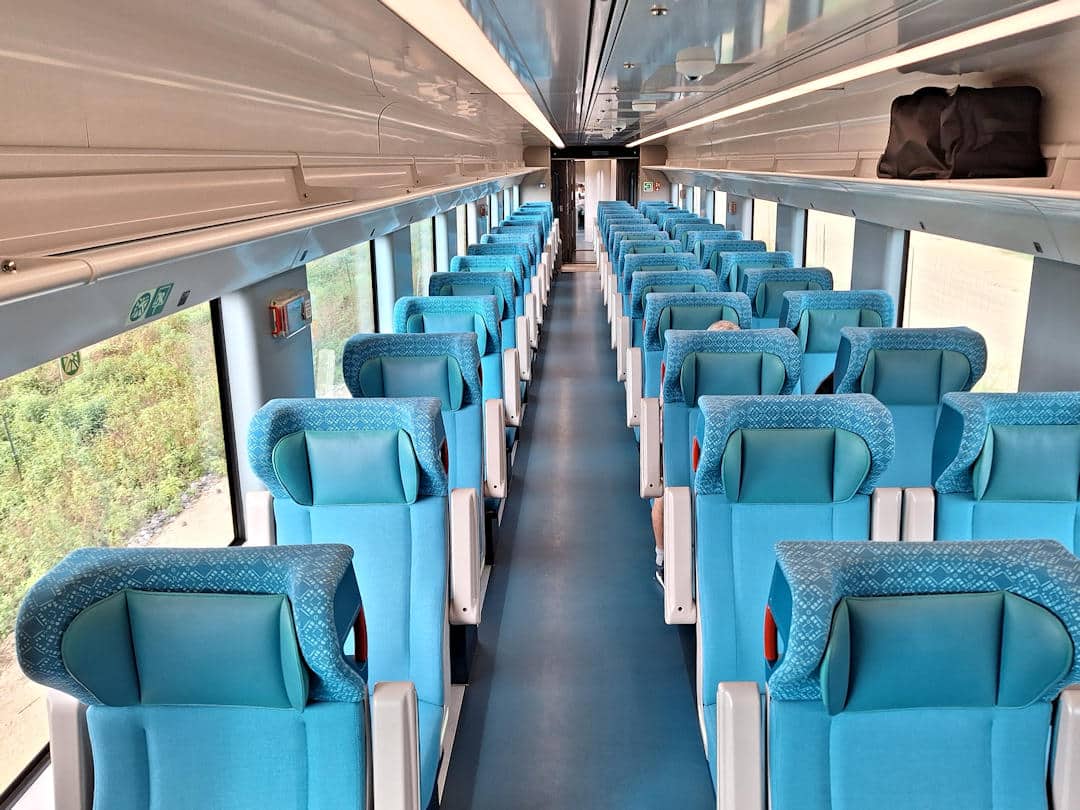
... while the Premier Class on the Tren Maya is a little more spacious
Explore Other Rail Journeys
Are you a rail travel enthusiast or (just) a mindful traveller? Embark on an overland journey of a different kind with our collection of rail travel adventures. Whether from Budapest to Romania or between Bar and Belgrade in Europe, Yogyakarta to Malang in Indonesia, or between Bacalar and Palenque in Mexico, each of our articles offers detailed travel advice, valuable insider tips and thoughtful reflections on intentional slow travel.
The journey
We found our seats facing backwards when we boarded, even though we’d booked forward-facing seats. We later learned that the train reverses direction in Escárcega. Even though the journey from Bacalar to Escárcega is much longer than from Escárcega to Palenque, the booking system showed only the direction of the latter stretch.
As our train was almost empty (we counted about 20 travellers, not including staff), we just changed seats to face forward and moved to our reserved seats in Escárcega. Changing seats is harder when the train is full. We hope that eventually, the booking system will reflect the entire journey so that travellers can make an informed decision as to which seats to book.
Another noteworthy point: As the train crossed into Campeche state (just after Nicolás Bravo/Kohunlich), you change time zones: Campeche, Tabasco and Chiapas are one hour behind Quintana Roo.

While not reclinable, the seats aboard the Tren Maya are comfortable, with a lot of leg room (and a footrest)
- Arriving at platform 1 (and letting passengers off/on),
- Moving out of the station and then back into the station to stop at platform 2,
- Waiting for the northbound Palenque-Mérida train to stop at platform 1,
- Moving out of the station and back to platform 1 after its departure (where we stopped again with doors remaining closed),
- until finally continuing our southward journey to Palenque.
If it hadn’t been for the switchbacks at Escárcega, our train would have arrived in Palenque on time. The switchbacks added a bit over 30 minutes to our schedule. While the train made up some of it, we arrived in Palenque about ten minutes behind schedule. Once the track works in Escárcega are completed, there will be no more switchbacks, and the train should arrive on time.

While jungle is the main feature coming from Bacalar, between Escárcega and Palenque, the Tren Maya goes right through towns and villages
The stretches between Bacalar and Escárcega, and between Escárcega and Palenque are noticeably different:
- Bacalar to Escárcega: Section 7 of the Tren Maya runs on elevated tracks through the jungle. While you see the occasional settlement in the distance, it’s (primarily) dense greenery flying by your window.
- Escárcega to Palenque: On section 1, the landscape changes from dense jungle to (mostly) open farmland, and the train regularly passes right through towns and villages.
We had read about the impact the construction of the Tren Maya had on communities – often slicing villages in two, with monstrous (yellow-painted) overpasses adding insult to injury – but seeing it was a different story. The train didn’t slow down as it travelled through (we measured 150km/h as the maximum speed during our journey), and we even recognised the houses of those who were relocated: Painted in beautiful colours, the houses all had the same design. We often wondered how different the lives of those displaced would be now.

As the Tren Maya travels from Campeche into and through Tabasco, it crosses open farmland and rivers
Facilities at Palenque train station
Arriving in Palenque, we found a modern and spacious station with step-free access, clean bathrooms and luggage lockers. While there’s a covered waiting area, there aren’t many shops or food outlets, so don’t count on grabbing snacks here.
Getting to Palenque from the train station
Like many other Tren Maya stations, the Palenque Terminal is a few kilometres out of town [Google Maps location].
The cheapest transportation option into town is the ADO shuttle bus, which departs shortly after each train arrives. Just before you exit the station, there are vending machines to the left, where you can buy tickets (MXN35 per person). The bus drops passengers at the ADO Station in town [Google Maps location].
A taxi is the most convenient choice for those staying further from the ADO Station. Taxis wait outside the Tren Maya station. Expect to pay around MXN200 for the ride into town.

The ADO shuttle is the cheapest way to travel from the Tren Maya Station to the centre of Palenque
Stay connected the moment you land
We use Airalo eSIMs on (almost) every trip to avoid roaming charges and the hassle of buying a local SIM. You can install your eSIM before you travel and get online as soon as you arrive. Airalo works in 200+ countries (we've used it across the Americas, Europe and Asia), but not everywhere - so check coverage before you buy.
New to Airalo? Use code NEWTOAIRALO15 for 15% off
Already a customer? Use AIRALOESIM10 for 10% off
How to navigate Tren Maya’s sustainability issues as a responsible traveller?
We acknowledge that the Tren Maya is controversial, and we found ourselves wrestling whether to travel by train or bus. In the end, we decided to take the train, because
- we wanted to experience it first-hand (to then share our learnings with you), and
- we concluded that, given the railway had already been built and was operational, boycotting it now wouldn’t reverse the environmental or social impacts of its construction. On the contrary: low ridership might exacerbate the adverse effects without delivering potential benefits to local communities.
When it came to the latter – potential benefits – we felt that, as responsible travellers, we could do more by directly supporting local communities impacted by the Tren Maya.
Choosing local family-run hospitality businesses helps keep money in the communities. Even better, many accommodations and experiences fund community initiatives, so your funds go right where they’re needed most:
- Community Tours Sian Ka’an (Muyil & Chunyaxché): Eco-tours led by local Maya guides in the Sian Ka’an Biosphere – small boat trips, wildlife watching, and cultural storytelling.
- Maya Ka’an Community Ecotourism Network: A collective of over 70 Maya communities offering low-impact tourism – birding, nature walks, and cultural exchange across remote villages.
- Centro Ecoturistico Kíichpam K’áax: Immerse yourself in Maya culture during your stay at the ecotourism center run by Maya families.
- Co’ox Mayab Community Ecotourism Network: An association of Maya cooperatives providing cultural and nature experiences, such as homestays, cycling, and cooking workshops.
- Hokol Vuh – Yaxunah Community Tourism: A community-operated initiative offering Maya village stays, traditional meals, workshops, and deeper cultural engagement.
- Cooperativa Turistica de Yaxunah: Stay with this Maya community 25 minutes’ drive from Chichen Itza and learn from the women of the village about their efforts to preserve native seeds, as well as traditional arts like wood carving and hand embroidery.
- Walk or cycle the Camino del Mayab, a 110 kilometres/68 miles long trail created in 2020 to reverse centuries of colonial exploitation in Yucatán.
Calakmul Community Tours: A network of local enterprises offering guided nature hikes, birdwatching, archaeological site visits and local crafts near Calakmul Biosphere Reserve.
- Top Che Ecotourism Camp (Lacandona Jungle): A Maya–run camp offering cabins, interpretive jungle trails and cultural immersion near Ocosingo.
- Indigenous Dining Experience (San Cristóbal de las Casas): Enjoy a five or seven course degustation menu created by Tzotzil chef Claudia Sántiz and her team with organic, locally sourced ingredients.

Once peaceful resting places, even village cemeteries are now right next to train tracks
When it comes to the Tren Maya’s carbon footprint, we hope that the Mexican government will eventually fund the complete electrification of the railway (from renewable sources).
Before we wrap up: Where to stay pre/post your Tren Maya journey?
Both Bacalar and Palenque have a wide variety of options to stay for any budget. For a positive impact, choose accommodations at small, family-run guesthouses to help ensure money stays in the community.
Where to stay in Bacalar
| Name | Property Features | Price Indicator | Book Now |
|---|---|---|---|
| Casa Momo 1 | Self-catered apartment in a quiet part of town yet in walking distance to the public swimming pier | $$ | Book Now |
| Casa Momo 2 | Self-catered apartment in a quiet part of town yet in walking distance to the public swimming pier | $$ | Book Now |
| Elmar Hostel | Beautifully designed hostel with dormitories and private rooms, a shared kitchen and a lot of outdoor space to relax; free bicycles also available | $$ | Book Now |
| Playa Laguna Bacalar Beach Front | Hotel with beachfront and garden bungalows, breakfast and bicycle and kayak use included | $$ | Book Now |
Where to stay in Palenque
| Name | Property Features | Price Indicator | Book Now |
|---|---|---|---|
| Small Cloud | One bedroom apartment with AC and small but well-equipped kitchen in walking distance to the centre of Palenque | $$ | Book Now |
| Lunas Apartment | Spacious, centrally located yet quiet one bedroom apartment with AC | $$ | Book Now |
| Casa Hadassa La Canada | Centrally located but quiet hotel with air-conditioned private rooms and a well-equipped shared kitchen | $$ | Book Now |
Planning another unforgettable rail journey?
Discover how to ride the historic Panama Canal Railway and pair it with visits to both the Pacific and Caribbean locks — all without paying for costly tours.
Before you go, if you liked our article and found it helpful, we would appreciate it if you could share it with your friends and family via the Share buttons below. Even better: Leave a short review on Trustpilot or Google, which would help us further build our online reputation as a (trustworthy and helpful) travel and lifestyle blog.