

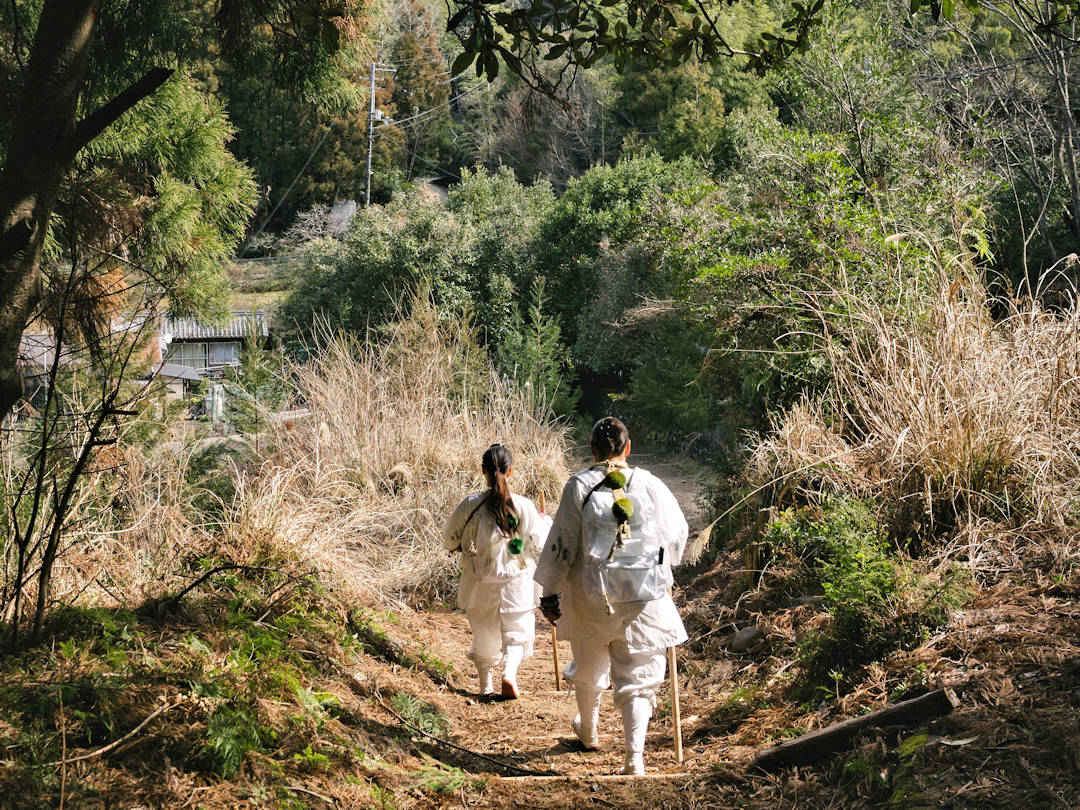
This article may contain links to products and services we use and recommend. We may receive compensation when you click on links to those products. For more information, see our Disclosure Policy.

Whether you’re after a rewarding outdoor experience or an enriching spiritual journey with one-of-a-kind hospitality, the Kumano Kodo has it all. Hiking the Kumano Kodo was one of our best experiences in Japan (and indeed, one of our all-time favourites). In this guide, you will find all the information you need to create your own unforgettable hiking adventure on the ancient pilgrimage trails of Japan.
Where is the Kumano Kodo (and what’s so special about it)?
The Kumano Kodo is a network of over 1,000-year-old pilgrimage routes on the Kii Peninsula of Japan‘s main island, Honshu. These trails have been connecting
- the ancient Imperial capitals of Nara (710-784) and Kyoto (794-1868),
- the important religious centres at Mt Kōya (home of Shingon Buddhism) and Mt Ōmine (home of Shugendō mountain ascetics), and
- Ise Jingū (home of Amaterasu, the mythical ancestress of the Imperial House of Japan)
with the Kumano Sanzan, among the most important Shinto religious sites in Japan.

The religious sites connected by the Kumano Kodo include Koyasan, founded by Kōbō Daishi in 816
Kumano Sanzan - the three Grand Shinto Shrines of the Kumano Kodo
Kumano Hongū Taisha
Kumano Hongū Taisha [Official website, Google Maps location] is located in the centre of the Kii Mountains, at the confluence of the Kumano and Otonashi Rivers. Its original entrance is marked by the world's largest shrine gate (called Torii) - the Ōyu no hara Torii - which is 34 metres high and 42 metres wide. Having been destroyed by floods (and rebuilt) a few times in its history, Kumano Hongū Taisha was relocated from its original site along the Kumano River to higher ground nearby in 1889. Among others, Kumano Hongū Taisha enshrines Izanagi, the founding father deity of Japan.
Kumano Nachi Taisha
Kumano Nachi Taisha is the second Grand Shrine in the Kii Mountains [Official website, Google Maps location]. It's uniquely positioned on the side of a mountain high above the Nachi River and next to Nachi Falls - at 133 metres, Japan's tallest single-drop waterfall and the home of Hiryū Gongen, another important Shinto deity. Nachi-san (as the sacred complex is often called) is also home to Seiganto-ji, a Temple of the Tendai School of Buddhism, and a holy 850-year-old Camphor tree, which is said to grant wishes to worshippers who walk through its hollow trunk.
Kumano Hayatama Taisha
The third Grand Shinto Shrine, Kumano Hayatama Taisha [Official website, Google Maps location], is located on the east coast of the Kii Peninsula, in Shingū City near the mouth of the Kumano River. The Grand Shrine is home to a sacred 850-year-old Podocarp tree called Nagi no Ki. It is said that Izanagi and Izanami, the mythological couple that created Japan, first arrived in the area on a rock named Gotobiki Iwa. The rock marks the location of Kamikura-jinja, the original shrine, which pilgrims can reach by climbing a narrow 500-step stairway a few hundred meters south of the main complex.
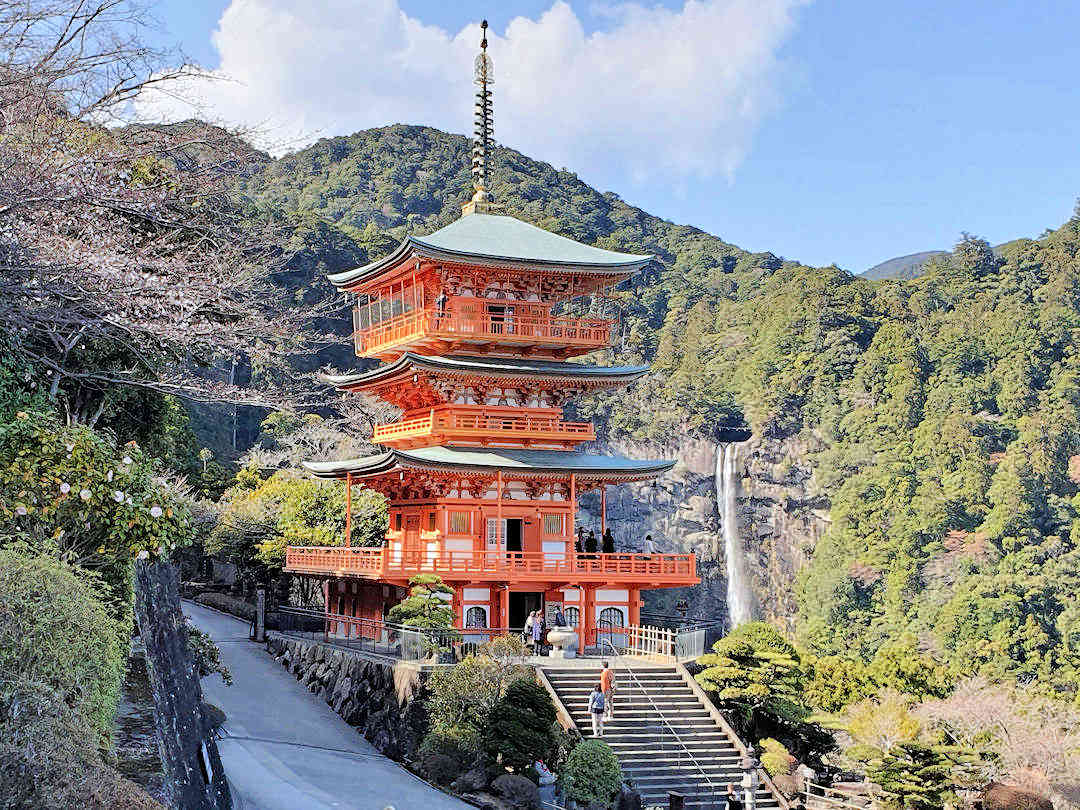
Nachi-san (which includes Nachi Falls) is one of three sacred sites comprising the Kumano Sanzan
In 2004, the sacred sites and pilgrimage trails on the Kii Peninsula were designated a UNESCO World Heritage site. Six of the ancient routes have been (partially) preserved. We have highlighted these routes (and the three Grand Shinto Shrines) on the map below and will discuss each route in more detail in this article.
What to expect when hiking the Kumano Kodo (compared to the Camino de Santiago)?
Religious/Spiritual Context
The Kumano Kodo and the Camino de Santiago are both renowned religious and spiritual pilgrimages. However, while all routes of the Camino de Santiago end at the Cathedral of Santiago de Compostela [Official Website, Google Maps location], the Kumano Kodo connects multiple sacred sites, allowing pilgrims to hike between them in either direction.
Both pilgrimages have pilgrim passports, and stamps can be collected along the route to receive official recognition:
- The minimum distance required for ANY of the Camino routes is 100 kilometres on foot or 200 kilometres by bicycle.
- The Kumano Kodo offers official recognition only on two of its six routes: three recognised options on the Nakahechi and the Kohechi route from Koyasan to Kumano Hongu Taisha.
Unlike the Camino de Santiago (and, to us, surprisingly), many of the people we spoke to on the Kumano Kodo did not choose it for religious or spiritual reasons. Instead, they sought refuge from the hustle and bustle of the big cities with a peaceful and immersive outdoor experience.
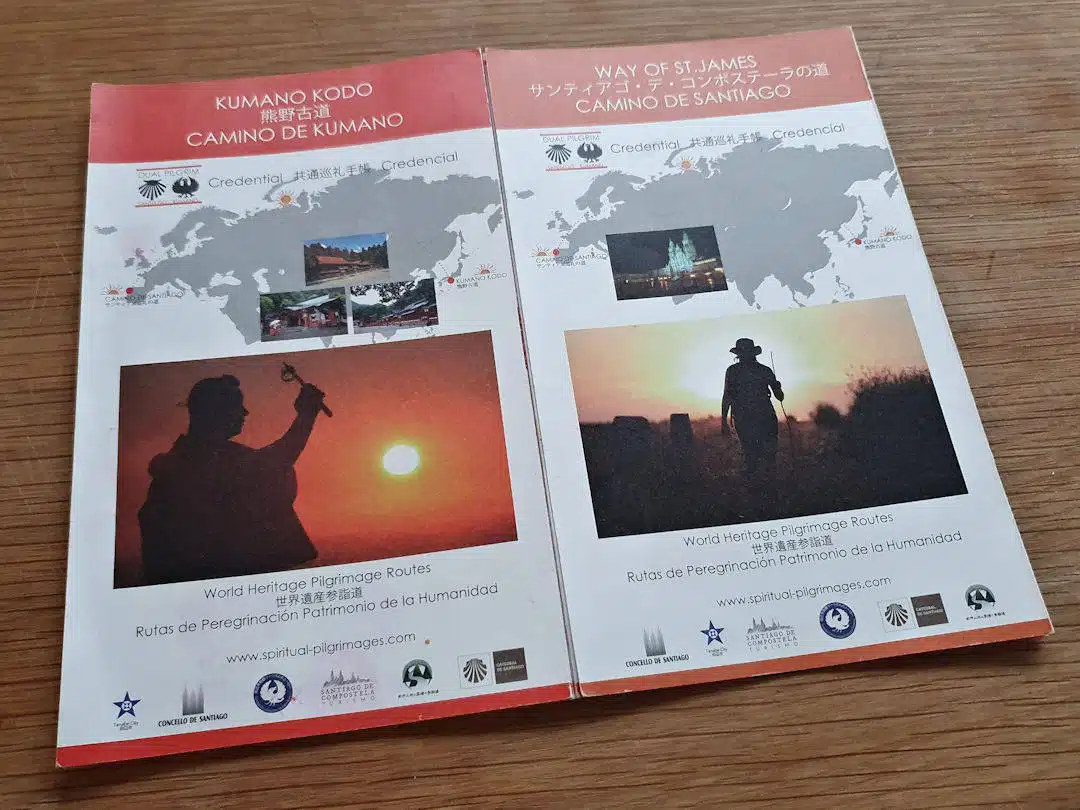
Pilgrims who do both the Camino de Santiago and the Kumano Kodo can become Dual Pilgrims
Terrain and Climate
Another significant difference between the two pilgrimages is the level of difficulty. All Kumano Kodo routes are (significantly) shorter, but the three mountain routes – the Omine Okugake Michi, Kohechi and Nakahechi – are (significantly) more physically demanding than the Camino routes. To give you an idea: On the Nakahechi (the easiest of the three mountain routes), we hiked 67 kilometres over five days, with an elevation gain of 3,400 meters. Long stretches of uphills and downhills, often on slippery terrain, put a strain on your feet, legs and knees. Therefore, on the mountain routes of the Kumano Kodo, a decent level of fitness is a must, and the use of trekking poles is highly recommended.
Both pilgrimages take you through some of the wettest regions of their respective countries: Galicia in Spain and the Kii Peninsula in Japan, so carrying a raincoat or poncho is essential in both cases.
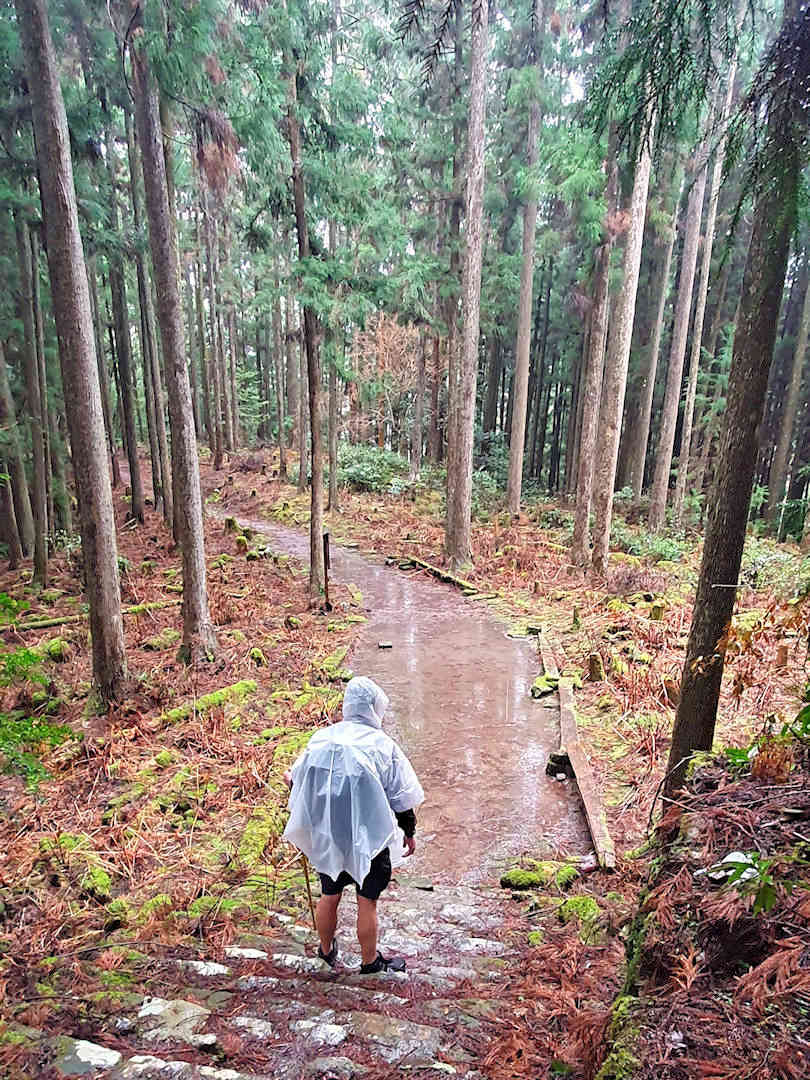
The Kii Peninsula is one of the wettest regions of Japan, so bringing a raincoat or poncho is essential when hiking the Kuman Kodo
Logistics and Infrastructure
While both pilgrimages pass through beautiful natural landscapes, the mountain routes of the Kumano Kodo – the Nakahechi, the Kohechi and the Omine Okugake Michi – lead mainly through forests and over mountain passes, and (significantly) fewer (and smaller) villages compared to the Camino. The coastal routes of the Kumano Kodo – the Iseji, the Kiiji, and the Ohechi – on the other hand, reminded us somewhat of the Camino Portugués de la Costa.
Unlike the Camino de Santiago, where pilgrims can usually find accommodation upon arrival (especially in the off-season), lodging on the Kumano Kodo mountain routes must be booked in advance, with the availability and location of accommodation dictating the distance hiked each day. On the most challenging route, the Omine Okugake Michi, you need to bring your camping gear.
Way markers are present on both pilgrimages, helping pilgrims stay on the trail. In many places, signs even indicate trails that are not part of the Kumano Kodo, making it hard to get lost. Most way markers are made of wood or stone, but in some cases, especially on (parts of) the more remote mountain routes, it may just be an arrow and ribbons. So, check your location regularly using offline maps that track your GPS.

Signs indicate trails that are not part of the Kumano Kodo, making it hard to get lost
Distance markers on the Camino count down the kilometres to the Cathedral of Santiago de Compostela (and on to Cape Finisterre). On the Kumano Kodo Nakahechi route, numbered markers (approximately every 500 meters) count up towards Kumano Hongū Taisha (and down towards Kumano Nachi Taisha). On the last stage of the Kohechi route, 33 statues of Kannon (the Buddhist deity of compassion and mercy) count down your distance to Kumano Hongū Taisha.
The symbol of the Camino de Santiago is the scallop shell, while the Kumano Kodo is symbolised by the three-legged crow (known as Yatagarasu).
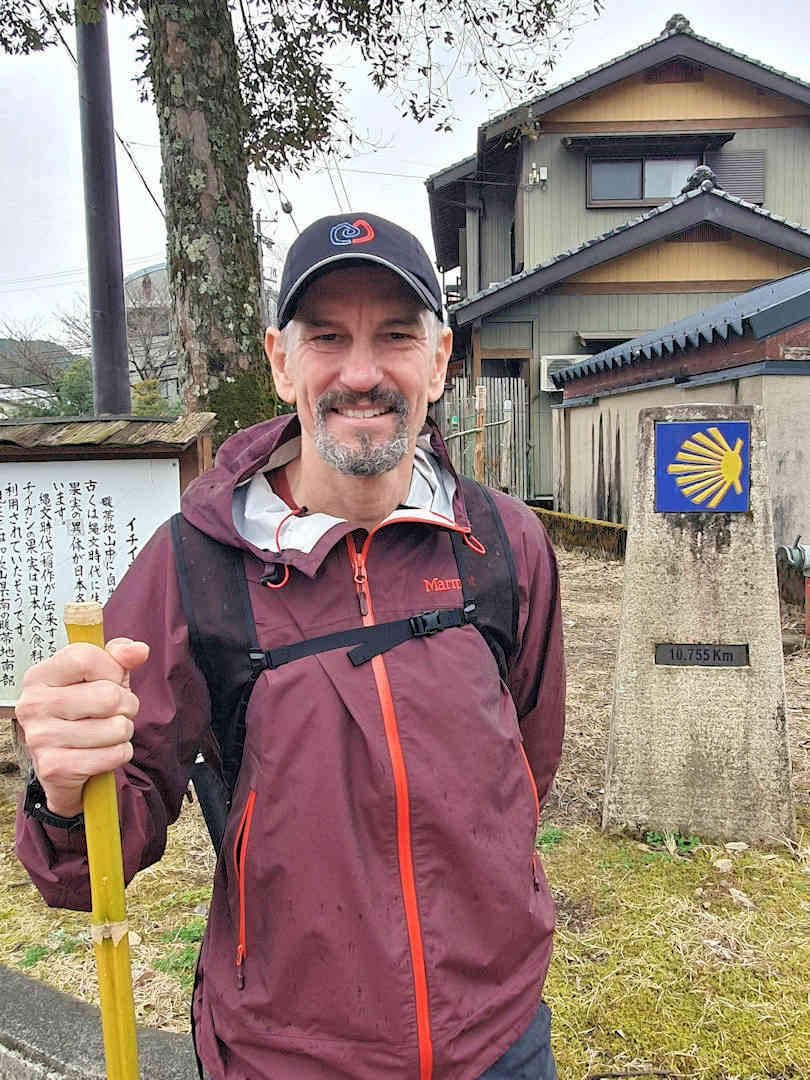
A Camino de Santiago distance marker can even be found in Hongu
Which Kumano Kodo route to choose?
Which of the six Kumano Kodo routes to choose will depend on the following:
- how many days do you have?
- the time of year of your visit,
- your fitness levels,
- your thirst for adventure/risk tolerance, and
- the gear you have (and are happy to carry on your back).
The three coastal routes (Iseji, Kiiji and Ohechi) are relatively straightforward (and easily accessible) routes that can be hiked in (shorter) stages. The Nakahechi route is more challenging but still easily accessible. It can be done as a (multi-day) point-to-point hike or in day hikes from a central base.
The Kohechi takes it up a notch from the Nakahechi. The complete route can only be done as a 4-day through-hike. Only the last section (from Totsukawa Onsen [Google Maps location] to Kumano Hongu Taisha) could be done as a day hike (from Hongu). The Omine Okugake Michi is the most challenging route. It can only be done as a through-hike, although it can be shortened by two days by avoiding the Ōminesan-ji Temple area (which is not accessible to female hikers).
To help you decide which Kumano Kodo route is the right one for you, we compare all six routes in more detail below (in alphabetical order):
| Start | Finish | Full Length | Hiking Days |
|---|---|---|---|
| Ise-Jingu Naiku (Ise City) [Google Maps location] | Inland branch (Hongudo): Kumano Hongū Taisha (joining the Nakahechi Route at Banze-toge Pass) Coastal branch (Hamakaido): Kumano Hayatama Taisha | 170 kilometres | 7-14 days (4-6 days for most popular section) |
Description
- The eastern coastal route has a maximum elevation of approximately 700 metres.
- The most popular section is the 78-kilometre-long Central Section from Umegadani [Google Maps location] to Hana no Iwaya-jinja [Google Maps location] (the oldest Shinto shrine in Japan and gravesite of Izanami, the founding mother deity of Japan)
- The route splits at Hana no Iwaya-jinja (Kumano City) with one branch heading inland and one branch continuing along the coast.
- Scenery highlights comprise river valleys, forests, quiet villages, mountain passes, ocean views, beaches and rice paddies.
| Start | Finish | Full Length | Hiking Days |
|---|---|---|---|
| Hachikenya-hama, Osaka [Google Maps location] | Tokei-jinja, Kii-Tanabe [Google Maps location] | 160 kilometres | 8-14 days (4-7 days for most popular section) |
- The western coastal route has a maximum elevation of around 300 metres.
- The most popular section is from Fujishiro-jinja (Kainan) to Kii-Tanabe (approximately 80 kilometres).
- Scenery highlights comprise quiet suburban neighbourhoods and villages, Daisen-ryo Kofun/Tomb of Emperor Nintoku (Sakai City), river valleys, rural countryside, orchards, forests, mountain passes and ocean views.
| Start | Finish | Full Length | Hiking Days |
|---|---|---|---|
| Koyasan Kongobu-ji [Google Maps location] | Kumano Hongū Taisha (joining the Nakahechi Route at Sangen-jaya) | 70 kilometres | 4 days (or day hike for final section only) |
Description
- This remote mountain route has a maximum elevation of approximately 1,200 metres.
- Its northern passes are snowed in and thus closed from mid-December to mid-March.
- The final section (Totsukawa to Kumano Hongū Taisha) is open all year and can be done as a day hike.
- Scenery highlights comprise forests, mountain passes, quiet villages and onsens.
- Bear sightings are possible.
| Start | Finish | Full Length | Hiking Days |
|---|---|---|---|
| Takijiri Ōji [Google Maps location] | Kumano Hongū Taisha / Kumano Nachi Taisha / Kumano Hayatama Taisha | 70 kilometres | 2-5 days (pending section chosen) |
Description
- This mountain route crosses the Kii Peninsula from West to East and has a maximum elevation of approximately 900 metres.
- Scenery highlights comprise forests, mountain passes, quiet villages, river valleys, onsens and ocean views.
| Start | Finish | Full Length | Hiking Days |
|---|---|---|---|
| Tokei-jinja, Kii-Tanabe [Google Maps location] | Fudarakusan-ji, Nachikatsuura [Google Maps location] | 90 kilometres | 4 days (2 days for recommended section) |
Description
- The southern coastal route offers a maximum elevation of around 500 meters.
- Due to heavy urbanisation, only the section from Kii-Tonda to Mirozu (approximately 37 kilometres) is recommended. Another worthwhile section leads through the forest from Uragami to Fudarakusan-ji (approximately 15 kilometres).
- Scenery highlights comprise the Ago-no-Watashi ferry crossing, mountain passes, forests and ocean views.
| Start | Finish | Full Length | Hiking Days |
|---|---|---|---|
| Yoshino Kinpusen-ji [Google Maps location] | Kumano Hongū Taisha | 90 kilometres | 7-8 days (5-6 days if started south of Ōminesan-ji Temple at Mt Daifugendake) |
Description
- This very remote alpine mountain route through Yoshino Kumano National Park has a maximum elevation of 1,900 metres.
- The route is largely uninhabited. It is a training route for Shugendō practitioners (mountain ascetics) from early May to end of September.
- Large drops are frequent, and some sections along cliff faces and ridgelines require the use of (installed) ladders, ropes and chains.
- Scenery highlights comprise mountain passes, forests, river valleys and panoramic mountain vistas.
- The Ōminesan-ji temple area is inaccessible to women, requiring a detour (or more southern start) for female hikers.
- Bear sightings are possible.

A small detour on the Iseji route takes you past the Maruyama Senmaida rice terraces | Photo by Soichiro Ito on Unsplash
When is the best time to hike the Kumano Kodo?
The best time to hike any of the Kumano Kodo routes is in Spring (March to May) or Autumn (mid-September to early December): The temperatures are perfect for hiking, there is enough daylight to finish each day’s stage without stress, and all service providers are open for business. On top of that:
- In Spring, you can witness the beautiful blooming of flowers and trees (including cherry trees).
- Autumn is a great time to enjoy the vibrant colours of the foliage change.
If you want to hike the Kumano Kodo in Winter (December to February), your options are reduced to the coastal routes (Iseji, Kiiji, and Ohechi) and the section from Hosshinmon-oji to Kumano Hongū Taisha on the Nakahechi route. Hiking all other Kumano Kodo routes in Winter is not recommended (even impossible) for various reasons:
- the days are shorter, leaving you insufficient time to finish stages during daylight hours, and
- alpine mountain passes are snowed in (and thus closed from mid-December to mid-March).
Summer (June to August) is typhoon season, which means it is hot and humid, with a lot more rain (and wind), making it less ideal for hiking. Summer also means some nasty critters are way more active (more on that below).
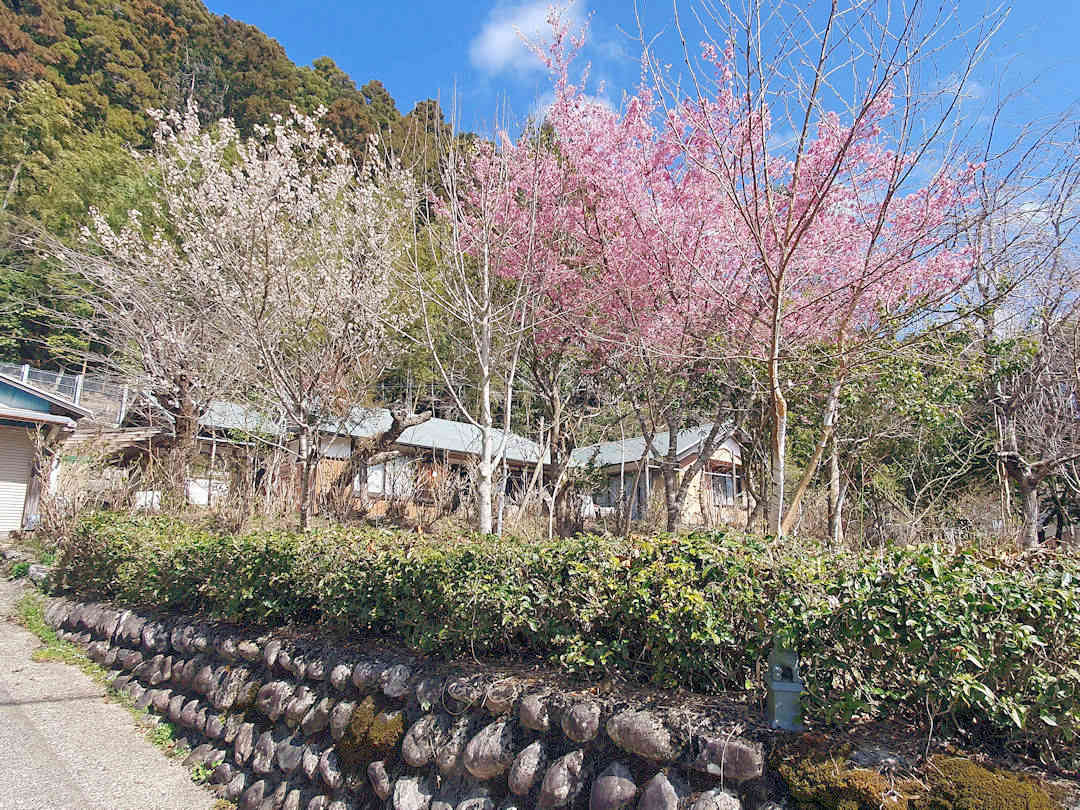
Spring is one of the best seasons to hike the Kumano Kodo
How to get to the Kumano Kodo?
Reaching the Kumano Kodo is relatively straightforward, especially when utilising Japan‘s efficient public transportation network, although it does require some time.
The Kii Peninsula is south of and roughly halfway between Osaka and Nagoya. The nearest international airports are Kansai International Airport [Google Maps location, IATA: KIX] located on an island south of Osaka, and Chubu Centrair International Airport [Google Maps location, IATA: NGO) on an island south of Nagoya. The closest regional airport is Nanki-Shirahama Airport [Google Maps location, IATA: SHM], located south of Kii-Tanabe, which offers regular flights to and from Tokyo International Airport (Haneda) [Google Maps location, IATA: HND].
The most common access points to the Kumano Kodo are as follows:
- Ise City (Iseshi): The JR Rapid Mie train takes 1.5 hours from Nagoya Station. From Iseshi Station, a bus ride of approximately 30 minutes will get you to Ise-Jingū Naiku.
- Umegadani: It takes just under 3 hours from Nagoya Station on the JR Nanki Limited Express and JR Kisei Local Shingū trains (a change is needed at Taki Station).
- Kumanoshi (the nearest train station to Hana-no-Iwaya-jinja): The JR Nanki Limited Express takes just over 3.5 hours.
- Hachikenya-hama is just outside Osaka’s Temmabashi Station (Tenmabashi-eki).
- Kainan (the nearest train station to Fujishiro-jinja): The JR Kuroshio takes just under 1 hour and 15 minutes from Shin-Osaka or Osaka Stations.
- The Nankai Limited Express or Nankai Koya Line trains from Osaka’s Namba Station to Gokurakubashi Station take 1 hour and 30-45 minutes.
- From Gokurakubashi Station, the Nankai Koyasan Cable car takes you to Kōyasan Station in 5 minutes.
- The bus ride from Kōyasan Station to the trailhead near the Senjuin-Bashi bus stop takes 10 minutes.
If you are planning to hike from Kumano Hongū Taisha to Kōyasan, your closest access points are Shingū and Kii-Tanabe (with bus rides from there taking between 1 hour and 1 hour 45 minutes) – see the Nakahechi tab on how to get to both from Nagoya/Osaka.
- Kii-Tanabe (the nearest town on the western side of the Kii Mountains) – The JR Kuroshio Limited Express train gets you there from Shin-Osaka or Osaka Stations in just under 2.5 hours.
- Kii-Katsuura and Shingū (the nearest towns on the eastern side of the Kii Peninsula) – From Nagoya Station, Shingū can be reached on the JR Nanki Limited Express train in approximately 3.5 hours (and Kii-Katsuura in about 4 hours). If you’re coming from Shin-Osaka or Osaka Stations, the JR Kuroshio Limited Express train takes about 4 hours to Kii-Katsuura (and 4 hours 15 minutes to Shingū).
From either of those access points, a bus ride is required to get to the starting point of your hike. Pending the selected route and starting point, this bus ride can take anywhere between 25 minutes and 2.5 hours. As the route and starting point chosen determine which access point is most suitable, we’ll cover this topic in more detail in our sample itineraries.
- Kii-Tanabe is the closest train station to Tokei-jinja – see the Nakahechi tab on how to get to Kii-Tanabe from Osaka.
- From Kii-Tanabe, the JR Kinokuni Local Shingū train takes you in just under an hour to Mirozu, 1 hour 45 minutes to Kii-Uragami and just over 2 hours to Nachi Station. The bus ride from Nachi Station to Nachi-san takes just under 20 minutes.
- Yoshino is the nearest train station to Yoshino Kinpusen-ji. It can be reached from Osaka’s Abenobashi Station using the Kintetsu Limited Express train in just over 1 hour and 15 minutes. The nearby ropeway, one of the oldest in Japan, whisks you up the mountain in under 5 minutes. The Kintetsu trains are not covered by the JR Pass.
- If you are planning to hike from Kumano Hongū Taisha to Yoshino Kinpusen-ji, your closest access points are Shingū and Kii-Tanabe (with bus rides from there taking between 1 hour and 1 hour 45 minutes) – refer to the Nakahechi tab to learn how to get to both from Nagoya/Osaka.

The JR Kuroshio Limited Express connects the Kii Peninsula with Osaka | Photo in Wikimedia Commons
Given the time it takes to get to most access points, it is not recommended to travel from Nagoya, Osaka or further afield on the day you plan to start your hike. Likewise, we do not recommend booking your flight out of Kansai International Airport [Google Maps location, IATA: KIX] or Chubu Centrair International Airport [Google Maps location, IATA: NGO] on your last day of hiking.
Is there public transportation along the Kumano Kodo?
The short answer: It depends. The three coastal routes are loosely traced by railway lines (and some local buses), making it relatively easy to join or leave the routes.
It’s different for the three mountain routes, where buses are the only form of public transportation (if they exist at all). The ancient Kumano Kodo mountain routes do not align with the modern road network (or vice versa), so the opportunities to join or leave the Kumano Kodo mountain routes are limited to the few occasions where the routes intersect with the bus network. Furthermore, buses go very infrequently. So, depending on the schedule, you may have to wait a few hours for the next bus.
Out of the three mountain routes, the Nakahechi is best serviced by buses, and you can join/leave the Kumano Kodo at various points. Check our itineraries for recommendations on standard entry and exit points, and visit the Tanabe City Kumano Tourism Bureau website for up-to-date bus timetables.
If you want to leave or join the Kohechi, the best option is to do so at Totsukawa Onsen. If you want to leave or join the Omine Okugake Michi, the best entry or exit point is the Wasamata-guchi bus stop (approximately 24 km from Mt. Daifugendake, located south of the Ōminesan-ji sacred boundary/exclusion zone for women).

Make sure to check the bus schedule as buses on the Kii Peninsula are very infrequent
Where to stay and how to book accommodation on the Kumano Kodo?
Traditional Japanese inns (known as Minshukus and Ryokans) are the most common form of accommodation on the Kumano Kodo (except the Omine Okugake Michi route), offering a unique cultural experience:
- You will be sleeping on futons in rooms with tatami floors and paper-thin sliding doors (if you’re a light sleeper: bring earplugs).
- Bathrooms are shared among the guests.
- Many of these inns feature hot springs (onsen) – a blissful way to relax and rejuvenate after a long day of hiking.
- Most inns offer home-cooked meals through meal plans (more on that below).

Traditional Japanese inns are the most common form of accommodation on the Kumano Kodo
Accommodation options along the Kumano Kodo are limited, particularly on the Kohechi and Nakahechi routes. We therefore recommend booking all your accommodations well in advance.
Traditional inns are often run by local families who don’t speak English (or very little). If you speak Japanese, you can contact the inns and make your reservation by phone; email is still relatively uncommon.
If you don’t speak Japanese, use booking platforms such as Booking.com, which list some guesthouses along the trail and provide a convenient and familiar way to secure your accommodation (we booked three of our five nights through these platforms), or make your reservation via the Kumano Travel website.
For easy reference, here are our accommodation recommendations on the Kumano Kodo Nakahechi route – from West to East (* where we stayed):
- Guest Cafe Kuchikumano* is a 1-star guest house with 5-star service. Highly recommended as a great starting accommodation for your pilgrimage.
- Guesthouse Ogawaya has free WiFi, a washing machine and a fully equipped kitchenette with a microwave and toaster.
- Guesthouse Takao, a 3-star property, also has a restaurant to make your stay more indulgent and memorable.
- Minshuku Momiji-no-Sato is a small rental house at the east end of the sleepy main street of Chikatsuyu village, directly on the Kumano Kodo route. It can be booked through Kumano Travel.
- Guest House AGAE (pronounced “ah-gah-eh”) is a lovingly renovated rental house in Chikatsuyu village. It too is booked through Kumano Travel.
- Minshuku Nakano* is a family-run guesthouse located in the southern part of Chikatsuyu village. The shared lounge area is nice.
- J-Hoppers Kumano Guesthouse* is situated in Yunomine Onsen, a 20-minute bus ride or 3 km / 1 hour walk on the Kumano Kodo Pilgrimage Route from Kumano Hongu Taisha.
- Guesthouse Yui is situated in Hongu, a short 10-minute walk from Kumano Hongu Taisha.
- Guesthouse Okagesan has two Japanese-style rooms, a living room, a kitchen, a bathroom and a toilet in the property. Couples particularly like the location.
- Koguchi Shizen-no-Ie* is an old junior high school that has been beautifully renovated as a lodge.
- @koguchi is a renovated house that used to belong to the owner’s grandmother, located just outside of Koguchi – owner will pick up/drop off hikers and cook her grandma’s recipes.
- Minshuku Momofuku is run by Mr. Nakazawa, a friendly retiree. This tiny guesthouse has only two rooms.
- Minpaku Kodo was a family home that was re-purposed into a guesthouse.
- WhyKumano is a friendly hostel with air-conditioned rooms and a shared kitchen.
- Chochu Stay So House is a very clean property near public transport.
- Guesthouse Yuzu is located just outside the Kumano Hayatama Taisha grounds. It features western and Japanese-style rooms with air-conditioning, free WiFi, free bikes and parking, and a shared kitchen, terrace and garden.
- Kokoyui Guesthouse Shingu is a beautiful, modern-looking, renovated older Japanese home in a quiet residential area of Shingu City. and can be booked through Kumano Travel.
- Shingu Guest House has private accommodation in Shingu with access to a garden, a shared lounge, and a shared kitchen.

Interacting with your Japanese hosts and other guests is a wonderful experience
Kumano Travel is a locally run agency that connects pilgrims with guesthouses and local activities. Their website provides a list of guesthouses in each location, along with details on meal plans, pricing and reviews. Once you have found an inn you like, complete a booking request and submit it. Kumano Travel typically responds within 24 hours, either confirming your booking or offering alternative options if your preferred guesthouse is unavailable.
It is important to note that Kumano Travel’s cancellation policy is quite strict, so it is essential to review the terms and conditions before making a booking. Once you have paid for your accommodation through the booking system, you will receive a booking confirmation to present to your inn upon arrival.
Is (wild) camping allowed on the Kumano Kodo?
On the Kumano Kodo, camping outside designated campgrounds is allowed only on the Omine Okugake Michi route, where the Misen Hut is the only serviced accommodation option among otherwise basic, unstaffed mountain huts and other shelters (the latter operating on a first-come/first-served basis).
There are several campgrounds on the
- Iseji: Naosobimura, Ise-Kashiwazaki, Furusato Onsen and Owase
- Kohechi: Omata
- Nakahechi: Chikatsuyu, Kawayu Onsen, Watase Onsen and Koguchi
- Ohechi: Kii-Tanabe, Tonda and Susami.
Some campgrounds may be off the actual Kumano Kodo trail, requiring additional walking from/to the trailhead. Booking is recommended (especially during Golden Week). In addition to dedicated campgrounds, you may also be able to camp on private land in the villages you pass through (after asking for permission).

On the Kumano Kodo, camping outside of designated campgrounds is only allowed on the Omine Okugake Michi route | Photo by Scott Goodwill on Unsplash
What about food (and water) on the Kumano Kodo?
How much food and water you should carry when hiking the Kumano Kodo will depend on the route you choose and the number of days you are planning to hike. Additionally, when booking accommodation in Japan (not just on the Kumano Kodo), you are commonly offered a meal plan, such as dinner only, breakfast only (one meal), dinner and breakfast (two meals), or dinner, breakfast, and lunchbox (three meals). It may be advisable to book a meal plan, depending on the route you choose. I’ll talk about both options (with and without a meal plan) in more detail below.
How much to carry (and where to stock up)
The coastal routes regularly pass through villages with small grocery stores/convenience stores or family-run restaurants, which means you can stock up (at least) at the end of each day and generally only need to carry enough food and water to sustain yourself through the day.
That said, shops and restaurants may not be open on the day of your hike, so always bring extra food. The coastal routes also have drink vending machines (at relatively regular intervals). To reduce the amount of plastic waste, however, we recommend refilling your water bottle at your accommodation before you start your hiking day.
Meal Plan
Given the prevalence of shops and eateries along the coastal routes, booking a meal plan is not generally needed. Do check though in advance that the shops and/or eateries you intend to visit are open on the day of your hike.
How much to carry (and where to stock up)
There are hardly any shops or restaurants in the small villages along this route; thus, booking a meal plan is recommended (see below). There are some water refill opportunities along the Kohechi, but you can’t rely on them, so make sure to fill up your water bottle each morning (and en route as needed).
Meal Plan
Given the remoteness of the trail and the lack of shops/restaurants, we recommend booking a full meal plan (dinner, breakfast and lunch box) for each of your overnight stays on this route.
How much to carry (and where to stock up)
On the Nakahechi route, you will pass through and stay in small villages (with small shops and eateries), so you only need to carry enough food and water to sustain yourself through the day. That said, we would encourage you to always carry extra food as these small businesses may not be open when you need them.
Some guest houses also sell food items to guests (for example, instant noodles, microwaveable meals, biscuits and muesli bars). And if you pass through Yunomine Onsen, you can boil eggs and sweet potatoes in the hot spring:
- You can buy both at the small grocery store across the road, but Yumune Chaya, the teahouse adjacent to the Yumune Kusushi Tōkō-ji Temple (squeezed between the river and the public onsen), offers the best price.
- Hang the little bags the eggs/sweet potatoes are sold in on the nails in the wooden frame around the hot spring and wait until they’re done (around 10-15 minutes).
While there are some places along the trail where you can fill up your water bottle, they are not as frequent. Therefore, it is advisable to fill up your water bottle at your accommodation before starting your hike in the morning (and en route as needed).
Meal Plan
We hiked the Nakahechi route largely without a meal plan, buying provisions for breakfast and lunch (sandwiches, boiled eggs, rice balls, etc) before our hike and at the small shops along the route, and eating dinner at one of the small restaurants in the villages or buying ingredients to cook at our accommodation.
That said, if you are hiking on a Sunday (when most shops are closed), stay in accommodation without a guest kitchen (most of them don’t have one) OR if you are hiking from Kumano Hongu Taisha to Kumano Nachi Taisha (or vice versa), we recommend to include a meal plan (for peace of mind and the experience). Our dinner in Koguchi was huge, the buffet breakfast (with scrambled eggs, sausages/bacon and toast) was a good base, and our lunchbox (supplemented with snacks) was sufficient to get us through the day.
How much to carry (and where to stock up)
Given the remoteness of this route, you will have to carry sufficient food for your entire hike – only the Misen Hut offers meals, and there are no villages along the route. Some mountain huts offer the opportunity to refill your water bottle; otherwise, you will need to refill from mountain streams (though they are not always reliable, so make sure you fill up whenever you can).
Meal Plan
The Misen Hut is the only serviced accommodation along this route. If you’re planning to stay in the hut, booking the full meal plan is recommended.
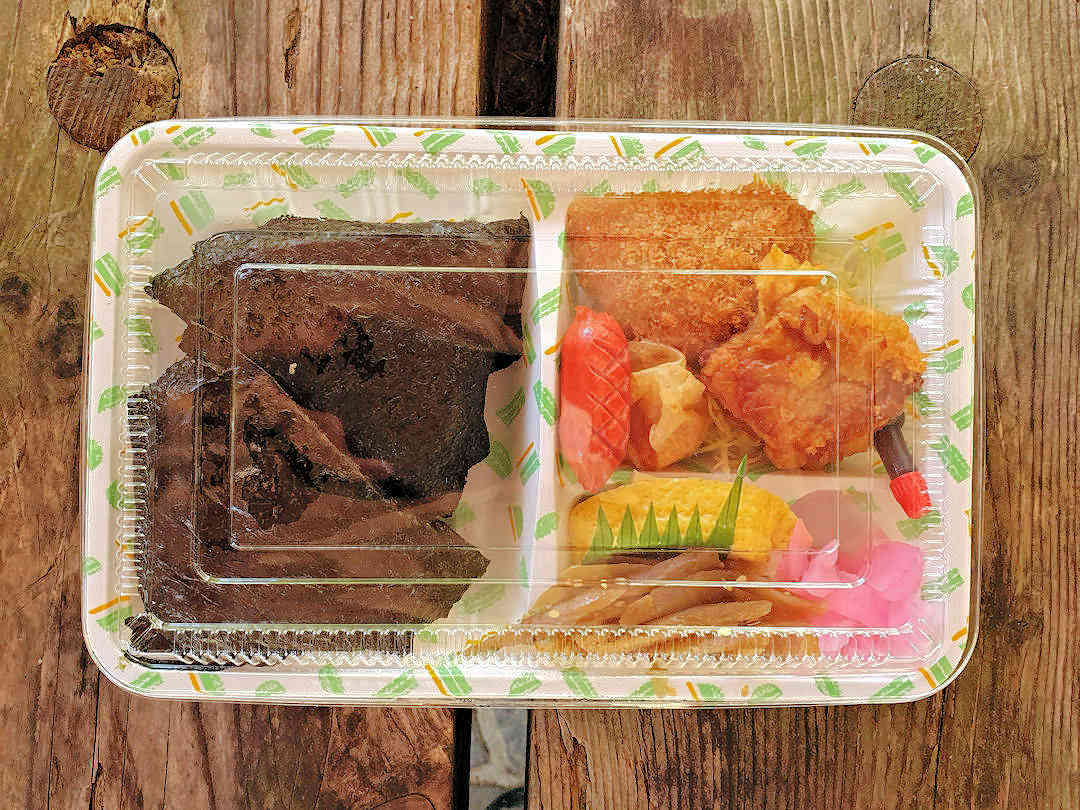
Meal plans with lunch boxes can be a worthwhile inclusion when booking accommodation along the Kumano Kodo
What to do with excess luggage during the Kumano Kodo?
Chances are that you don’t just come to Japan to hike the Kumano Kodo. So what do you do with any luggage you don’t need to schlepp around on the trails? You can either store any excess luggage (and pick it up afterwards) or forward it to your next destination.
Luggage storage options
Before we headed to the Kii Peninsula, we reduced the content of our travel packs to the absolute minimum, leaving everything we didn’t need (including our laptops) in a separate bag in Osaka. If you need a place to store your excess luggage, Daikoku near Osaka’s Shin-Imamiya Station [Google Maps location] is a safe and convenient option. With storage costs of JPY80 per day for a carry-on-sized bag, Daikoku is also significantly more affordable than coin lockers (which have time limits as well).
If you’re travelling through Kii-Tanabe, you can also store your excess luggage at the Tanabe Tourist Information Center (next to the train station) for JPY500 per bag/day.

Daikoku near Osaka’s Shin-Imamiya Station is a safe and affordable option to store luggage while hiking the Kumano Kodo
Luggage forwarding options
If you only want to carry a daypack with food and water but have your main luggage available at your accommodation each night, same-day luggage forwarding services are available along the Nakahechi and Kohechi routes. The best is to ask your accommodation to organise this for you. The service is not cheap, though: budget between JPY 2,500 and JPY 5,500 per bag/day. We only did this once, for one of our packs, from Koguchi to Kii-Katsuura (organised by our accommodation host in Koguchi the evening we arrived, picked up the following morning and delivered to our accommodation in the afternoon).
If you want to hike the Kumano Kodo with a reduced pack and have your excess luggage join you after your hike, you can also forward your excess luggage to your post-hike destination. We did this when hiking the Nakasendo, using Yamato (organised by Daikoku near Osaka’s Shin-Imamiya Station [Google Maps location]) and paying JPY 1,620 for a one-way travel pack from Osaka to Matsumoto. We did have to pick it up at the Yamato Office in Matsumoto (but that wasn’t a problem for us).

Same-day luggage forwarding is available along the Nakahechi and Kohechi routes of the Kumano Kodo
What else to know before hiking the Kumano Kodo?
Budget for your Kumano Kodo hike and bring enough cash
It is important to bring plenty of cash as very few businesses along any of the Kumano Kodo routes accept credit cards, and ATMs that accept foreign cards are not readily available (and may charge withdrawal fees).
Over the six nights we spent on the Kumano Kodo (Nakahechi route) in March 2023, we averaged JPY 7,150 per person per night. This includes four nights’ accommodation in traditional Japanese inns and two nights’ accommodation in a hostel (all private rooms), all food/beverages, luggage storage (one bag/one week) and luggage forwarding (one bag/same day) as well as public bus transportation on the Kumano Kodo. Not included is the train journey to Kii-Tanabe/from Kii-Katsuura. For more details, check out how to budget for your Kumano Kodo adventure – updated regularly to reflect inflation.
Ten essential tips for a safe Kumano Kodo pilgrimage
For over 1,000 years, people from all levels of society have attempted the Kumano Kodo pilgrimage - sadly, not all survived it. Even today, some areas along the Kumano Kodo lack mobile phone coverage and/or have limited access to emergency services for injured pilgrims.
So, heed our advice to make sure you and your hiking pals have a safe and enjoyable experience:
- Do not attempt to hike in the dark. Make sure you leave early to have plenty of time to enjoy your hike, take sufficient breaks, and arrive at your next accommodation well before sunset.
- Carry enough food and water to sustain yourself. Many of the routes are physically demanding, so staying hydrated and keeping your energy levels up is vital.
- Protecting yourself from the sun is also important. Apply sunscreen and wear a hat, especially on sunny days. While hiking through forests for most of the day, you can get sunburned.
- Insect repellent may also be necessary during the summer to protect yourself from bugs and mosquitoes.
- Most injuries on the Kumano Kodo result from slips and falls, as many old, moss-covered stones and wooden planks are slippery (even when not wet). Take your time and watch your steps, especially on downhill sections. Where possible, walk along the side of cobble-stoned sections where leaves and tree roots provide a safer surface. Trekking poles are also recommended.
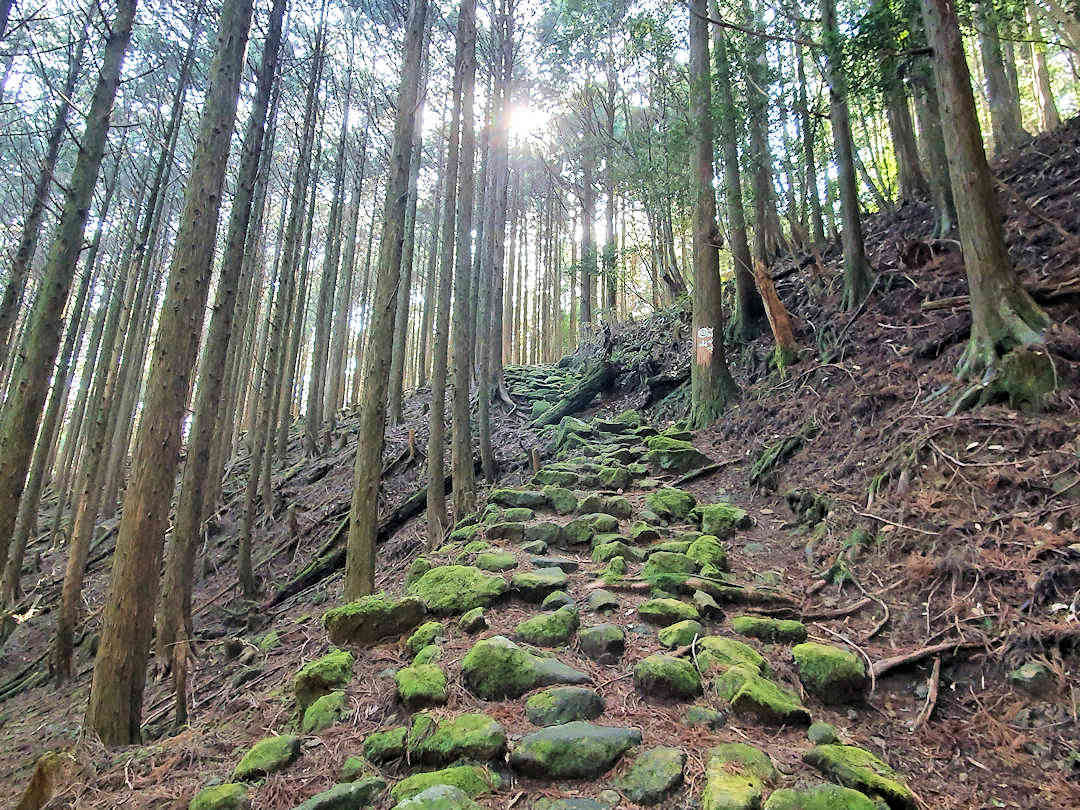
Most injuries on the Kumano Kodo are from slips and falls, so watch your steps on those slippery moss-covered stones
- Carry a satellite communicator on remote routes (for example, the Garmin inReach Mini): Mobile coverage on sections like the Omine Okugake Michi is limited to nonexistent. A device like this gives you a reliable way to communicate, share your location, and call for help if something goes wrong—not just trigger an emergency signal. If you're sticking to busier routes, you may not need it, but once you move into more remote sections, it becomes a practical safety tool rather than a nice-to-have.
- While you are not likely to encounter bears on the more frequented routes (including the Nakahechi), Asian black bears roam the Kii Mountains, and carrying a bear bell is advised when hiking more remote trails. For further information on bear safety, check out this post (from Oze National Park in the centre of Honshu).
- Other potentially dangerous animals include the venomous Mamushi snake (a small pit viper, 50 to 80 centimetres long), the Mukade (a black centipede with orange legs, about the length of an adult hand, with an excruciating bite), and the giant hornet, known as Suzumebachi. These critters are most active during the summer months. If a snake bites you, call emergency services (119) immediately.
- Summer (June to August) is also typhoon season. Typhoons can bring powerful winds, heavy rainfalls, flash floods, and landslides, making hiking unsafe (you will see some of the damage from prior typhoons along the trails). Stay up to date on the latest weather conditions to ensure your safety.
- In the event of an accident or bite, you may end up in the hospital. While Japanese medical facilities are excellent, they are not cheap. So, do make sure to buy travel insurance for your trip.

Asian black bears roam the Kii Mountains and carrying a bear bell is advised on remote Kumano Kodo trails
Get your (dual) pilgrimage recognised
If you want to have your pilgrimage recognised (particularly if you have completed or are planning to also walk the Camino de Santiago)
- Pick up a pilgrim passport free of charge at the Tanabe Tourist Information Center [Official website, Google Maps location].
- Make sure you collect stamps along the route. They can be found at many of the small shrines (oji) along the trail (look out for the small huts on poles) and are proof that you actually walked the route. Also, don’t forget your completion stamp.

Collect stamps along the Kumano Kodo if you want to have your pilgrimage (officially) recognised
If you’ve already completed the Camino de Santiago and would like to be recognised as a dual pilgrim, head to the Kumano Hongu Heritage Center [Official website, Google Maps location] across the road from Kumano Hongu Taisha, or to the Tanabe Tourist Information Center for your dual pilgrimage registration:
- You need a copy of your Camino de Santiago Pilgrims certificate – a digital copy is sufficient.
- The registration process takes about 10 minutes.

For those who have completed the Camino de Santiago and the Kumano Kodo, Dual Pilgrim certificates are issued by the Kumano Kodo Heritage Center in Hongu
Where to find further information about the Kumano Kodo?
Stage-by-stage description: Ise to Noasobimura | Noasobimura to Ise-Kashiwazaki | Ise-Kashiwazaki to Furusato Onsen | Furusato Onsen to Owase | Owase to Kata | Kata to Kumano City | Kumano City to Shingu
Brochures, maps and videos:
Stage-by-stage description: Hachikenya-hama to Abi-oji | Abi-oji to Izumi Fuchu | Izumi Fuchu to Yamanakadani | Yamanakadani to Kainan | Kainan to Yuasa | Yuasa to Gobo | Gobo to Kirime | Kirime to Kii-Tanabe
Maps (Japanese only):
Stage-by-stage description: Koyasan to Omata | Omata to Miura-guchi | Miura-guchi to Totsukawa Onsen | Totsukawa Onsen to Kumano Hongū Taisha
Brochures, maps and videos:
Brochures, maps and videos:
Brochures, maps and videos:

The Tourist Information Centre in Kii-Tanabe is a great place to obtain route maps (and your pilgrim passport) and ask about any route adjustments
The Tanabe Tourist Information Centre [Google Maps location] is a great place to
- Obtain a paper copy of the Kumano Kodo route maps and an up-to-date bus schedule.
- Check for any route adjustments (typhoons in prior years have closed routes or required detours).
And last but not least, head to the Kumano Hongu Heritage Centre [Google Maps location], across the road from Kumano Hongu Taisha, to learn more about Wakayama Prefecture and the UNESCO World Heritage sites of the Kii Mountains.
Have you hiked the Kumano Kodo?
What route did you take, when did you do it and most importantly, how was your experience? If you’re still planning your trip: What question/s do you have that I haven’t answered?
Before you go, if you liked our article and found it helpful, we would appreciate it if you could share it with your friends and family via the Share buttons below. Even better: Leave a short review on Trustpilot or Google, which would help us further build our online reputation as a (trustworthy and helpful) travel and lifestyle blog.